

Story of Shu'ayb عليه السلام
The Prophet sent to Madyan and the people of al-Aykah, calling them to worship Allah alone, give full measure and weight, stop cheating people, stop corruption on the roads, and trust Allah instead of corrupt wealth.
The journey of Shu'ayb عليه السلام
A clear path through his people, their business corruption, their threats, his duas, and the punishment that seized them.
Allah sends Shu'ayb عليه السلام
He is sent to Madyan, and the Qur’an also mentions him with the people of al-Aykah.
He calls to tawheed
He begins with worshipping Allah alone, as all Prophets did.
He confronts business corruption
His people cheated in measure and weight and deprived people of their due.
He warns against road corruption
They sat on roads, threatened believers, and turned people away from Allah’s path.
He teaches reform with sincerity
He says his only desire is reform as much as he can, and success is only from Allah.
The leaders mock and threaten
They mock his prayer, threaten expulsion, and demand that he and the believers return to their religion.
He turns to Allah with dua
He asks Allah to judge between him and his people with truth.
The punishment arrives
The Qur’an describes the quake, the cry, and the punishment of the day of shadow.
Shu'ayb عليه السلام turns away
He says he delivered the messages of his Lord and advised them, but they chose disbelief.
Time, people, and place
The Qur’an gives his mission clearly. Exact dates and many location details are not given.
Exact year is not given
No confirmed BC/CE date, birth year, death year, age, or grave location of Shu'ayb عليه السلام is given in the Qur’an or authentic hadith. He belongs to the ancient Prophetic period before Musa عليه السلام.
Madyan and al-Aykah
The Qur’an mentions Shu'ayb عليه السلام with Madyan, and also mentions the people of al-Aykah. Scholars discuss whether these were the same people described by different names or closely connected groups. The page should mention both Qur’anic names without forcing details the Qur’an does not spell out.
Exact map is not the main lesson
Madyan is usually connected with the region around north-west Arabia and nearby lands, but the Qur’an’s focus is their moral and financial corruption, not a modern map claim.
Family Tree / Lineage
Personal Family Tree
This visual should show only the reliable close family details connected to Shu'ayb عليه السلام.
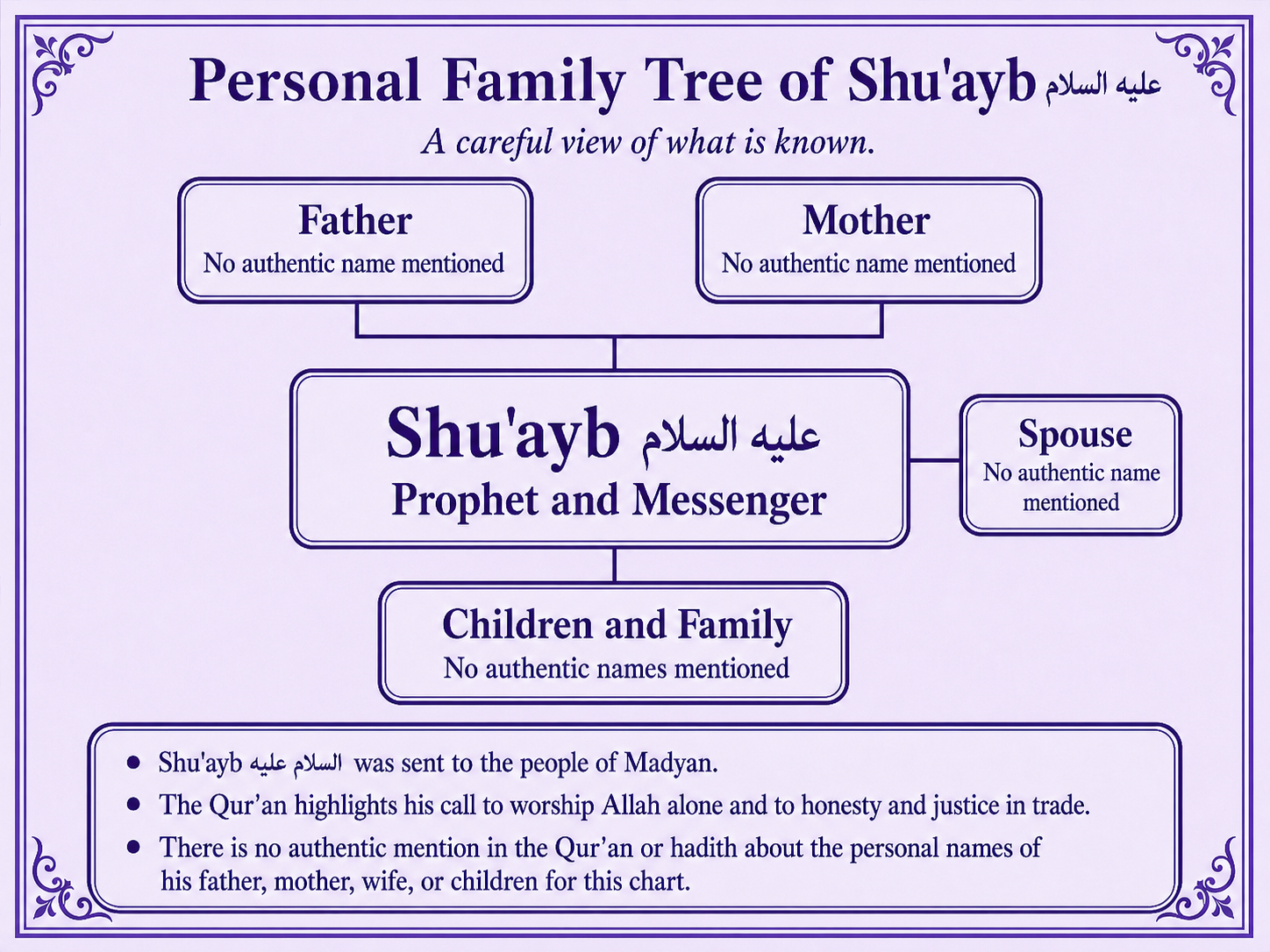
- Use for: Shu'ayb عليه السلام only, unless reliable close family details are added later.
- Not confirmed: parents, mother’s name, spouse, children, exact tribal chain, and grave location are not named in the Qur’an.
- Keep careful: the old man of Madyan in the story of Musa عليه السلام should not be labelled as Shu'ayb عليه السلام as a confirmed Qur’an fact.
Prophetic Lineage
This visual should show the broader Prophetic lineage context without claiming every missing generation is known.
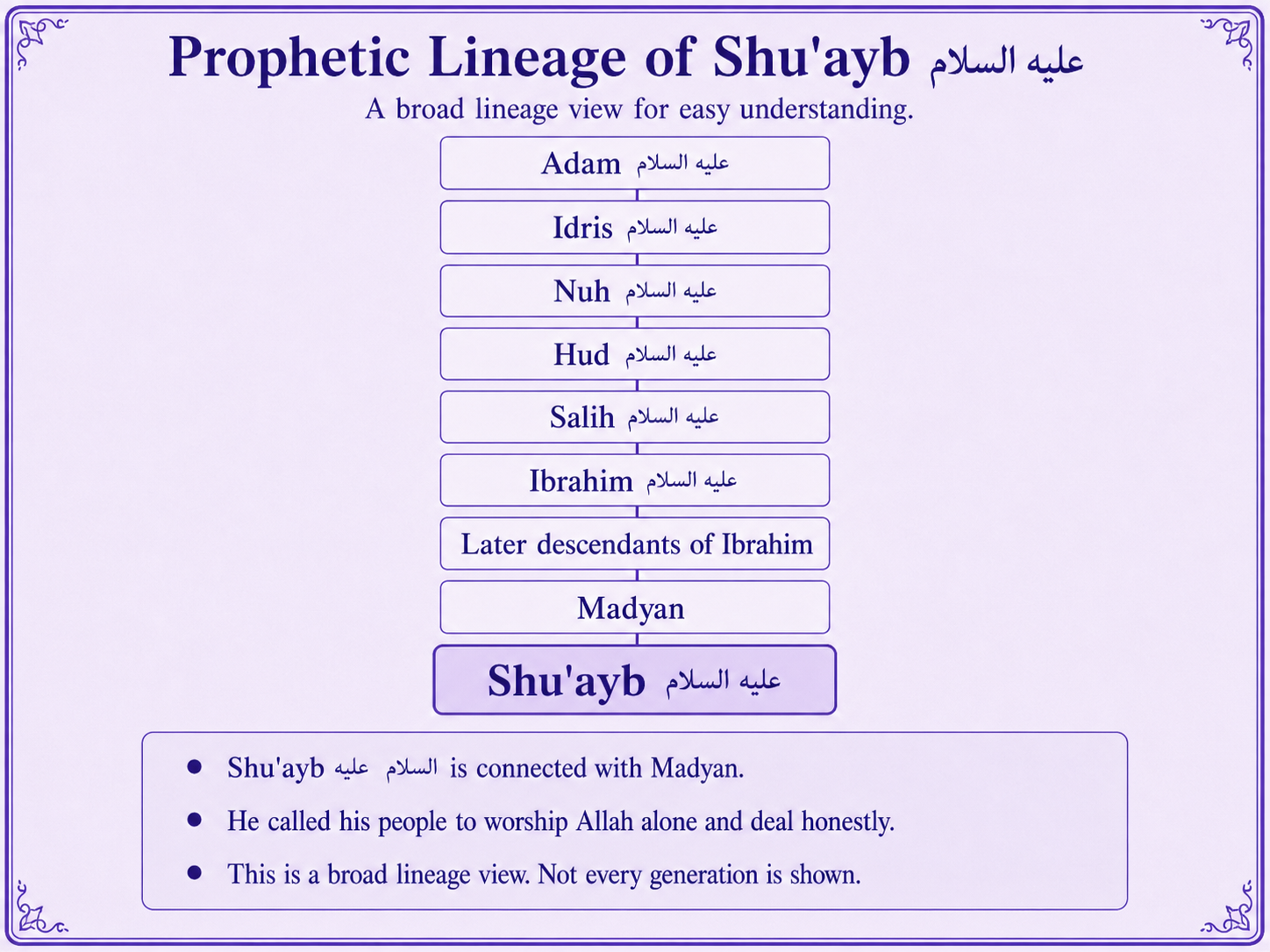
- Use for: broad Prophetic context showing Shu'ayb عليه السلام as the Prophet sent to Madyan and the people of al-Aykah.
- Purpose: show his place in the Prophets journey without inventing an exact ancestry chain.
- Do not invent: exact intermediate generations, parents, or links to Musa عليه السلام not confirmed in the Qur’an or authentic hadith.
A Prophet sent to a corrupt marketplace
Shu'ayb عليه السلام was sent to a people whose corruption had entered their worship, trade, roads, and public life.
His people did not only deny Allah’s message. They also cheated in business. They reduced people’s measure and weight, took more than they gave, and treated wealth as if it had no accountability before Allah.
Shu'ayb عليه السلام called them back to tawheed and justice. He taught them that faith is not only prayer words. Faith must enter the marketplace, the scales, the contracts, the roads, and the way people treat one another.
To Madyan, their brother Shu'ayb
وَإِلَىٰ مَدْيَنَ أَخَاهُمْ شُعَيْبًا
Wa ila Madyana akhahum Shu'ayba.
And to Madyan, their brother Shu'ayb. Source: Quran 7:85, relevant part.
The people of al-Aykah
The people of al-Aykah denied the Messengers when Shu'ayb عليه السلام called them to fear Allah. Source: Quran 26:176-177, meaning summarized.
The Qur’an names both Madyan and al-Aykah in the story of Shu'ayb عليه السلام. Both should be included without inventing unsupported details.
Worship Allah alone
Like every Prophet, Shu'ayb عليه السلام began with the foundation: worship Allah alone. His message was not only about business honesty. It was first about Allah.
He told his people that they had no god besides Allah. Then he connected that belief to the way they traded. A person who believes Allah sees him cannot cheat the scale and still think his religion is untouched.
This is why his story is powerful for every buyer, seller, employer, employee, shopkeeper, online seller, and business owner. Tawheed must reach the weighing scale.
You have no god besides Him
يَا قَوْمِ اعْبُدُوا اللَّهَ مَا لَكُم مِّنْ إِلَٰهٍ غَيْرُهُ
Ya qawmi'budullaha ma lakum min ilahin ghayruh.
O my people, worship Allah. You have no god besides Him. Source: Quran 7:85, relevant part.
Every reform begins with tawheed. Honest trade without faith is still incomplete, and faith without honesty is contradicted by action.
Give full measure and full weight
The people of Shu'ayb عليه السلام were warned because their corruption touched people’s money and rights.
They cheated in measure and weight. They reduced what people were owed. They took advantage in transactions. They treated business as a place where power could crush fairness.
Shu'ayb عليه السلام told them to give full measure and weight with justice, and not deprive people of their things. He also told them that what remains from Allah is better for them if they are believers.
This is a very direct Islamic business lesson: barakah is not in cheating, fake shortage, dishonest quantity, bad quality, hidden defects, false claims, or squeezing people. What Allah leaves for you through halal is better than what you steal through cleverness.
Do not reduce measure and weight
فَأَوْفُوا الْكَيْلَ وَالْمِيزَانَ وَلَا تَبْخَسُوا النَّاسَ أَشْيَاءَهُمْ
Fa awful-kayla wal-mizana wa la tabkhasun-nasa ashya'ahum.
So give full measure and weight, and do not deprive people of their things. Source: Quran 7:85, relevant part.
Weigh with an even balance
وَزِنُوا بِالْقِسْطَاسِ الْمُسْتَقِيمِ
Wa zinu bil-qistasil-mustaqim.
And weigh with an even balance. Source: Quran 26:182.
Do not deprive people of their due
وَلَا تَبْخَسُوا النَّاسَ أَشْيَاءَهُمْ
Wa la tabkhasun-nasa ashya'ahum.
And do not deprive people of their things. Source: Quran 11:85 and Quran 26:183, relevant part.
What remains from Allah is better
بَقِيَّتُ اللَّهِ خَيْرٌ لَّكُمْ إِن كُنتُم مُّؤْمِنِينَ
Baqiyyatullahi khayrul-lakum in kuntum mu'minin.
What remains from Allah is better for you, if you are believers. Source: Quran 11:86, relevant meaning.
The halal profit Allah leaves after honesty is better than extra money gained by deception.
Do not sit on every road threatening people
Shu'ayb عليه السلام also warned his people against spreading corruption on earth and blocking people from Allah’s path. They sat on roads, threatened, and tried to turn believers away from guidance.
This shows that their corruption was not only in shops and markets. It had become social pressure, intimidation, and public obstruction. They wanted false religion and corrupt business to remain normal.
He reminded them that they were once few, then Allah increased them. Blessing should have made them grateful, not arrogant.
Do not sit on every road
وَلَا تَقْعُدُوا بِكُلِّ صِرَاطٍ تُوعِدُونَ
Wa la taq'udu bikulli siratin tu'idun.
And do not sit on every path, threatening. Source: Quran 7:86, relevant part.
Blocking people from Allah’s path
They threatened people, turned them away from Allah’s path, and sought to make that path appear crooked. Source: Quran 7:86, meaning summarized.
Corrupt people often do not stop at sinning. They also pressure others to accept corruption as normal.
I only desire reform as much as I can
Shu'ayb عليه السلام explained the purity of his mission with words every caller to Allah should remember.
He did not want to forbid them from something and then secretly do it himself. He did not call them for fame, money, power, or revenge. He wanted reform as much as he was able.
Then he said that his success was only through Allah. Upon Allah he relied, and to Allah he returned. This is the soul of sincere work: effort without ego, reform without hypocrisy, and trust without laziness.
Success is only through Allah
إِنْ أُرِيدُ إِلَّا الْإِصْلَاحَ مَا اسْتَطَعْتُ ۚ وَمَا تَوْفِيقِي إِلَّا بِاللَّهِ ۚ عَلَيْهِ تَوَكَّلْتُ وَإِلَيْهِ أُنِيبُ
In uridu illal-islaha mastata't. Wa ma tawfiqi illa billah. 'Alayhi tawakkaltu wa ilayhi unib.
I only desire reform as much as I am able. My success is only through Allah. Upon Him I rely, and to Him I return. Source: Quran 11:88, relevant meaning.
Use these words when trying to fix a family, business, project, community, or personal habit. The servant works, but success comes from Allah.
Does your prayer command you?
The people of Shu'ayb عليه السلام mocked the connection between worship and business honesty. They said, “Does your prayer command you that we leave what our fathers worshipped or stop doing what we want with our wealth?”
This is one of the sharpest lines in the story. They understood that salah should change life. They hated that his prayer called him to challenge their idols and their corrupt money.
Their mockery is repeated in many ages with different words: keep religion in the mosque, do not bring halal and haram into business, do not question what people inherited, do not touch our money. Shu'ayb عليه السلام teaches that worship and trade cannot be separated.
Does your prayer command you?
أَصَلَاتُكَ تَأْمُرُكَ أَن نَّتْرُكَ مَا يَعْبُدُ آبَاؤُنَا
Asalatuka ta'muruka an natruka ma ya'budu aba'una?
Does your prayer command you that we leave what our fathers worshipped? Source: Quran 11:87, relevant part.
True salah reforms worship, money, habits, and public behaviour. That is exactly why corrupt people resist it.
The arrogant leaders threaten expulsion
When arguments failed, the arrogant leaders threatened Shu'ayb عليه السلام and the believers. They said they would drive them out of their town unless they returned to their religion.
Shu'ayb عليه السلام rejected the idea of returning to falsehood after Allah had saved them. To return would be to invent a lie against Allah. Then he placed the matter before Allah with one of the great duas of the Prophets.
Expulsion or return
The arrogant leaders said they would drive Shu'ayb عليه السلام and the believers out of the town unless they returned to their religion. Source: Quran 7:88, meaning summarized.
Judge between us with truth
رَبَّنَا افْتَحْ بَيْنَنَا وَبَيْنَ قَوْمِنَا بِالْحَقِّ وَأَنتَ خَيْرُ الْفَاتِحِينَ
Rabbana iftah baynana wa bayna qawmina bil-haqqi wa anta khayrul-fatihin.
Our Lord, decide between us and our people with truth, and You are the best of those who decide. Source: Quran 7:89.
Do not let hatred of me lead you to ruin
Shu'ayb عليه السلام warned his people not to let opposition to him lead them into the same kind of destruction that had struck earlier nations, including the people of Nuh, Hud, Salih, and Lut عليهم السلام.
He reminded them that the people of Lut عليه السلام were not far from them. This was both a moral warning and a historical warning. Nearby ruins and old punishments were not museum pieces. They were signs.
He also called them to seek forgiveness and repent, telling them that his Lord is Merciful and Loving. Even after their corruption, the door of repentance was still open before punishment came.
Do not be struck like earlier nations
Shu'ayb عليه السلام warned them not to let opposition to him cause them to suffer like the people of Nuh, Hud, Salih, or Lut عليهم السلام. Source: Quran 11:89, meaning summarized.
My Lord is Merciful and Loving
وَاسْتَغْفِرُوا رَبَّكُمْ ثُمَّ تُوبُوا إِلَيْهِ ۚ إِنَّ رَبِّي رَحِيمٌ وَدُودٌ
Wastaghfiru rabbakum thumma tubu ilayh. Inna rabbi rahimun wadud.
Seek forgiveness from your Lord, then repent to Him. Indeed, my Lord is Merciful and Loving. Source: Quran 11:90.
The quake, the cry, and the day of shadow
When they rejected the warning and persisted in corruption, Allah’s punishment came.
The Qur’an describes the punishment in different passages: the earthquake seized them, the terrible cry seized them, and the punishment of the day of shadow seized the people of al-Aykah. These descriptions do not weaken the story. They show different aspects of a devastating punishment.
They became fallen in their homes, as if they had never lived there. The people who thought corrupt wealth would secure them lost both their wealth and their homes.
The earthquake seized them
فَأَخَذَتْهُمُ الرَّجْفَةُ
Fa akhadhathumur-rajfah.
So the earthquake seized them. Source: Quran 7:91, relevant part.
The cry seized them
وَأَخَذَتِ الَّذِينَ ظَلَمُوا الصَّيْحَةُ
Wa akhadhatil-ladhina zalamus-sayhah.
And the cry seized those who wronged. Source: Quran 11:94, relevant part.
The day of shadow
فَأَخَذَهُمْ عَذَابُ يَوْمِ الظُّلَّةِ
Fa akhadhahum 'adhabu yawmiz-zullah.
So the punishment of the day of shadow seized them. Source: Quran 26:189.
Shu'ayb عليه السلام turns away from them
After the punishment came, Shu'ayb عليه السلام turned away from them and said that he had delivered the messages of his Lord and advised them. He did not fail in his mission. They failed to accept guidance.
He asked how he could grieve over a disbelieving people after they had rejected the truth. His sadness was not the sadness of someone who had hidden guidance from them. He had called, warned, advised, and pleaded. They chose corruption.
I conveyed the messages of my Lord
لَقَدْ أَبْلَغْتُكُمْ رِسَالَاتِ رَبِّي وَنَصَحْتُ لَكُمْ
Laqad ablaghtukum risalati rabbi wa nasahtu lakum.
I certainly conveyed to you the messages of my Lord and advised you. Source: Quran 7:93, relevant meaning.
Duas and powerful words of Shu'ayb عليه السلام
وَمَا تَوْفِيقِي إِلَّا بِاللَّهِ ۚ عَلَيْهِ تَوَكَّلْتُ وَإِلَيْهِ أُنِيبُ
Wa ma tawfiqi illa billah. 'Alayhi tawakkaltu wa ilayhi unib.
My success is only through Allah. Upon Him I rely, and to Him I return. Source: Quran 11:88, relevant part.
رَبَّنَا افْتَحْ بَيْنَنَا وَبَيْنَ قَوْمِنَا بِالْحَقِّ وَأَنتَ خَيْرُ الْفَاتِحِينَ
Rabbana iftah baynana wa bayna qawmina bil-haqqi wa anta khayrul-fatihin.
Our Lord, decide between us and our people with truth, and You are the best of those who decide. Source: Quran 7:89.
وَاسْتَغْفِرُوا رَبَّكُمْ ثُمَّ تُوبُوا إِلَيْهِ
Wastaghfiru rabbakum thumma tubu ilayh.
Seek forgiveness from your Lord, then repent to Him. Source: Quran 11:90, relevant part.
بَقِيَّتُ اللَّهِ خَيْرٌ لَّكُمْ إِن كُنتُم مُّؤْمِنِينَ
Baqiyyatullahi khayrul-lakum in kuntum mu'minin.
What remains from Allah is better for you, if you are believers. Source: Quran 11:86, relevant meaning.
Common questions about Shu'ayb عليه السلام
These points are often mixed with history reports, so they need clean wording.
Were Madyan and al-Aykah the same people?
Scholars discuss this. The Qur’an mentions Shu'ayb عليه السلام with Madyan and also mentions him calling the people of al-Aykah. The safe page wording is to include both names and avoid forcing a detail the Qur’an does not explicitly define in one sentence.
Was their sin only cheating in business?
No. They were also called to tawheed, warned against spreading corruption, threatening on roads, blocking Allah’s path, rejecting a Messenger, and mocking his prayer.
Why are different punishments mentioned?
The Qur’an mentions the earthquake, the cry, and the punishment of the day of shadow. These can be understood as different descriptions or aspects of the punishment that came upon the people connected to Shu'ayb عليه السلام.
Was Shu'ayb عليه السلام the orator of the Prophets?
This is a famous description in some books, but it should not be presented as a clear Qur’anic title or a firmly established authentic hadith title. His eloquence is visible in the Qur’anic dialogue itself.
Was the old man of Madyan in Musa’s story Shu'ayb عليه السلام?
Many people say the old man whom Musa عليه السلام later met in Madyan was Shu'ayb عليه السلام, but the Qur’an does not name that old man. It should not be taught as certain Qur’anic fact.
Do we know his grave?
There are local claims about the grave of Shu'ayb عليه السلام, but no exact grave location is established from the Qur’an or authentic hadith. Such claims should not be taught as required belief.
Tawheed must enter business
Shu'ayb عليه السلام connected worship of Allah with honest measure, fair weight, and people’s rights.
Halal profit is better
What remains from Allah through honesty is better than extra wealth gained by cheating.
Prayer should reform money
His people mocked his prayer because it challenged their idols and their financial corruption.
Do not block Allah’s path
They threatened people on the roads and turned them away from guidance.
Reform needs sincerity
Shu'ayb عليه السلام wanted reform as much as he could, while knowing success is only from Allah.
Mocking warnings does not stop them
Their threats and arrogance ended with punishment, while the message of Shu'ayb عليه السلام remained.
Common mistakes about this story
- Reducing the story to trade only: the story begins with tawheed and includes worship, money, roads, threats, and repentance.
- Ignoring business rights: cheating in measure and weight is a major Qur’anic warning.
- Making Madyan and al-Aykah confusing: mention both Qur’anic names without adding unsupported certainty.
- Calling the old man in Musa’s story Shu'ayb as certainty: the Qur’an does not name him there.
- Claiming exact dates or graves: these are not established from Qur’an or authentic hadith.
- Separating salah from business: his people mocked prayer exactly because it challenged their money habits.
The whole story in seven lines
- Allah sent Shu'ayb عليه السلام to Madyan and the people of al-Aykah.
- He called them to worship Allah alone.
- He warned them to give full measure and weight and stop cheating people.
- He told them not to spread corruption or block Allah’s path.
- They mocked his prayer and threatened him and the believers.
- He asked Allah to judge between them with truth.
- The punishment came, and they became as if they had never lived there.
Main references used
- Qur’an: Shu'ayb عليه السلام and Madyan: Quran 7:85-93, Quran 11:84-95, Quran 29:36-37.
- Qur’an: Shu'ayb عليه السلام and the people of al-Aykah: Quran 26:176-191.
- Qur’an: Full measure, full weight, and people’s rights: Quran 7:85, 11:84-86, 26:181-183.
- Qur’an: Reform, tawakkul, and repentance: Quran 11:88-90.
- Qur’an: Threat of expulsion and dua for judgment with truth: Quran 7:88-89.
- Qur’an: Punishments described as earthquake, cry, and day of shadow: Quran 7:91, 11:94, 26:189.
- Extra details: Exact dates, grave location, full family details, and identifying the old man in Musa’s Madyan story as Shu'ayb عليه السلام are not established as clear Qur’an or authentic hadith facts.
Shu'ayb عليه السلام teaches that faith must weigh honestly
His story is a mirror for every age where people want worship without business ethics. He called to Allah, then called the marketplace back to justice. He warned against cheating, corruption, intimidation, and inherited falsehood. His words still stand over every scale, invoice, product listing, contract, and sale: what remains from Allah is better for you, if you are believers.