

Story of Ayyub عليه السلام
The Prophet remembered for extraordinary patience, severe trial, gentle dua, healing by Allah’s command, restoration of family and blessings, and a heart that never turned pain into rebellion against Allah.
The journey of Ayyub عليه السلام
A clear path through his trial, duas, healing, family restoration, oath, and lessons of patient worship.
Allah honours Ayyub عليه السلام
The Qur’an names him among the guided Prophets.
A severe trial touches him
Harm and hardship reach him, but his heart remains attached to Allah.
He makes a gentle dua
He mentions his pain and praises Allah as the Most Merciful of the merciful.
Allah answers him
Allah removes the harm and restores his family and more with them.
He is told to strike the ground
Allah provides a cool washing place and drink.
The oath is fulfilled with mercy
Allah teaches him a way to fulfil his oath without harshness.
Allah praises his patience
Allah calls him an excellent servant who constantly turned back to Him.
Approximate Timeline / Dates
Dates are kept safe and simple. Exact years are not claimed where revelation does not confirm them.
Exact dates are not confirmed
The Qur’an and authentic hadith do not give a confirmed birth year, death year, exact age, or full calendar timeline for Ayyub عليه السلام.
He is counted among the guided Prophets mentioned after Ibrahim عليه السلام. His exact historical period is not fixed in the Qur’an.
Exact place is not confirmed
Some historical reports mention regions connected to Sham or surrounding lands, but the Qur’an does not give a precise location for his home, trial, or burial place.
Family Tree / Lineage
Personal Family Tree
This visual should show only the reliable close family details connected to Ayyub عليه السلام.
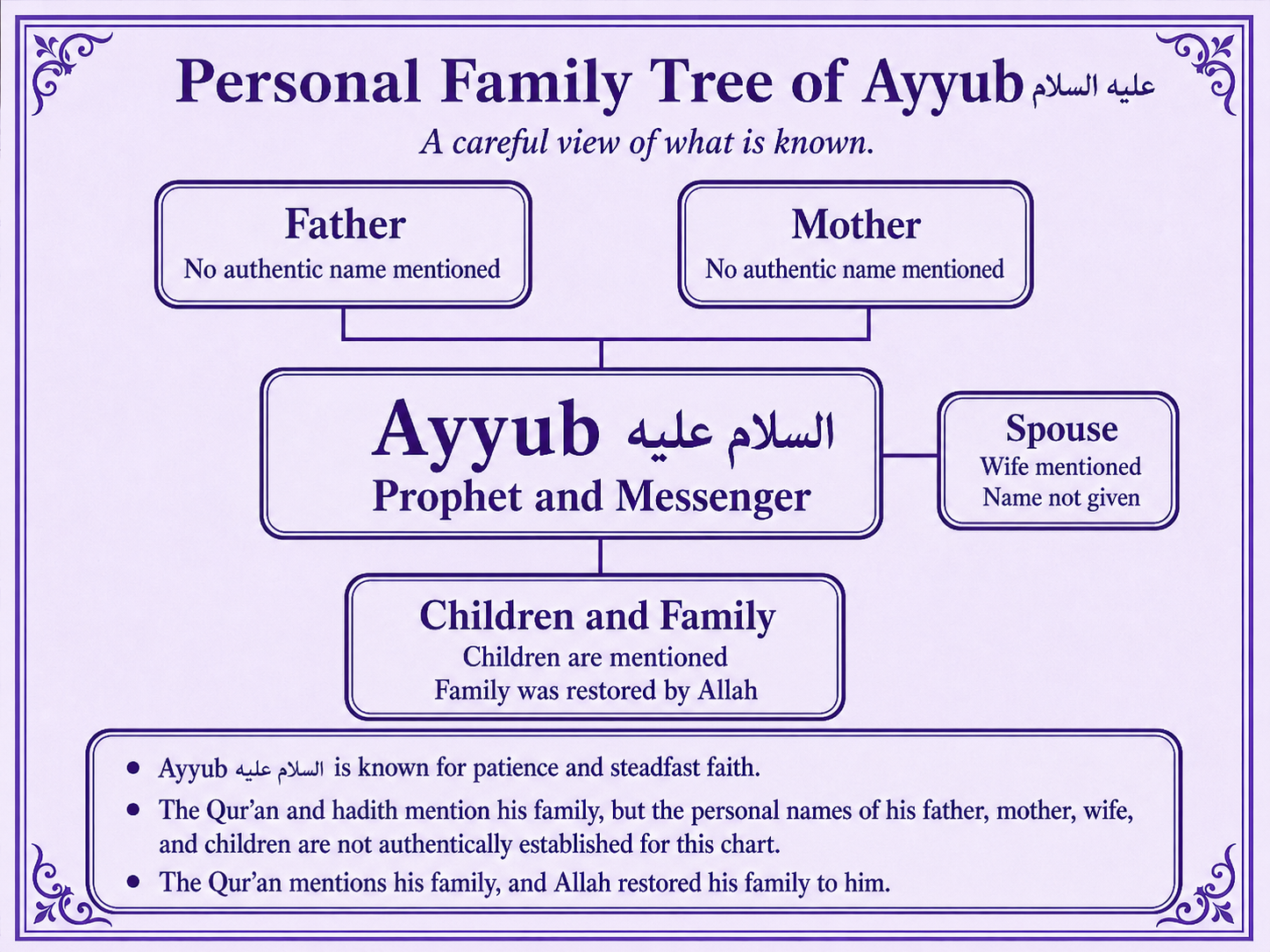
- Use for: Ayyub عليه السلام, his wife, and his family restored by Allah.
- Confirmed: Allah mentions his family being restored to him, with more like them as mercy from Allah.
- Do not add: wife’s name, children’s names, parents, exact number of children, or burial details as Qur’an-confirmed facts.
Prophetic Lineage
This visual should show the broader Prophetic lineage context without claiming every missing generation is known.
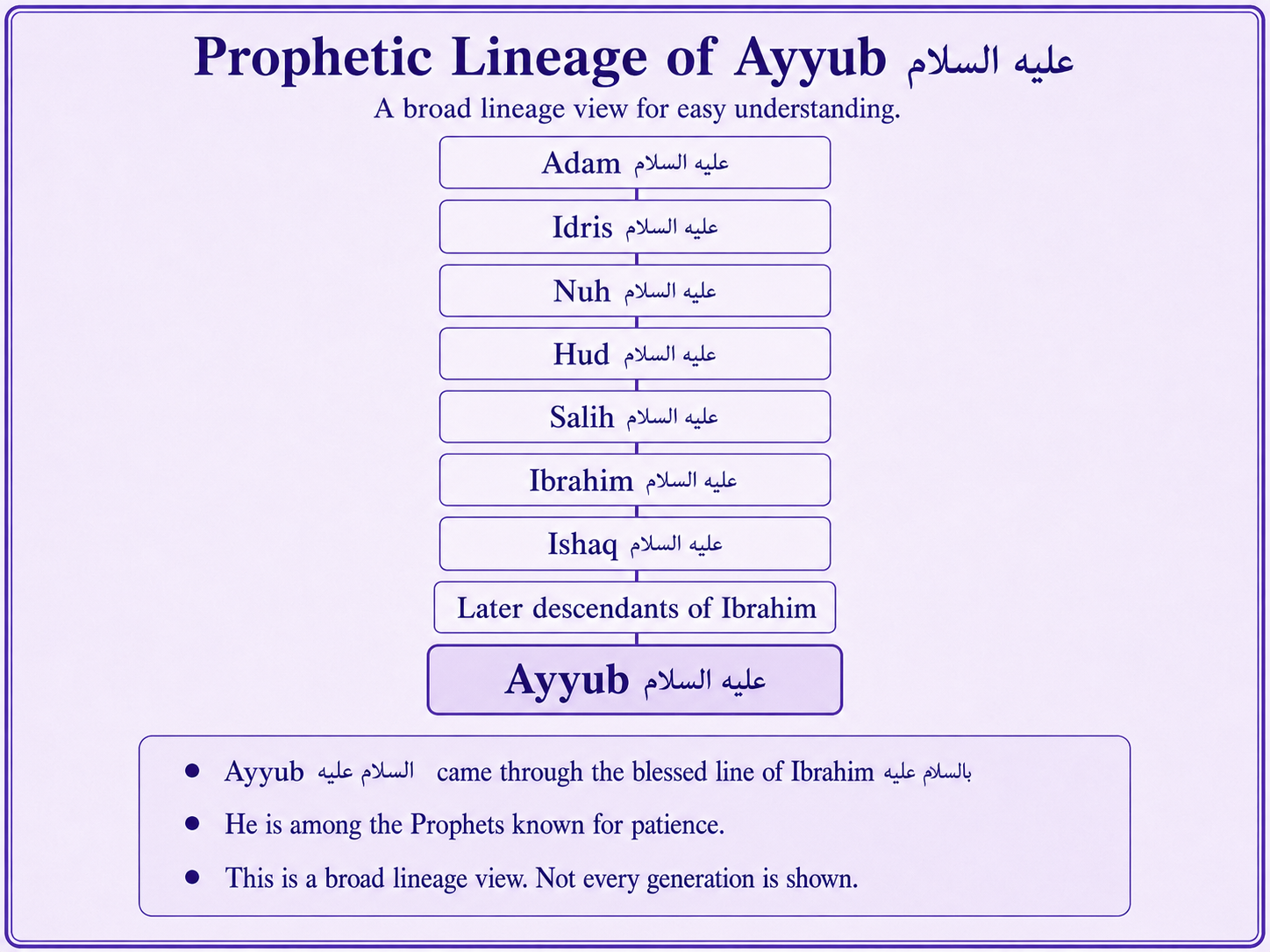
- Use for: broad Prophetic family context after Ibrahim عليه السلام, with Ayyub عليه السلام placed among the guided Prophets.
- Purpose: show his place in the Prophetic journey without inventing exact missing links.
- Do not invent: exact ancestry chain or intermediate generations not confirmed in the Qur’an or authentic hadith.
A Prophet tested through pain
Ayyub عليه السلام is remembered as a Prophet who was severely tested, yet remained patient and constantly turned back to Allah.
The Qur’an does not give a long biography of his early life. It gives something more focused: a picture of a servant touched by distress who still knows how to speak to Allah. His body was afflicted, his life was shaken, and his family was affected, but his worship did not collapse.
Many storybooks add dramatic details about the type of disease, exact years, names, places, and conversations. The Qur’an keeps the lesson pure: harm touched him, he called upon Allah, Allah answered him, and his patience became a reminder for worshippers.
Allah guided Ayyub عليه السلام
Allah mentions Ayyub عليه السلام among the Prophets He guided, along with Nuh, Ibrahim, Ishaq, Ya'qub, Yusuf, Musa, Harun, Dawud, Sulayman, and others. Source: Quran 6:84-87, meaning summarized.
Ayyub عليه السلام is not only a symbol of illness. He is a guided Prophet chosen by Allah.
Allah calls him an excellent servant
إِنَّا وَجَدْنَاهُ صَابِرًا ۚ نِّعْمَ الْعَبْدُ ۖ إِنَّهُ أَوَّابٌ
Inna wajadnahu sabira. Ni'mal-'abd. Innahu awwab.
Indeed, We found him patient. What an excellent servant. Indeed, he constantly turned back to Allah. Source: Quran 38:44, relevant part.
When harm touched him
The test of Ayyub عليه السلام was severe, but his dua was full of adab.
He did not speak to Allah with anger. He did not accuse Allah. He did not say that he deserved better. He said only that harm had touched him, and that Allah is the Most Merciful of the merciful.
This is one of the most beautiful duas for illness and distress. It is short, gentle, humble, and full of trust. Ayyub عليه السلام mentioned his condition and praised Allah’s mercy. His words did not demand. They opened a door of need before the Most Merciful.
The dua of Ayyub عليه السلام
أَنِّي مَسَّنِيَ الضُّرُّ وَأَنتَ أَرْحَمُ الرَّاحِمِينَ
Anni massaniyad-durru wa anta arhamur-rahimin.
Indeed, harm has touched me, and You are the Most Merciful of the merciful. Source: Quran 21:83.
Use this dua in illness, weakness, grief, family hardship, or any painful trial. It teaches a servant to mention need while praising Allah’s mercy.
Allah answered him and removed the harm
Allah answered Ayyub عليه السلام. The harm was removed, and Allah restored his family to him and more with them. The Qur’an describes this as mercy from Allah and a reminder for worshippers.
This matters: the story is not only about patience during pain. It is also about Allah’s ability to open relief after pain. Ayyub عليه السلام did not know the exact moment relief would arrive, but he knew the One who gives relief.
Allah removed the harm
فَاسْتَجَبْنَا لَهُ فَكَشَفْنَا مَا بِهِ مِن ضُرٍّ
Fastajabna lahu fakashafna ma bihi min durr.
So We answered him and removed what was upon him of harm. Source: Quran 21:84, relevant part.
Family restored as mercy
وَآتَيْنَاهُ أَهْلَهُ وَمِثْلَهُم مَّعَهُمْ رَحْمَةً مِّنْ عِندِنَا
Wa ataynahu ahlahu wa mithlahum ma'ahum rahmatam-min 'indina.
And We gave him his family and the like of them with them, as mercy from Us. Source: Quran 21:84, relevant meaning.
A reminder for worshippers
وَذِكْرَىٰ لِلْعَابِدِينَ
Wa dhikra lil-'abidin.
And a reminder for the worshippers. Source: Quran 21:84, relevant part.
Strike with your foot
In Surah Sad, Allah gives another scene from the healing of Ayyub عليه السلام.
Ayyub عليه السلام called to his Lord, saying that Shaytan had touched him with hardship and suffering. Allah commanded him to strike the ground with his foot. Then came a cool washing place and drink.
This water was by Allah’s command. The Qur’an does not turn the story into a medical formula for everyone. The lesson is that Allah can place cure where He wills, when He wills, and how He wills.
Hardship and suffering touched me
أَنِّي مَسَّنِيَ الشَّيْطَانُ بِنُصْبٍ وَعَذَابٍ
Anni massaniyash-shaytanu binusbin wa 'adhab.
Indeed, Shaytan has touched me with hardship and suffering. Source: Quran 38:41, relevant meaning.
A cool wash and drink
ارْكُضْ بِرِجْلِكَ ۖ هَٰذَا مُغْتَسَلٌ بَارِدٌ وَشَرَابٌ
Urkud birijlika. Hadha mughtasalun baridun wa sharab.
Strike with your foot. This is a cool washing place and drink. Source: Quran 38:42.
The oath and the bundle of grass
The Qur’an also mentions that Ayyub عليه السلام had an oath to fulfil. Allah commanded him to take a bundle in his hand and strike with it, and not break his oath.
The Qur’an does not give every detail of the oath in the verse itself. Some reports connect it to his wife and something that happened during his trial, but the exact background should not be presented as Qur’anic wording.
The lesson is clear and beautiful: Allah gave Ayyub عليه السلام a way to fulfil his oath with mercy. This shows that Allah’s law is not cruelty. It carries justice, wisdom, and compassion.
Take a bundle in your hand
وَخُذْ بِيَدِكَ ضِغْثًا فَاضْرِب بِّهِ وَلَا تَحْنَثْ
Wa khudh biyadika dighthan fadrib bihi wa la tahnath.
And take in your hand a bundle and strike with it, and do not break your oath. Source: Quran 38:44, relevant meaning.
Allah opened a merciful way for the oath to be fulfilled without harshness.
The gold locusts and love for Allah’s blessing
Authentic hadith mention a beautiful moment after Allah restored Ayyub عليه السلام.
While Ayyub عليه السلام was bathing, gold locusts fell upon him. He began gathering them in his garment. Allah called to him, asking whether He had not made him free of need from what he saw. Ayyub عليه السلام replied that he could never be free of need from Allah’s blessing.
This hadith shows that accepting Allah’s blessings is not against piety. The heart of a Prophet does not worship blessings, but it also does not despise them. Ayyub عليه السلام recognised blessings as gifts from Allah.
The report of Ayyub عليه السلام bathing and gold locusts falling upon him is reported in Sahih al-Bukhari, meaning summarized.
Duas and words of Ayyub عليه السلام
أَنِّي مَسَّنِيَ الضُّرُّ وَأَنتَ أَرْحَمُ الرَّاحِمِينَ
Anni massaniyad-durru wa anta arhamur-rahimin.
Indeed, harm has touched me, and You are the Most Merciful of the merciful. Source: Quran 21:83.
أَنِّي مَسَّنِيَ الشَّيْطَانُ بِنُصْبٍ وَعَذَابٍ
Anni massaniyash-shaytanu binusbin wa 'adhab.
Indeed, Shaytan has touched me with hardship and suffering. Source: Quran 38:41, relevant meaning.
نِّعْمَ الْعَبْدُ ۖ إِنَّهُ أَوَّابٌ
Ni'mal-'abd. Innahu awwab.
What an excellent servant. Indeed, he constantly turned back to Allah. Source: Quran 38:44, relevant part.
Common questions about Ayyub عليه السلام
Some popular details are repeated often, but the wording must remain respectful and accurate.
Do we know his exact illness?
The Qur’an says harm, hardship, and suffering touched him, but it does not name a specific disease. Claims about worms, disgusting scenes, or humiliating descriptions should not be taught as confirmed fact and should be avoided because Prophets must be spoken about with honour.
Was he sick for a specific number of years?
Some historical reports mention a number of years, but the Qur’an and authentic hadith do not give a confirmed duration that must be taught as fact. The lesson is patience and reliance on Allah, not the exact number.
Do we know his wife’s name?
Popular stories mention names for the wife of Ayyub عليه السلام, but the Qur’an does not name her. The page should not present a name as revelation.
What exactly happened with the oath?
The Qur’an mentions the command to take a bundle and strike with it so he would not break his oath. It does not give all the background details in the verse.
Is it wrong to receive blessings after hardship?
No. The hadith of the gold locusts shows that Ayyub عليه السلام valued Allah’s blessing. The problem is not having blessings. The problem is forgetting the Giver.
Do we know his grave?
There are local and historical claims about the grave of Ayyub عليه السلام, but no exact grave location is established from the Qur’an or authentic hadith.
Patience does not mean silence from dua
Ayyub عليه السلام was patient, yet he called upon Allah and asked for mercy.
Speak to Allah with adab
His dua mentioned his pain and praised Allah’s mercy without anger or accusation.
Allah can restore after loss
Allah removed his harm and restored his family and blessings as mercy.
Illness does not reduce honour
Ayyub عليه السلام was afflicted, yet Allah praised him as an excellent servant.
Mercy belongs inside law
The bundle command shows a merciful way to fulfil an oath without cruelty.
Never despise Allah’s blessing
The gold locusts hadith teaches that blessings are gifts when the heart remembers Allah.
Common mistakes about this story
- Using disrespectful illness details: do not narrate humiliating disease scenes as confirmed fact.
- Claiming exact duration: the Qur’an does not give the number of years.
- Naming his wife as certainty: the Qur’an does not name her.
- Thinking patience means no dua: Ayyub عليه السلام made dua while being patient.
- Forgetting restoration: the story includes both trial and Allah’s relief.
- Claiming exact grave location: grave claims are not established from Qur’an or authentic hadith.
The whole story in seven lines
- Ayyub عليه السلام was a guided Prophet and an excellent servant of Allah.
- Severe harm and hardship touched him.
- He called upon Allah with humility and praised Allah’s mercy.
- Allah answered him and removed the harm.
- Allah restored his family and blessings as mercy and a reminder.
- Allah gave him a merciful way to fulfil his oath.
- His story teaches patience, dua, adab, and trust in Allah’s relief.
Main references used
- Qur’an: Ayyub عليه السلام among the guided Prophets: Quran 6:84.
- Qur’an: Ayyub’s dua, Allah’s answer, removal of harm, and restoration of family: Quran 21:83-84.
- Qur’an: Hardship, healing water, restored family, oath, and praise of patience: Quran 38:41-44.
- Hadith: The report of Ayyub عليه السلام bathing and gold locusts falling upon him is reported in Sahih al-Bukhari, meaning summarized.
- Extra details: Exact illness, duration, wife’s name, birth date, death date, age, and grave location are not established as clear Qur’an or authentic hadith facts.
Ayyub عليه السلام teaches patience that still makes dua
His story is not a story of a man who felt nothing. It is the story of a Prophet who was touched by pain and still turned to Allah with beautiful adab. He did not complain against Allah. He complained to Allah. Then Allah removed the harm, restored blessings, and praised him forever as an excellent servant. His dua remains a lantern for every sick, tired, tested heart: harm has touched me, and You are the Most Merciful of the merciful.