

Story of Ilyas عليه السلام
The Prophet who called his people away from Ba'l worship and back to Allah, the Best of creators, Lord of them and Lord of their forefathers. His story is brief in the Qur’an, but its message is sharp: fear Allah, abandon false gods, and return to pure tawheed.
The journey of Ilyas عليه السلام
A concise Qur’anic story arranged around his mission, his people’s idol worship, their denial, Allah’s praise, and what must not be added without proof.
Allah names Ilyas عليه السلام among the righteous
He is mentioned among guided Prophets in Surah al-An'am.
Ilyas عليه السلام is sent as a Messenger
Surah as-Saffat clearly says Ilyas was among the Messengers.
He calls his people to fear Allah
His first recorded call is a warning: will you not fear Allah?
He confronts Ba'l worship
He asks whether they call upon Ba'l and leave the Best of creators.
He reminds them of Allah’s Lordship
Allah is their Lord and the Lord of their forefathers.
They deny him
The Qur’an says they denied him and would be brought, except Allah’s sincere servants.
Allah preserves honour for him
Allah leaves for him praise among later generations.
Peace is sent upon Ilyas
The Qur’an sends peace upon Ilyasin, understood in relation to Ilyas عليه السلام.
He is praised as a believing servant
Allah says he was among His believing servants.
Time, people, and place
The Qur’an gives his mission clearly but does not give exact dates, location, or a long biography.
Exact year is not given
No confirmed BC/CE date, birth year, death year, exact age, or grave location of Ilyas عليه السلام is given in the Qur’an or authentic hadith. He belongs to the Prophetic period after Musa عليه السلام among the Prophets of Bani Israel.
A people attached to Ba'l
The Qur’an records that his people called upon Ba'l and left the Best of creators. The story focuses on their shirk and his call to tawheed.
The call against Ba'l worship is in Quran 37:125.
Exact location is not confirmed in the Qur’an
Some historical discussions connect his people with regions of Sham and the worship of Ba'l, but the Qur’an does not give a precise map location. A public page should not turn later geography into Qur’anic certainty.
Family Tree / Lineage
Personal Family Tree
This visual should show only the reliable close family details connected to Ilyas عليه السلام.
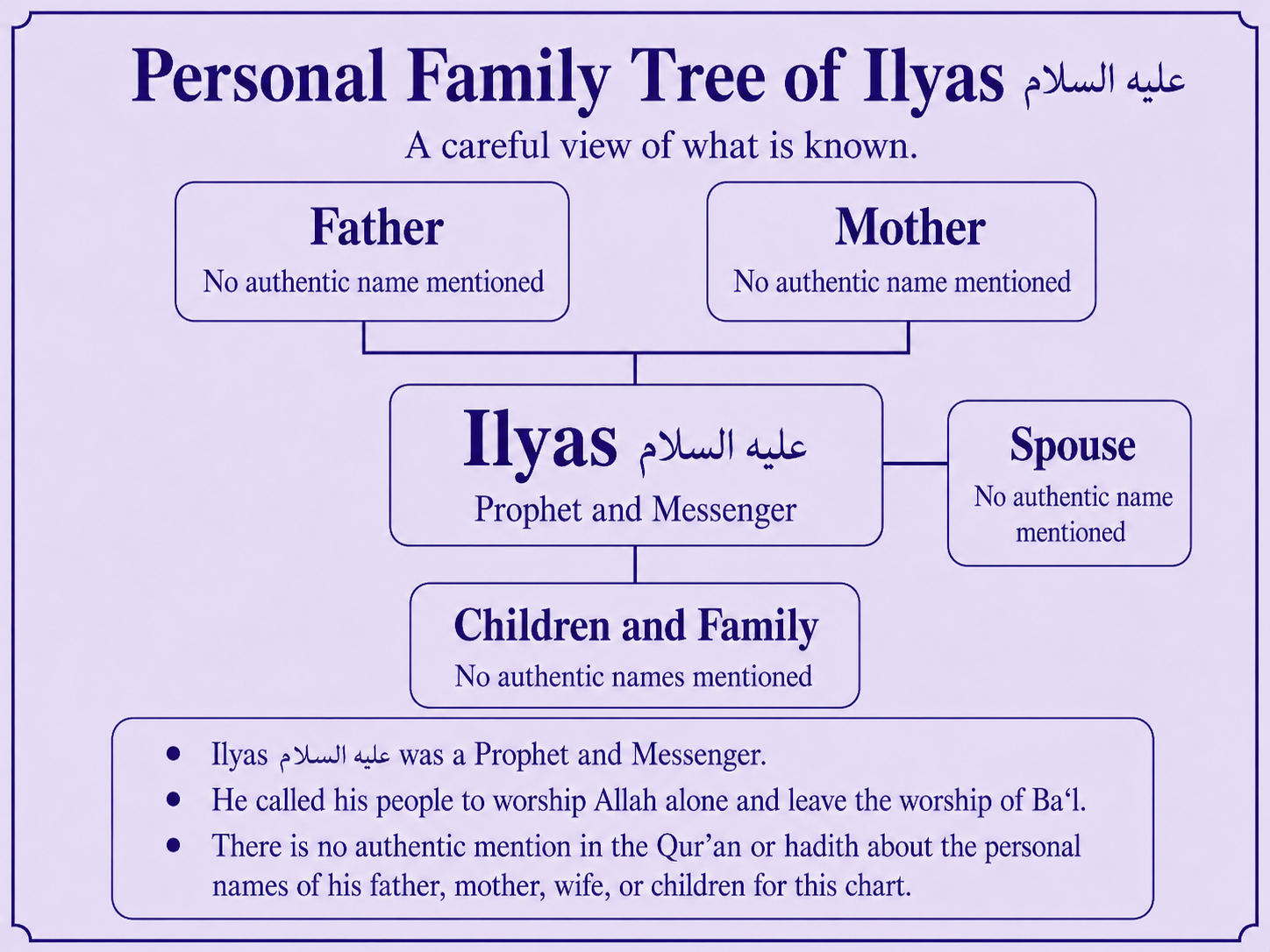
- Use for: Ilyas عليه السلام only, unless reliable close family details are added later.
- Not confirmed: parents, mother’s name, spouse, children, exact tribal chain, and grave location are not named in the Qur’an.
- Keep simple: the image can clearly state that personal family details are not confirmed.
Prophetic Lineage
This visual should show the broader Prophetic lineage context without claiming every missing generation is known.
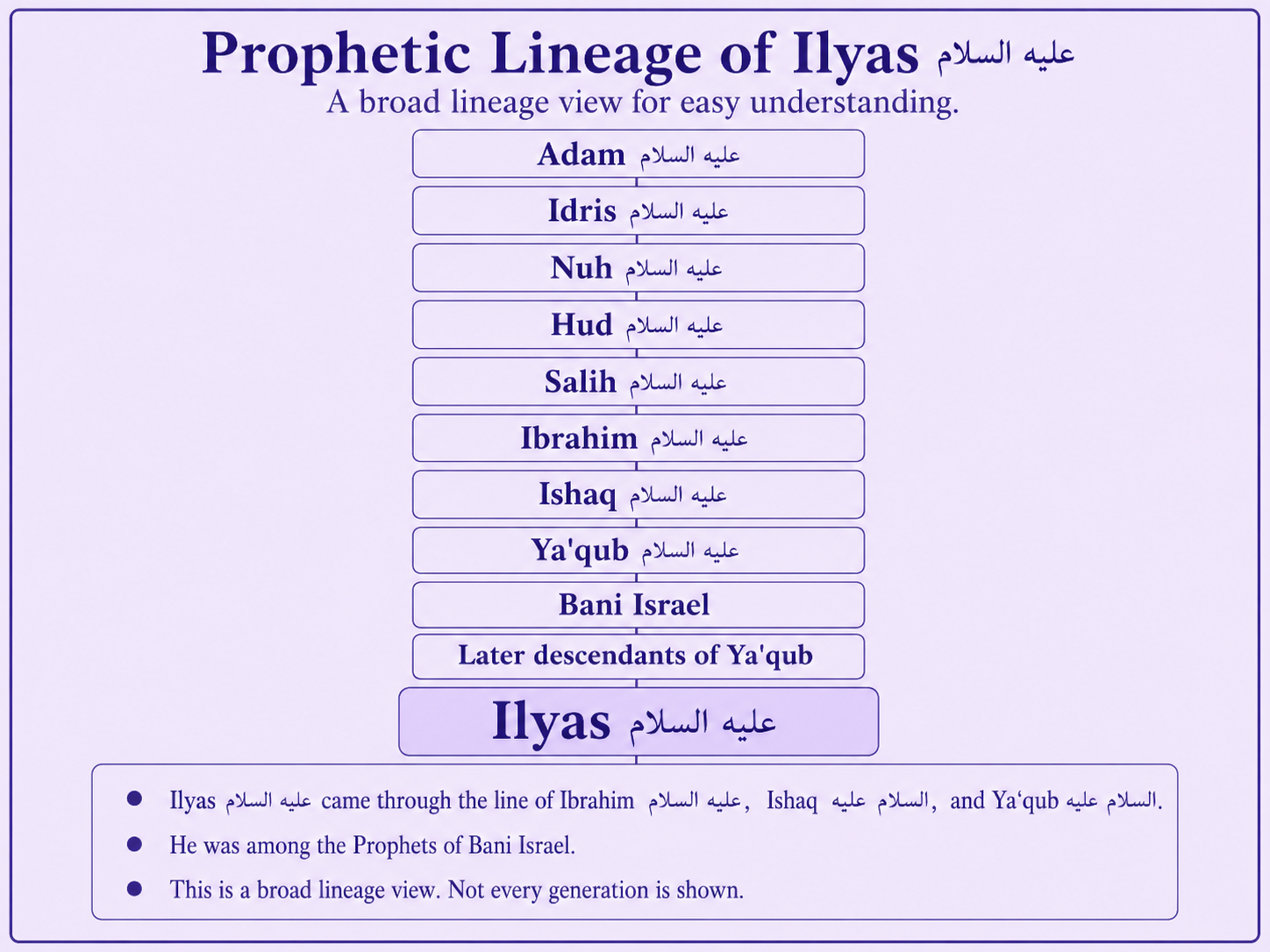
- Use for: Ibrahim عليه السلام → Ishaq عليه السلام → Ya'qub عليه السلام → Bani Israel Prophets → Ilyas عليه السلام.
- Purpose: show Ilyas عليه السلام as a Prophet sent among Bani Israel.
- Do not invent: exact intermediate generations or links to Al-Yasa' عليه السلام not confirmed in the Qur’an or authentic hadith.
Ilyas عليه السلام among the righteous Prophets
Ilyas عليه السلام is mentioned by name among Prophets whom Allah guided.
In Surah al-An'am, Allah lists several Prophets and includes Ilyas عليه السلام among them. The verse ends by describing them as among the righteous. This establishes his honour clearly.
His page should not feel empty just because his story is short. A brief Qur’anic story can still carry a heavy lesson: tawheed must be protected even when a whole society has beautified idol worship.
Ilyas عليه السلام among the guided
وَزَكَرِيَّا وَيَحْيَىٰ وَعِيسَىٰ وَإِلْيَاسَ ۖ كُلٌّ مِّنَ الصَّالِحِينَ
Wa Zakariyya wa Yahya wa 'Isa wa Ilyas. Kullum-minas-salihin.
And Zakariyya, Yahya, 'Isa, and Ilyas. All were among the righteous. Source: Quran 6:85.
He was among the Messengers
وَإِنَّ إِلْيَاسَ لَمِنَ الْمُرْسَلِينَ
Wa inna Ilyasa laminal-mursalin.
And indeed, Ilyas was surely among the Messengers. Source: Quran 37:123.
Will you not fear Allah?
Ilyas عليه السلام called his people with a direct question: will you not fear Allah? This question cuts through excuses. The issue was not merely a cultural tradition or an old public symbol. It was worship being given to other than Allah.
He then named the false object of worship: Ba'l. He asked whether they called upon Ba'l and left the Best of creators. This is the central conflict of his story.
His people had a choice: a created idol or the Creator, inherited falsehood or the Lord of their forefathers, public habit or revealed truth.
Will you not fear Allah?
أَلَا تَتَّقُونَ
Ala tattaqun?
Will you not fear Allah? Source: Quran 37:124.
Do you call upon Ba'l?
أَتَدْعُونَ بَعْلًا وَتَذَرُونَ أَحْسَنَ الْخَالِقِينَ
Atad'una Ba'lan wa tadharuna ahsanal-khaliqin?
Do you call upon Ba'l and leave the Best of creators? Source: Quran 37:125.
Allah is your Lord and the Lord of your forefathers
Ilyas عليه السلام did not only say that Ba'l was false. He reminded them who Allah is: Allah is their Lord and the Lord of their earliest forefathers.
This was important because people often use ancestors as an excuse for false worship. Ilyas عليه السلام answered that their true Lord was never the idol. Their fathers and forefathers were created, provided for, and owned by Allah.
The message was simple and complete: leave the false god, return to the true Lord, and fear Allah before the day when denial has consequences.
Allah, your Lord and the Lord of your forefathers
اللَّهَ رَبَّكُمْ وَرَبَّ آبَائِكُمُ الْأَوَّلِينَ
Allaha rabbakum wa rabba aba'ikumul-awwalin.
Allah, your Lord and the Lord of your earliest forefathers. Source: Quran 37:126.
Ancestry cannot make shirk true. Allah is the Lord of every generation.
They denied him
The people denied Ilyas عليه السلام. The Qur’an then says they would surely be brought, except the sincere servants of Allah.
This tells us that rejection of a Messenger is not just disagreement. It is a matter that returns to the Hereafter. People may gather around an idol in this world, but they will be gathered before Allah in the next.
The exception is important: the sincere servants of Allah are saved. In every age, the path is not numbers. The path is sincerity to Allah.
They denied him
فَكَذَّبُوهُ فَإِنَّهُمْ لَمُحْضَرُونَ
Fakadhdhabuhu fa innahum lamuhdarun.
But they denied him, so they will surely be brought. Source: Quran 37:127.
Except Allah’s sincere servants
إِلَّا عِبَادَ اللَّهِ الْمُخْلَصِينَ
Illa 'ibadallahi al-mukhlasin.
Except the sincere servants of Allah. Source: Quran 37:128.
Peace upon Ilyas عليه السلام
After mentioning the denial of his people, Allah says He left for Ilyas عليه السلام among later generations. The Qur’an then says: peace upon Ilyasin. This is understood in relation to Ilyas عليه السلام, with scholarly discussion over the wording and recitation.
Allah then says that this is how He rewards the doers of good, and that Ilyas عليه السلام was among His believing servants.
The people who denied him faded into warning. The Prophet they rejected remains honoured by Qur’anic peace.
Allah left honour for him
وَتَرَكْنَا عَلَيْهِ فِي الْآخِرِينَ
Wa tarakna 'alayhi fil-akhirin.
And We left for him among later generations. Source: Quran 37:129.
Peace upon Ilyasin
سَلَامٌ عَلَىٰ إِلْ يَاسِينَ
Salamun 'ala Ilyasin.
Peace upon Ilyasin. Source: Quran 37:130. This is understood in relation to Ilyas عليه السلام, with scholarly discussion over the wording.
Thus Allah rewards the doers of good
إِنَّا كَذَٰلِكَ نَجْزِي الْمُحْسِنِينَ
Inna kadhalika najzil-muhsinin.
Indeed, thus do We reward the doers of good. Source: Quran 37:131.
Among Allah’s believing servants
إِنَّهُ مِنْ عِبَادِنَا الْمُؤْمِنِينَ
Innahu min 'ibadinal-mu'minin.
Indeed, he was among Our believing servants. Source: Quran 37:132.
What was Ba'l?
Ba'l was a false object of worship called upon by the people of Ilyas عليه السلام. The Qur’an does not give a long description of this idol or cult. It simply exposes the main issue: they called upon Ba'l and left Allah, the Best of creators.
Some historical discussions connect Ba'l worship with ancient idol practices in the wider region of Sham. A public Islamic page should not depend on those details. The Qur’anic point is already clear: worship belongs to Allah alone.
So the page should explain Ba'l as the false deity or idol worshipped by his people, without turning later historical detail into revealed certainty.
False worship, not harmless culture
Ilyas عليه السلام did not treat Ba'l worship as a harmless tradition. He called it out because it directed worship away from Allah.
The Qur’an focuses on tawheed
The Qur’an does not need a museum description of Ba'l to make the lesson clear. Any worship given to other than Allah is false.
Duas and powerful words connected to Ilyas عليه السلام
The Qur’an does not quote a specific dua from Ilyas عليه السلام, and no authentic hadith dua from him is established for this page. The Qur’an does quote his dawah words to his people.
أَلَا تَتَّقُونَ
Ala tattaqun?
Will you not fear Allah? Source: Quran 37:124.
أَتَدْعُونَ بَعْلًا وَتَذَرُونَ أَحْسَنَ الْخَالِقِينَ
Atad'una Ba'lan wa tadharuna ahsanal-khaliqin?
Do you call upon Ba'l and leave the Best of creators? Source: Quran 37:125.
اللَّهَ رَبَّكُمْ وَرَبَّ آبَائِكُمُ الْأَوَّلِينَ
Allaha rabbakum wa rabba aba'ikumul-awwalin.
Allah, your Lord and the Lord of your earliest forefathers. Source: Quran 37:126.
سَلَامٌ عَلَىٰ إِلْ يَاسِينَ
Salamun 'ala Ilyasin.
Peace upon Ilyasin. Source: Quran 37:130, understood in relation to Ilyas عليه السلام.
Common questions about Ilyas عليه السلام
Because his Qur’anic story is short, many extra claims should be handled with care.
Was Ilyas عليه السلام a Messenger?
Yes. The Qur’an clearly says Ilyas عليه السلام was among the Messengers in Quran 37:123.
What did his people worship?
The Qur’an says they called upon Ba'l and left the Best of creators. Ba'l should be explained as a false deity or idol they worshipped, without overloading the page with uncertain historical detail.
Why does the verse say Ilyasin?
Quran 37:130 says “Peace upon Ilyasin.” This is understood in relation to Ilyas عليه السلام, with scholarly discussion over the wording and recitation. A simple page can mention it as Qur’anic peace upon him while avoiding unnecessary dispute.
Is Ilyas عليه السلام Elijah?
Ilyas عليه السلام is commonly identified with Elijah in English discussions. On an Islamic page, the safest main name is the Qur’anic name Ilyas عليه السلام.
Do we have a dua from him?
No specific dua spoken by Ilyas عليه السلام is quoted in the Qur’an or established authentic hadith. The page includes his Qur’anic words of dawah instead.
Do we know his grave?
There are local and historical claims, but no exact grave location is established from the Qur’an or authentic hadith. Such claims should not be taught as required belief.
Tawheed must be protected
Ilyas عليه السلام called his people away from Ba'l and back to Allah alone.
Fear Allah before culture
Inherited idol worship could not excuse leaving the Best of creators.
Allah is Lord of every generation
Ilyas عليه السلام reminded them that Allah is their Lord and Lord of their forefathers.
Numbers do not define truth
His people denied him, but Allah honoured him and saved the sincere servants.
Allah preserves honour
Those who denied him disappeared into warning, while peace remains upon Ilyas عليه السلام.
Short stories can be deep
The Qur’an gives few details, but the lesson of tawheed is complete.
Common mistakes about this story
- Adding a long invented biography: the Qur’an does not give his full life story.
- Claiming exact dates or places: these are not established from Qur’an or authentic hadith.
- Over-explaining Ba'l with uncertain history: the Qur’anic lesson is worship Allah alone.
- Quoting a dua from him: no specific dua from him is quoted in the Qur’an or established authentic hadith.
- Confusing Ilyasin: mention it as Qur’anic wording connected to Ilyas عليه السلام without creating confusion.
- Treating short mention as weak importance: Allah’s praise is greater than story length.
The whole story in seven lines
- Ilyas عليه السلام was among the righteous Prophets.
- He was sent as a Messenger to his people.
- He called them to fear Allah.
- He warned them against calling upon Ba'l.
- He reminded them that Allah is their Lord and Lord of their forefathers.
- They denied him, except Allah’s sincere servants.
- Allah preserved honour for him and sent peace upon him.
Main references used
- Qur’an: Ilyas عليه السلام listed among the righteous Prophets: Quran 6:85.
- Qur’an: Ilyas عليه السلام among the Messengers, his call to fear Allah, warning against Ba'l worship, denial by his people, sincere servants, and Qur’anic peace upon him: Quran 37:123-132.
- Extra details: Exact dates, exact location, grave location, detailed biography, and full historical explanation of Ba'l worship are not established as clear Qur’an or authentic hadith facts.
- Dua note: No specific dua or direct supplication from Ilyas عليه السلام is quoted in the Qur’an or established authentic hadith; his quoted words are words of dawah.
Ilyas عليه السلام teaches pure tawheed in a world of false worship
His Qur’anic story is short, but it strikes like a clear bell: do not call upon Ba'l and leave the Best of creators. Ilyas عليه السلام teaches that false worship may become public, inherited, decorated, and defended, but it never becomes truth. Allah is the Lord of every generation, and the honour of those who call to Him remains long after the idols vanish.