

Story of Al-Yasa' عليه السلام
A Prophet named in the Qur’an among those favoured by Allah and among the excellent. His detailed life story is not narrated in the Qur’an, so this page honours what Allah revealed and avoids unsupported biography.
The journey of Al-Yasa' عليه السلام
The Qur’an does not narrate a long scene-by-scene story for Al-Yasa' عليه السلام. His page must therefore be complete through Qur’anic mention, rank, dates note, family tree note, and careful boundaries.
Allah mentions him by name
Al-Yasa' عليه السلام is named in the Qur’an in Surah al-An'am and Surah Sad.
He is mentioned with honoured Prophets
He is listed with Isma'il, Yunus, Lut, Isma'il, and Dhu al-Kifl عليهم السلام in Qur’anic passages.
Allah favoured him
The Qur’an says Allah favoured those Prophets over the worlds.
He is among the excellent
Surah Sad says each of them was among the excellent.
His exact dates are not given
No confirmed birth year, death year, age, or century is given in the Qur’an or authentic hadith.
His family tree is not detailed
The Qur’an does not give his parents, spouse, children, or exact lineage.
Later identifications need caution
He is commonly identified with Elisha in English discussions, but the page should use the Qur’anic name.
The lesson remains strong
Allah’s praise is enough even when the biography is brief.
Approximate Timeline / Dates
As discussed, dates are included only where safe. Exact years are not invented.
Exact dates are not confirmed
No confirmed BC/CE date, birth year, death year, exact age, or exact century of Al-Yasa' عليه السلام is given in the Qur’an or authentic hadith.
He is generally placed among the Prophets of Bani Israel after Musa عليه السلام, and is often discussed near the period of Ilyas عليه السلام. This is a broad placement, not an exact date.
Exact place is not confirmed
Some historical discussions connect him with the region of Sham and with Ilyas عليه السلام, but the Qur’an does not give a precise map location. This should not be stated as certain Qur’anic detail.
Family Tree / Lineage
Personal Family Tree
This visual should show only the reliable close family details connected to Al-Yasa' عليه السلام.
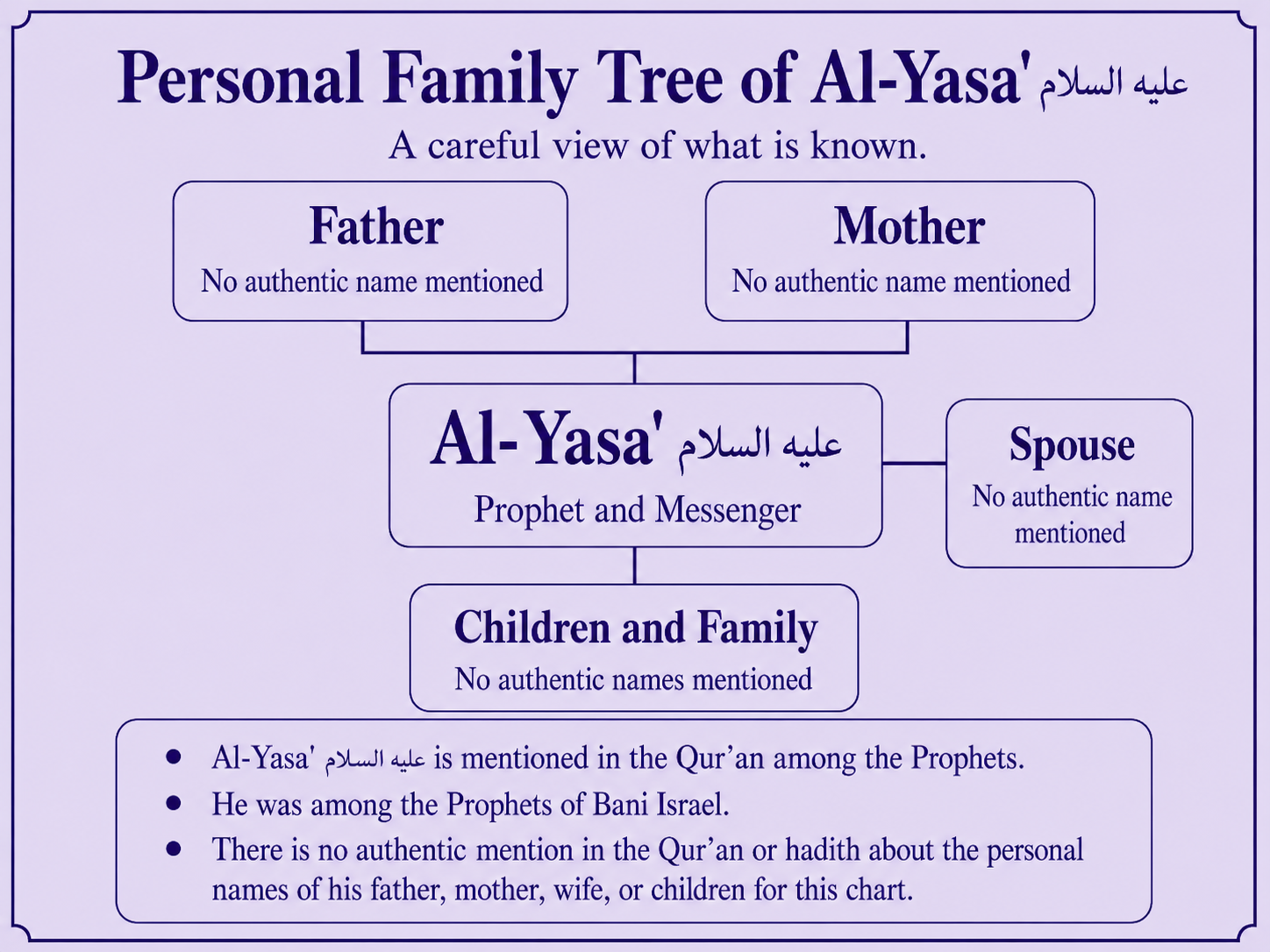
- Use for: Al-Yasa' عليه السلام and any reliable close family details if shown later.
- Not confirmed: parents, mother’s name, spouse, children, exact tribal chain, and grave location are not named in the Qur’an.
- Keep simple: if no reliable image detail is available, the visual can clearly mark the family tree as not confirmed.
Prophetic Lineage
This visual should show the broader Prophetic lineage context without claiming every missing generation is known.
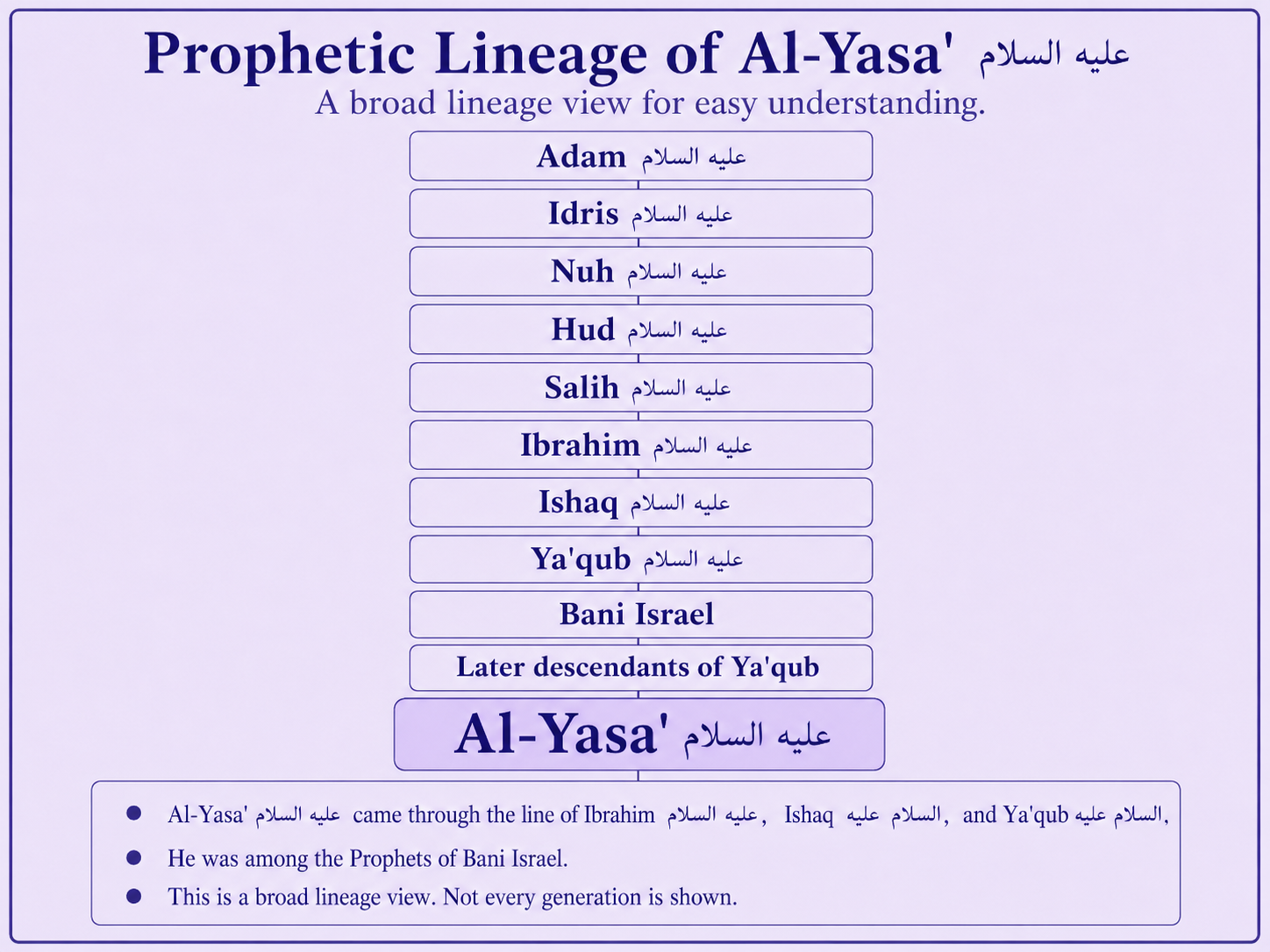
- Use for: Ibrahim عليه السلام → Ishaq عليه السلام → Ya'qub عليه السلام → Bani Israel Prophets → Al-Yasa' عليه السلام.
- Purpose: show broad placement among the Prophets of Bani Israel.
- Do not invent: exact intermediate generations are not confirmed in the Qur’an or authentic hadith.
A Prophet named with the favoured
Al-Yasa' عليه السلام is mentioned in the Qur’an among Prophets whom Allah favoured.
In Surah al-An'am, his name appears with Isma'il, Yunus, and Lut عليهم السلام. The verse says that each was favoured over the worlds. This is enough to establish honour and rank.
The Qur’an does not give a long story about his people, his dialogue, his miracle, or his death. So the safest way to teach his story is to present what Allah stated and to clearly mark what is not stated.
Al-Yasa' عليه السلام among those favoured
وَإِسْمَاعِيلَ وَالْيَسَعَ وَيُونُسَ وَلُوطًا ۚ وَكُلًّا فَضَّلْنَا عَلَى الْعَالَمِينَ
Wa Isma'ila wal-Yasa'a wa Yunusa wa Lutan. Wa kullan faddalna 'alal-'alamin.
And Isma'il, Al-Yasa', Yunus, and Lut. And all We favoured over the worlds. Source: Quran 6:86.
Among the excellent
In Surah Sad, Allah commands remembrance of Isma'il, Al-Yasa', and Dhu al-Kifl عليهم السلام, and says each was among the excellent. This is the second Qur’anic mention of Al-Yasa' عليه السلام.
The word is not empty decoration. It tells the believer how to view him. Al-Yasa' عليه السلام was not forgotten by Allah. He was preserved in the Qur’an among the excellent servants.
This is why a short page can still be complete: Allah did not tell us every event, but He did tell us how to honour him.
Remember Isma'il, Al-Yasa', and Dhu al-Kifl
وَاذْكُرْ إِسْمَاعِيلَ وَالْيَسَعَ وَذَا الْكِفْلِ ۖ وَكُلٌّ مِّنَ الْأَخْيَارِ
Wadhkur Isma'ila wal-Yasa'a wa Dhal-Kifl. Wa kullum-minal-akhyar.
And remember Isma'il, Al-Yasa', and Dhu al-Kifl. Each was among the excellent. Source: Quran 38:48.
Al-Yasa' or Elisha?
Al-Yasa' عليه السلام is commonly identified with Elisha in English discussions and in many comparative writings. However, an Islamic educational page should keep the Qur’anic name as the main name: Al-Yasa' عليه السلام.
The Qur’an does not narrate the details that appear in other religious traditions. So it is not correct to import every external story and present it as Islamic fact.
A safe note is: Al-Yasa' عليه السلام is the Qur’anic name. He is commonly identified with Elisha in English, but our page follows Qur’an-based wording and does not rely on external stories.
How should the name be written?
Use Al-Yasa' عليه السلام for the page title and main content. Other spellings like Alyasa, Al-Yasa, or Al-Yasa'a may appear in transliteration, but one consistent website spelling is better.
Do not import unverified stories
Stories from outside the Qur’an should not be written as Islamic certainty. The page should remain clean: Qur’anic mention, rank, honour, and limits.
What the Qur’an clearly tells us
The Qur’an gives few details, but the details it gives are full of honour.
Al-Yasa' عليه السلام is named by Allah. He is mentioned among Prophets. He is included among those favoured over the worlds. He is mentioned among the excellent.
These points are enough to build a trustworthy page without adding fragile story glass that may shatter under checking.
- Name: Al-Yasa' عليه السلام is mentioned in Quran 6:86 and Quran 38:48.
- Rank: He is mentioned with Prophets and honoured servants.
- Favour: Allah says all of them were favoured over the worlds.
- Excellence: Allah says each was among the excellent.
- Story limit: His detailed mission, speeches, miracles, and family details are not narrated in the Qur’an.
What should not be added as certainty
Some sources give expanded stories about Al-Yasa' عليه السلام, his link to Ilyas عليه السلام, his exact place, his miracles, and his people. Some may be historical or comparative discussions, but they are not narrated in the Qur’an.
Since this is a public Islamic page, the wording should avoid declaring uncertain points as established facts. We can mention broad scholarly or historical discussion only as a note, not as the core story.
The golden rule for this page: if Allah did not narrate it clearly, do not dress it up as certainty.
Duas and words connected to Al-Yasa' عليه السلام
The Qur’an does not quote a specific dua or direct speech from Al-Yasa' عليه السلام. No authentic hadith dua from him is established for this page.
وَكُلًّا فَضَّلْنَا عَلَى الْعَالَمِينَ
Wa kullan faddalna 'alal-'alamin.
And all We favoured over the worlds. Source: Quran 6:86, relevant part.
وَكُلٌّ مِّنَ الْأَخْيَارِ
Wa kullum-minal-akhyar.
And each was among the excellent. Source: Quran 38:48, relevant part.
Common questions about Al-Yasa' عليه السلام
Because his story is brief, the common questions matter more than usual.
Was Al-Yasa' عليه السلام a Prophet?
He is included in Qur’anic lists with Prophets and honoured servants. Muslim tradition generally includes him among the Prophets, and this page treats him with that honour.
Do we know his exact time period?
No exact date is given in the Qur’an or authentic hadith. He is broadly placed among the Prophets of Bani Israel after Musa عليه السلام, often discussed near Ilyas عليه السلام, but exact dates should not be stated.
Do we know his family tree?
The Qur’an does not give his parents, spouse, children, or exact line. So the page can show only broad placement among Prophets of Bani Israel and must say the detailed family tree is not confirmed.
Is Al-Yasa' عليه السلام Elisha?
He is commonly identified with Elisha in English discussions. The page should keep the Qur’anic name and avoid importing external stories as Islamic certainty.
Do we have a dua from him?
No specific dua spoken by Al-Yasa' عليه السلام is quoted in the Qur’an or established authentic hadith. The page includes Qur’anic praise connected to him instead.
Do we know his grave?
There are local and historical claims about graves connected to Al-Yasa' عليه السلام, but no exact grave location is established from the Qur’an or authentic hadith. It should not be taught as required belief.
Allah’s mention is honour
Al-Yasa' عليه السلام is honoured because Allah named him in the Qur’an.
Excellence can be quiet
His detailed story is not narrated, but Allah still calls him among the excellent.
Do not invent what revelation did not give
Honesty means stopping where clear evidence stops.
Family trees need evidence
If the Qur’an does not give exact lineage, the page should say so clearly.
Dates need humility
Approximate historical placement is not the same as confirmed date.
Short pages can still teach deeply
A few Qur’anic words can carry a whole lantern of guidance.
Common mistakes about this story
- Writing a full invented biography: the Qur’an does not narrate his full life story.
- Claiming exact dates: no exact year, century, age, or death date is established in Qur’an or authentic hadith.
- Inventing a family tree: the Qur’an does not name his parents, spouse, children, or exact lineage.
- Using external stories as certainty: do not import every Elisha-related story as Islamic fact.
- Quoting a dua from him: no specific dua from him is quoted in Qur’an or established authentic hadith.
- Thinking brief mention means small honour: Allah calls him among the excellent.
The whole story in six lines
- Al-Yasa' عليه السلام is mentioned by name in the Qur’an.
- He is mentioned among honoured Prophets and servants of Allah.
- Allah says all of them were favoured over the worlds.
- Allah says each was among the excellent.
- His exact dates, family tree, place, and detailed mission are not narrated in the Qur’an.
- The lesson is to honour Allah’s praise and avoid unsupported certainty.
Main references used
- Qur’an: Al-Yasa' عليه السلام mentioned with Isma'il, Yunus, and Lut عليهم السلام and favoured over the worlds: Quran 6:86.
- Qur’an: Al-Yasa' عليه السلام mentioned with Isma'il and Dhu al-Kifl عليهم السلام and described among the excellent: Quran 38:48.
- Dates note: Exact birth year, death year, age, and century are not given in the Qur’an or authentic hadith.
- Family tree note: Parents, spouse, children, and exact lineage of Al-Yasa' عليه السلام are not named in the Qur’an.
- Dua note: No specific dua or direct speech from Al-Yasa' عليه السلام is quoted in the Qur’an or established authentic hadith.
- Extra details: Exact location, grave claim, detailed mission scenes, and external Elisha stories should not be taught as Qur’anic certainty.
Al-Yasa' عليه السلام teaches quiet excellence
His story is not long in the Qur’an, but his honour is not small. Allah named him, placed him with honoured Prophets, favoured him, and called him among the excellent. Al-Yasa' عليه السلام teaches that a servant does not need a loud biography when Allah has written his name into the Book with praise.