

Story of Yunus عليه السلام
The Prophet also called Dhu an-Nun and Sahib al-Hut, who left his people before Allah’s permission, was swallowed by the fish, called upon Allah from darkness, was saved by mercy, and whose people believed before punishment fully came.
The journey of Yunus عليه السلام
A clear path through his mission, leaving his people, the ship, the fish, the famous dua, Allah’s rescue, and the belief of his people.
Allah sends Yunus عليه السلام
He is among the Messengers and is sent to a large people.
His people reject the warning
He leaves them while angry, before Allah’s permission for departure.
He boards a loaded ship
The ship becomes troubled, and lots are cast.
He is among those cast into the sea
The fish swallows him while he is blameworthy for leaving early.
He calls from layers of darkness
He declares Allah’s oneness, Allah’s perfection, and his own wrong.
Allah answers and saves him
Allah delivers him from grief and says He saves the believers like this.
He is cast onto the open shore
He is ill, and Allah causes a plant to grow over him.
Allah sends him to more than one hundred thousand
They believe, and Allah gives them enjoyment for a time.
His story becomes a warning and mercy
The Prophet ﷺ is told not to be like the companion of the fish in impatience.
Approximate Timeline / Dates
The Qur’an and authentic hadith do not give exact calendar dates, so this page gives only safe timeline placement.
Exact dates are not confirmed
No confirmed BC/CE birth year, death year, exact age, or exact century of Yunus عليه السلام is given in the Qur’an or authentic hadith.
He is broadly placed among ancient Prophets after Musa عليه السلام in the period of Bani Israel Prophets, but exact dates should not be stated as confirmed.
His city is not named in the Qur’an
Many discussions identify his people with Nineveh, but the Qur’an does not name the city. A careful page can mention that identification as common discussion, but the core wording should follow the Qur’an.
Family Tree / Lineage
Personal Family Tree
This visual should show the direct family information related to Yunus عليه السلام only. Keep it limited to what is reliable.
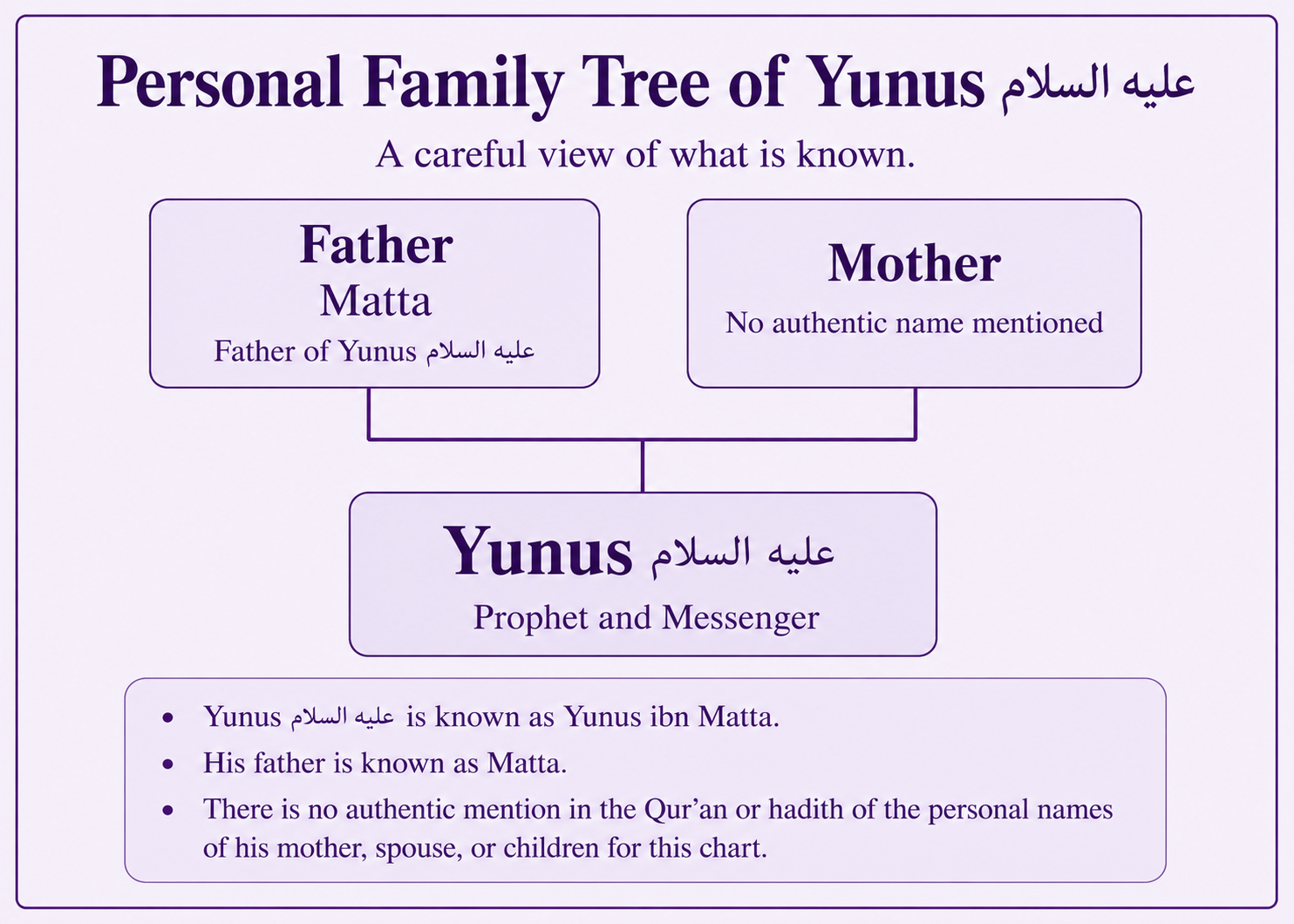
- Use for: Matta → Yunus عليه السلام, and mother unknown if you want to show it visually.
- Confirmed: Authentic hadith refer to him as Yunus ibn Matta.
- Do not add without proof: spouse, children, exact tribal chain, or grave location.
Prophetic Lineage
This visual should show the broader lineage context so readers understand where Yunus عليه السلام broadly fits among the Prophets.
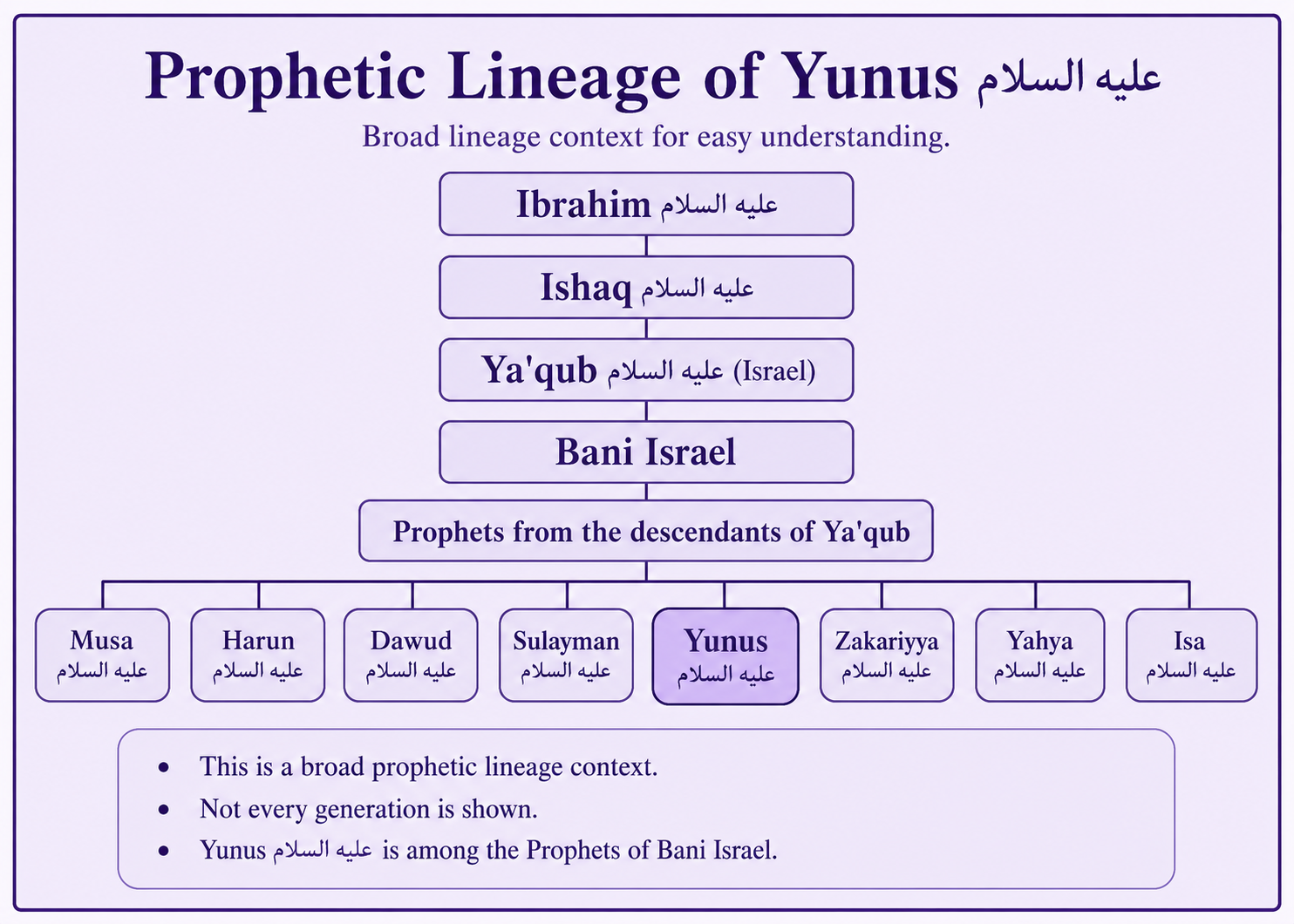
- Use for: Ibrahim عليه السلام → Ishaq عليه السلام → Ya'qub عليه السلام → line of Bani Israel Prophets → Yunus عليه السلام.
- Purpose: This is a broad learning map, not a claim that every missing generation is fully known.
- Keep clear: mark broad context separately from confirmed personal family details.
Yunus عليه السلام among the Messengers
Yunus عليه السلام was one of Allah’s Messengers, and the Qur’an mentions him among the honoured Prophets.
He is mentioned by name in the Qur’an and is also called Dhu an-Nun, meaning the companion of the fish, and Sahib al-Hut, meaning the companion of the whale or great fish.
His story is not a story of a Prophet abandoned by Allah. It is a story of a Prophet corrected by Allah, saved by Allah, honoured by Allah, and made a lasting sign for every believer trapped in darkness.
Yunus عليه السلام among the Messengers
وَإِنَّ يُونُسَ لَمِنَ الْمُرْسَلِينَ
Wa inna Yunusa laminal-mursalin.
And indeed, Yunus was surely among the Messengers. Source: Quran 37:139.
Among those favoured over the worlds
وَإِسْمَاعِيلَ وَالْيَسَعَ وَيُونُسَ وَلُوطًا ۚ وَكُلًّا فَضَّلْنَا عَلَى الْعَالَمِينَ
Wa Isma'ila wal-Yasa'a wa Yunusa wa Lutan. Wa kullan faddalna 'alal-'alamin.
And Isma'il, Al-Yasa', Yunus, and Lut. And all We favoured over the worlds. Source: Quran 6:86.
He left while angry
Yunus عليه السلام called his people, but they rejected the warning. He left them while angry, thinking that Allah would not restrict him or hold him to account for leaving at that moment.
The Qur’an does not allow us to speak about him with disrespect. He was a Prophet and Messenger. At the same time, the Qur’an teaches that he left before Allah’s permission, and Allah corrected him through a severe trial.
This is one of the most powerful lessons of Prophetic stories: even a righteous caller must wait for Allah’s command and not allow frustration with people to outrun obedience.
Dhu an-Nun left in anger
وَذَا النُّونِ إِذ ذَّهَبَ مُغَاضِبًا
Wa Dhan-Nuni idh dhahaba mughadiba.
And Dhu an-Nun, when he went away in anger. Source: Quran 21:87, relevant part.
Do not be like the companion of the fish
The Prophet ﷺ was told to be patient for the judgement of his Lord and not be like the companion of the fish when he called out while distressed. Source: Quran 68:48, meaning summarized.
The loaded ship and the casting of lots
Yunus عليه السلام boarded a loaded ship. The ship became troubled, and lots were cast. He was among those who lost in the drawing of lots and was cast into the sea.
The fish swallowed him while he was blameworthy for leaving early. This did not mean Allah abandoned him. It meant Allah was teaching, correcting, and preparing a mercy that would become one of the greatest duas in the Qur’an.
He fled to the loaded ship
إِذْ أَبَقَ إِلَى الْفُلْكِ الْمَشْحُونِ
Idh abaqa ilal-fulkil-mashhun.
When he fled to the loaded ship. Source: Quran 37:140.
He cast lots and was among the losers
فَسَاهَمَ فَكَانَ مِنَ الْمُدْحَضِينَ
Fasahama fakana minal-mudhadin.
Then he cast lots and was among those overcome. Source: Quran 37:141.
The fish swallowed him
فَالْتَقَمَهُ الْحُوتُ وَهُوَ مُلِيمٌ
Faltaqamahul-hutu wa huwa mulim.
Then the fish swallowed him while he was blameworthy. Source: Quran 37:142.
The dua from darkness
Inside the darkness, Yunus عليه السلام called upon Allah with words that became a rescue lantern for the Ummah.
He declared that none has the right to be worshipped except Allah. He declared Allah free from every imperfection. Then he admitted that he had been among the wrongdoers.
This dua carries tawheed, tasbih, humility, and confession. It is not a complaint against Allah. It is a servant returning to Allah with complete need.
There is no god except You
لَّا إِلَٰهَ إِلَّا أَنتَ سُبْحَانَكَ إِنِّي كُنتُ مِنَ الظَّالِمِينَ
La ilaha illa Anta, subhanaka, inni kuntu minaz-zalimin.
There is no god except You. Glory be to You. Indeed, I was among the wrongdoers. Source: Quran 21:87.
Use this dua in distress, fear, guilt, darkness, anxiety, and when asking Allah for rescue with humility.
Allah answered him and saved him from grief
Allah answered Yunus عليه السلام and saved him from grief. Then Allah made the lesson general by saying: thus do We save the believers.
That line is enormous. It means the dua of Yunus عليه السلام is not locked in the belly of the fish. It is a door for believers in every darkness, as long as they return to Allah with tawheed, tasbih, and humility.
We answered him
فَاسْتَجَبْنَا لَهُ وَنَجَّيْنَاهُ مِنَ الْغَمِّ
Fastajabna lahu wa najjaynahu minal-ghamm.
So We answered him and saved him from grief. Source: Quran 21:88, relevant part.
Thus We save the believers
وَكَذَٰلِكَ نُنجِي الْمُؤْمِنِينَ
Wa kadhalika nunjil-mu'minin.
And thus do We save the believers. Source: Quran 21:88, relevant part.
Cast onto the open shore
Allah says that if Yunus عليه السلام had not been among those who glorified Allah, he would have remained in the belly of the fish until the Day they are resurrected. But Allah saved him.
He was cast onto the open shore while ill, and Allah caused a plant of gourd to grow over him. Then Allah sent him to a hundred thousand or more, and they believed, so Allah gave them enjoyment for a time.
Because he glorified Allah
If Yunus عليه السلام had not been among those who glorified Allah, he would have remained in the fish’s belly until the Day of Resurrection. Source: Quran 37:143-144, meaning summarized.
Cast onto the shore while ill
فَنَبَذْنَاهُ بِالْعَرَاءِ وَهُوَ سَقِيمٌ
Fanabadhnahu bil-'ara'i wa huwa saqim.
So We cast him onto the open shore while he was ill. Source: Quran 37:145.
A gourd plant grew over him
وَأَنبَتْنَا عَلَيْهِ شَجَرَةً مِّن يَقْطِينٍ
Wa anbatna 'alayhi shajaratam-min yaqteen.
And We caused to grow over him a plant of gourd. Source: Quran 37:146.
His people believed
The people of Yunus عليه السلام are unique in the Qur’an because their belief benefited them when they believed before the punishment was completed upon them.
Allah says there was no town that believed and its faith benefited it except the people of Yunus. When they believed, Allah removed from them the punishment of disgrace in worldly life and gave them enjoyment for a time.
This is a story of mercy at a huge scale: a Prophet is rescued from darkness, and a people are rescued from punishment.
Sent to a hundred thousand or more
وَأَرْسَلْنَاهُ إِلَىٰ مِائَةِ أَلْفٍ أَوْ يَزِيدُونَ
Wa arsalnahu ila mi'ati alfin aw yazidun.
And We sent him to a hundred thousand or more. Source: Quran 37:147.
They believed
فَآمَنُوا فَمَتَّعْنَاهُمْ إِلَىٰ حِينٍ
Fa amanu famatta'nahum ila hin.
And they believed, so We gave them enjoyment for a time. Source: Quran 37:148.
The people of Yunus benefited from belief
No town believed and its faith benefited it except the people of Yunus. When they believed, Allah removed from them the punishment of disgrace in worldly life and gave them enjoyment for a time. Source: Quran 10:98, meaning summarized.
A people saved through faith
Their story teaches that repentance before the punishment fully arrives can still open mercy. But delaying repentance until the last breath or after seeing the unseen is not the path of safety.
Duas and powerful words connected to Yunus عليه السلام
لَّا إِلَٰهَ إِلَّا أَنتَ سُبْحَانَكَ إِنِّي كُنتُ مِنَ الظَّالِمِينَ
La ilaha illa Anta, subhanaka, inni kuntu minaz-zalimin.
There is no god except You. Glory be to You. Indeed, I was among the wrongdoers. Source: Quran 21:87.
فَاسْتَجَبْنَا لَهُ وَنَجَّيْنَاهُ مِنَ الْغَمِّ
Fastajabna lahu wa najjaynahu minal-ghamm.
So We answered him and saved him from grief. Source: Quran 21:88, relevant part.
وَكَذَٰلِكَ نُنجِي الْمُؤْمِنِينَ
Wa kadhalika nunjil-mu'minin.
And thus do We save the believers. Source: Quran 21:88, relevant part.
Authentic hadith mention Yunus ibn Matta and warn against claiming superiority over him. This protects the honour of Yunus عليه السلام and teaches adab with Prophets.
Common questions about Yunus عليه السلام
These points are often misunderstood, so the wording must protect his honour while keeping the Qur’anic lesson clear.
Why is he called Dhu an-Nun?
Dhu an-Nun means the companion of the fish. The Qur’an uses this title in Quran 21:87. He is also called Sahib al-Hut, the companion of the fish, in Quran 68:48.
Did Yunus عليه السلام sin?
The Qur’an says he left in anger and was blameworthy, then he called upon Allah, and Allah saved him. We should learn the lesson without speaking about a Prophet disrespectfully.
Was his city Nineveh?
Many people identify his people with Nineveh, but the Qur’an does not name the city. Use “the people of Yunus” as the main wording.
Was it a whale?
The Qur’an uses the word al-hut, meaning the fish or great fish. In English, people often say whale, but the Qur’anic wording should remain the main guide.
Why were his people special?
Quran 10:98 says the people of Yunus believed and their belief benefited them, so Allah removed the punishment of disgrace and gave them enjoyment for a time.
Do we know his full family tree?
Authentic hadith call him Yunus ibn Matta. The Qur’an does not give his full lineage, spouse, children, or detailed family tree.
Do not outrun Allah’s command
A caller to Allah must be patient until Allah opens the next step.
Tawheed saves from darkness
The dua of Yunus عليه السلام begins with “There is no god except You.”
Admit your wrong to Allah
His dua includes humility: “I was among the wrongdoers.”
No darkness is beyond Allah
Allah heard him from the darkness of the fish, the sea, and the night.
Repentance can save a people
The people of Yunus believed and Allah removed the punishment from them.
Protect the honour of Prophets
Learn the warning without speaking about Yunus عليه السلام disrespectfully.
Common mistakes about this story
- Speaking disrespectfully about Yunus عليه السلام: the Qur’an teaches correction while preserving Prophetic honour.
- Inventing exact dates: no exact year, age, or century is confirmed in the Qur’an or authentic hadith.
- Claiming a full family tree: authentic hadith name him Yunus ibn Matta, but detailed lineage is not given.
- Naming the city as Qur’an fact: the Qur’an does not name the city of his people.
- Treating the dua as ordinary words: it is one of the greatest duas for distress.
- Forgetting his people’s repentance: their belief is a major part of the story.
The whole story in eight lines
- Yunus عليه السلام was among the Messengers.
- He called his people, but left them in anger before Allah’s permission.
- He boarded a loaded ship, and lots were cast.
- He was cast into the sea and swallowed by the fish.
- He made the famous dua from darkness.
- Allah answered him and saved him from grief.
- Allah cast him onto the shore and caused a plant to grow over him.
- His people believed, so Allah removed the punishment and gave them enjoyment for a time.
Main references used
- Qur’an: Yunus عليه السلام among the Messengers, the loaded ship, lots, fish, shore, gourd plant, and people believing: Quran 37:139-148.
- Qur’an: Dhu an-Nun leaving in anger, the dua from darkness, Allah’s answer, and saving believers: Quran 21:87-88.
- Qur’an: The people of Yunus believing and punishment removed: Quran 10:98.
- Qur’an: The Prophet ﷺ told not to be like the companion of the fish in impatience: Quran 68:48-50.
- Qur’an: Yunus عليه السلام among those favoured over the worlds: Quran 6:86.
- Hadith: Authentic hadith mention Yunus ibn Matta and warn against claiming superiority over him, preserving adab with Prophets.
- Dates and family tree note: Exact dates, full lineage, spouse, children, grave location, and city name are not given as clear Qur’an facts.
Yunus عليه السلام teaches hope from the deepest darkness
His story begins with a Prophet leaving in anger and enters the darkness of the sea, the fish, and distress. But the darkness could not block Allah’s hearing. Yunus عليه السلام turned back with tawheed, tasbih, and humility, and Allah saved him from grief. His dua remains a door for every believer who feels trapped: no darkness is deeper than Allah’s mercy.