

Story of Musa عليه السلام
The Prophet most frequently mentioned in the Qur’an: saved as a baby from Pharaoh, raised in the palace, exiled to Madyan, called at the sacred valley, sent with Harun عليه السلام, supported with signs, opposed by Pharaoh, saved through the sea, given the Tawrah, and tested repeatedly with Bani Israel.
The journey of Musa عليه السلام
A wide Qur’anic story, arranged in a clean order from birth to mission, rescue, revelation, Bani Israel, and major later lessons.
Pharaoh oppresses Bani Israel
He kills sons, spares women, and claims power over Egypt.
Musa عليه السلام is placed in the river
Allah inspires his mother and promises to return him and make him a Messenger.
He returns to his mother
Allah prevents him from accepting other nursing women until his sister guides them to his mother.
He grows and leaves Egypt
After accidentally killing a man, he repents and flees toward Madyan.
He helps the two women
He waters their flock and makes dua in need.
Allah calls him at the sacred valley
He sees a fire, reaches Tuwa, and hears Allah’s command.
He is sent to Pharaoh
He asks Allah to expand his chest, ease his task, and appoint Harun عليه السلام to support him.
The staff and hand become signs
Allah gives him miracles and sends him with clear proof.
The magicians believe
Pharaoh’s challenge becomes a public defeat for falsehood.
The sea opens
Allah saves Musa عليه السلام and Bani Israel and drowns Pharaoh and his army.
The Tawrah and tests of Bani Israel
The mountain, tablets, calf, manna, quails, cow, rock, and holy land all become lessons.
Musa عليه السلام keeps turning to Allah
His duas, anger for Allah, repentance, and hope remain a map for believers.
Approximate Timeline / Dates
Dates are kept safe and simple. Exact years are not claimed where revelation does not confirm them.
Exact dates are not confirmed
The Qur’an and authentic hadith do not give a confirmed birth year, death year, exact age, or full calendar timeline for Musa عليه السلام.
Musa عليه السلام lived before Dawud and Sulayman عليهما السلام, and before Isa عليه السلام. His story is connected to Pharaoh, Egypt, the Exodus, Bani Israel, and the revelation of the Tawrah.
Egypt, Madyan, and Bani Israel
His story moves through Egypt, Madyan, the return to Pharaoh, and the journey of Bani Israel after rescue. Exact grave location and many later place claims should not be stated as Qur’an-confirmed facts.
Family Tree / Lineage
Personal Family Tree
This visual should show only the reliable close family details connected to Musa عليه السلام.
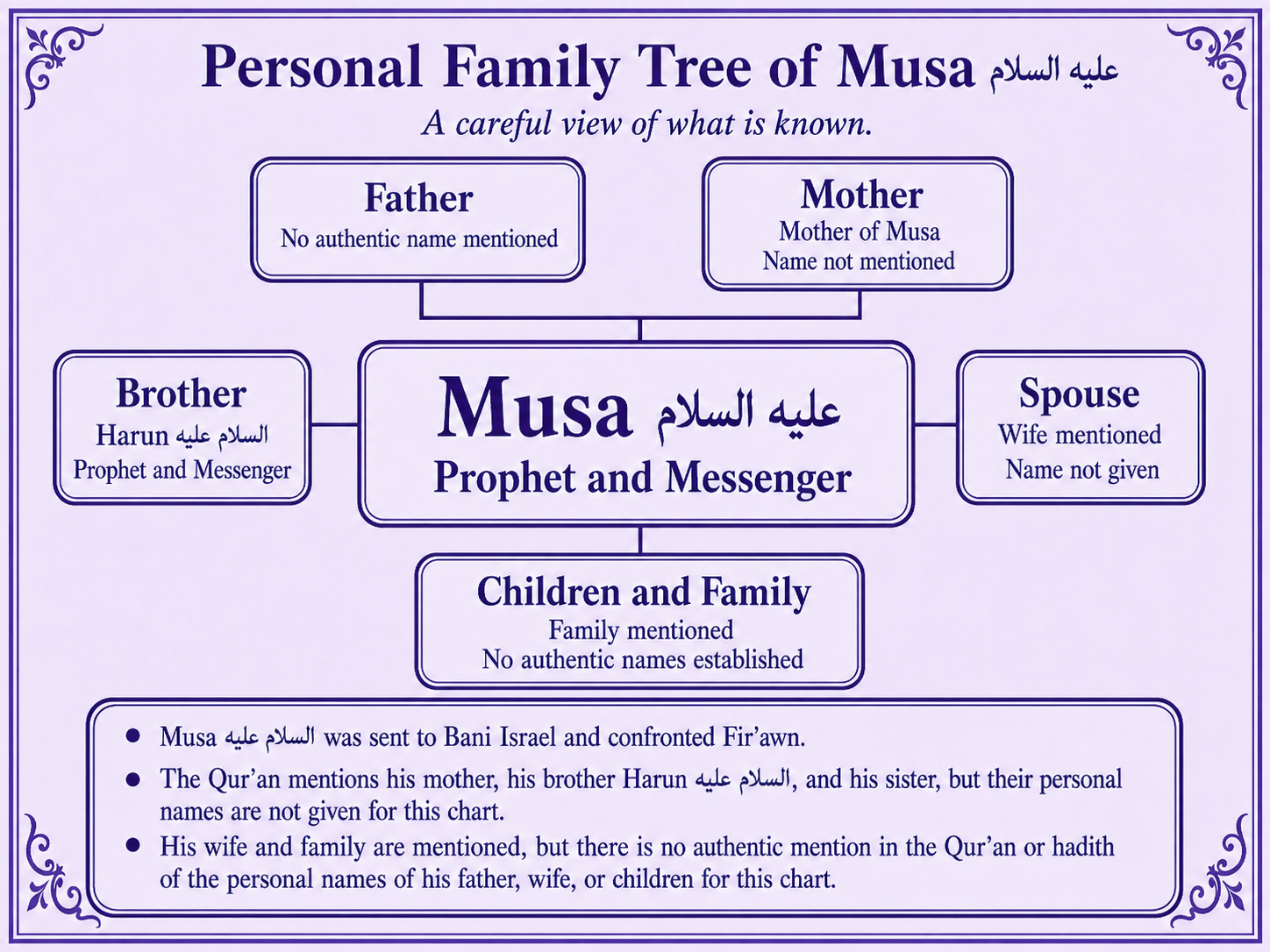
- Use for: Musa عليه السلام, Harun عليه السلام, their mother, and his sister in the story context.
- Confirmed: Harun عليه السلام was Musa’s brother, his mother was inspired to place him in the river, and his sister followed him.
- Keep careful: do not add parents’ names, sister’s name, wife’s name, children’s names, exact birth order, or grave location as Qur’an-confirmed facts.
Prophetic Lineage
This visual should show the broader Prophetic lineage context without claiming every missing generation is known.
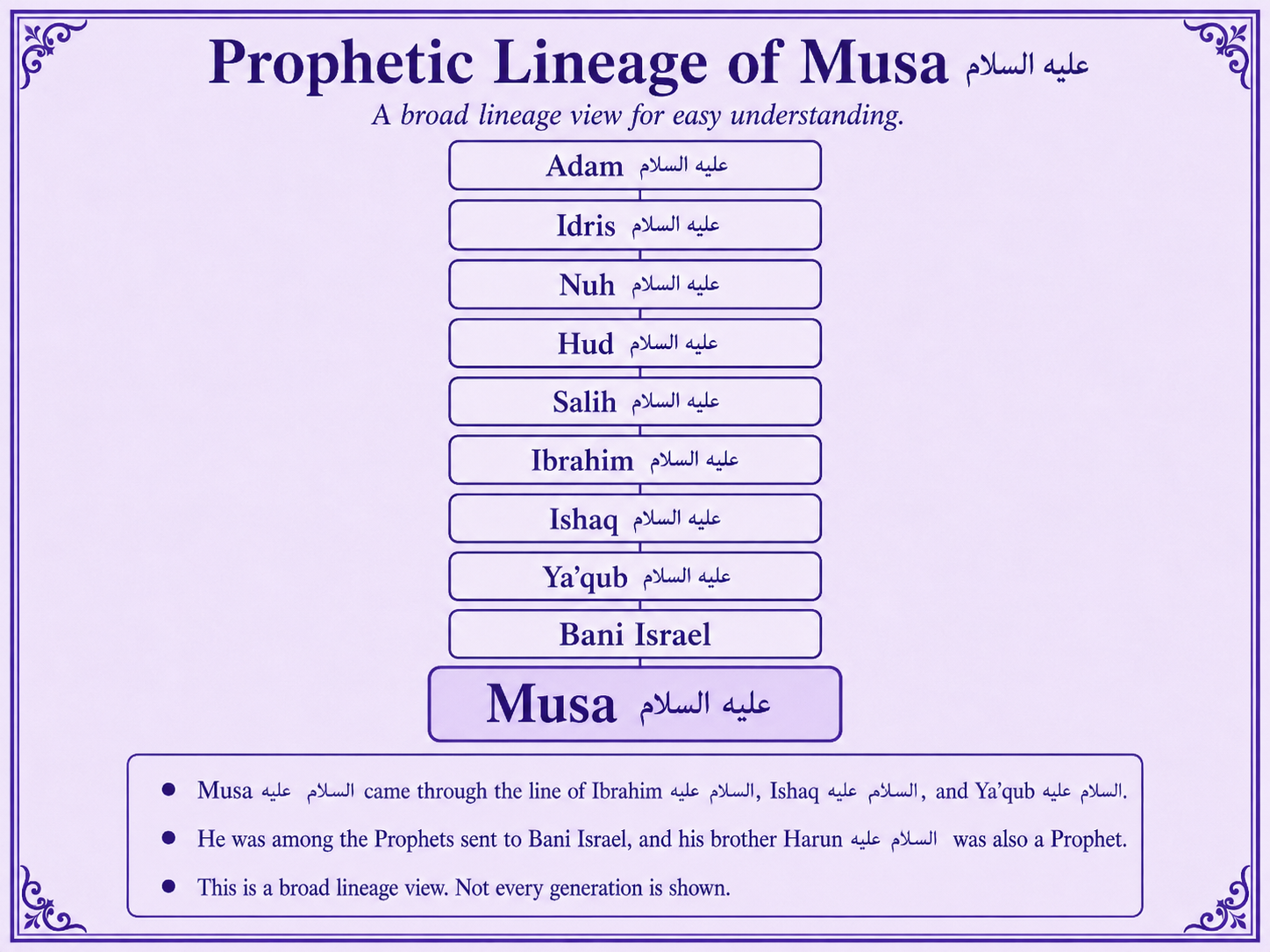
- Use for: Ibrahim عليه السلام → Ishaq عليه السلام → Ya'qub عليه السلام → Bani Israel → Musa and Harun عليهما السلام.
- Purpose: show Musa عليه السلام as a major Prophet from Bani Israel and the one given the Tawrah.
- Do not invent: exact intermediate generations not confirmed in the Qur’an or authentic hadith.
A baby born under Pharaoh’s terror
Musa عليه السلام was born when Pharaoh was killing the sons of Bani Israel and sparing their women.
Pharaoh had made his people into groups, weakening one group among them. He slaughtered their sons and let their women live. But Allah wanted to favour the oppressed and make them leaders and inheritors.
In the same land where Pharaoh tried to control life and death, Allah caused the child who would challenge him to be born.
Pharaoh weakened a group
Pharaoh exalted himself in the land, made its people into groups, weakened one group, slaughtered their sons, and spared their women. Source: Quran 28:4, meaning summarized.
Allah wanted to favour the oppressed
Allah wanted to favour those who were oppressed in the land, make them leaders, make them inheritors, and show Pharaoh what he feared. Source: Quran 28:5-6, meaning summarized.
A tyrant may plan with armies, but Allah’s plan can begin with a baby in a basket.
Allah inspires the mother of Musa عليه السلام
Allah inspired the mother of Musa عليه السلام to nurse him, and when she feared for him, to cast him into the river. She was told not to fear or grieve, because Allah would return him to her and make him one of the Messengers.
This was a command that cut through a mother’s heart. But Allah’s promise held her together. The river did not carry Musa عليه السلام away from Allah’s plan. It carried him into it.
The family of Pharaoh picked him up, so the enemy of Allah ended up raising the child Allah would later send against him.
Do not fear and do not grieve
وَلَا تَخَافِي وَلَا تَحْزَنِي
Wa la takhafi wa la tahzani.
Do not fear and do not grieve. Source: Quran 28:7, relevant part.
Allah promised to return him
إِنَّا رَادُّوهُ إِلَيْكِ وَجَاعِلُوهُ مِنَ الْمُرْسَلِينَ
Inna radduhu ilayki wa ja'iluhu minal-mursalin.
Indeed, We will return him to you and make him among the Messengers. Source: Quran 28:7, relevant part.
Returned to his mother inside Pharaoh’s own world
The wife of Pharaoh asked that the child not be killed, hoping he might benefit them or be taken as a son. The Qur’an does not name her in this passage, but her compassion became part of Musa’s protection.
The heart of Musa’s mother became empty with worry. His sister followed him from a distance. Allah had already forbidden other nursing women to him, so his sister guided them to a household that could care for him. In this way, Allah returned him to his mother so her eye would be comforted and she would know Allah’s promise is true.
The wife of Pharaoh protects him
The wife of Pharaoh said the child was a comfort of the eye for her and Pharaoh, and asked that he not be killed. Source: Quran 28:9, meaning summarized.
Returned so her eye would be comforted
Allah returned Musa عليه السلام to his mother so her eye would be comforted, she would not grieve, and she would know Allah’s promise is true. Source: Quran 28:13, meaning summarized.
The accidental killing and repentance
When Musa عليه السلام reached maturity, Allah gave him judgment and knowledge. One day he entered the city and found two men fighting: one from his group and one from his enemy. The one from his group asked Musa عليه السلام for help, and Musa struck the other man. The man died.
Musa عليه السلام did not justify the killing. He admitted wrongdoing and asked Allah for forgiveness. Allah forgave him. This scene shows the honesty of Prophets: when a mistake happens, the heart runs to repentance.
He then said he would never be a supporter of criminals because of the favour Allah had given him.
My Lord, I have wronged myself
رَبِّ إِنِّي ظَلَمْتُ نَفْسِي فَاغْفِرْ لِي
Rabbi inni zalamtu nafsi faghfir li.
My Lord, indeed I have wronged myself, so forgive me. Source: Quran 28:16.
I will not support criminals
رَبِّ بِمَا أَنْعَمْتَ عَلَيَّ فَلَنْ أَكُونَ ظَهِيرًا لِّلْمُجْرِمِينَ
Rabbi bima an'amta 'alayya falan akuna zahiral-lil-mujrimin.
My Lord, because of the favour You have bestowed upon me, I will never be a supporter of the criminals. Source: Quran 28:17.
Fleeing Egypt and helping the two women
A man came from the farthest part of the city and warned Musa عليه السلام that the leaders were planning to kill him. Musa عليه السلام left Egypt fearful and watchful, asking Allah to save him from the wrongdoing people.
He travelled toward Madyan. At the water, he found people watering their flocks and two women holding back their animals. He watered for them, then turned to the shade and made one of the most beloved duas for need.
One of the women came to him walking with modesty and invited him to meet her father. The old man offered marriage to one of his daughters in exchange for Musa عليه السلام working eight years, with ten as a voluntary completion. The Qur’an does not name this old man, so he should not be named as certain Qur’anic fact.
Save me from the wrongdoing people
رَبِّ نَجِّنِي مِنَ الْقَوْمِ الظَّالِمِينَ
Rabbi najjini minal-qawmiz-zalimin.
My Lord, save me from the wrongdoing people. Source: Quran 28:21.
I am in need of whatever good You send down
رَبِّ إِنِّي لِمَا أَنزَلْتَ إِلَيَّ مِنْ خَيْرٍ فَقِيرٌ
Rabbi inni lima anzalta ilayya min khayrin faqir.
My Lord, indeed I am in need of whatever good You send down to me. Source: Quran 28:24.
The old man is not named in the Qur’an
Many people say he was Shu'ayb عليه السلام, but the Qur’an does not name him in this passage. It is better to call him the old man of Madyan or the father of the two women unless discussing historical views separately.
The fire and the sacred valley
After completing the term, Musa عليه السلام travelled with his family. He saw a fire and told his family to wait, hoping to bring news or a burning brand. But the fire was not an ordinary fire. Allah was calling him.
At the sacred valley of Tuwa, Musa عليه السلام was told to remove his sandals. Allah told him that He is Allah, there is no god but Him, so worship Him and establish prayer for His remembrance.
Here the fugitive of Egypt became the Messenger sent back to Egypt. The man who had left in fear would return with revelation.
You are in the sacred valley Tuwa
إِنِّي أَنَا رَبُّكَ فَاخْلَعْ نَعْلَيْكَ ۖ إِنَّكَ بِالْوَادِ الْمُقَدَّسِ طُوًى
Inni ana rabbuka fakhla' na'layk. Innaka bil-wadil-muqaddasi Tuwa.
Indeed, I am your Lord, so remove your sandals. Indeed, you are in the sacred valley of Tuwa. Source: Quran 20:12.
Establish prayer for My remembrance
وَأَقِمِ الصَّلَاةَ لِذِكْرِي
Wa aqimis-salata lidhikri.
And establish prayer for My remembrance. Source: Quran 20:14, relevant part.
Sent to Pharaoh with signs
Allah showed Musa عليه السلام the sign of the staff becoming a serpent and his hand becoming white without harm. Then Allah sent him to Pharaoh, who had transgressed.
Musa عليه السلام asked Allah to expand his chest, ease his task, untie the knot from his tongue, and appoint Harun عليه السلام from his family as a helper. He did not pretend the mission was easy. He asked Allah for the strength to carry it.
Expand my chest and ease my task
رَبِّ اشْرَحْ لِي صَدْرِي وَيَسِّرْ لِي أَمْرِي
Rabbishrah li sadri. Wa yassir li amri.
My Lord, expand for me my chest, and ease for me my task. Source: Quran 20:25-26.
Untie the knot from my tongue
وَاحْلُلْ عُقْدَةً مِّن لِّسَانِي يَفْقَهُوا قَوْلِي
Wahlul 'uqdatam-min lisani. Yafqahu qawli.
And untie the knot from my tongue, so they may understand my speech. Source: Quran 20:27-28.
Appoint for me a helper from my family
وَاجْعَل لِّي وَزِيرًا مِّنْ أَهْلِي هَارُونَ أَخِي
Waj'al li waziram-min ahli. Haruna akhi.
And appoint for me a helper from my family, Harun, my brother. Source: Quran 20:29-30.
Strengthen me through him
Musa عليه السلام asked Allah to strengthen him through Harun عليه السلام, share the task with him, and help them glorify and remember Allah much. Source: Quran 20:31-35, meaning summarized.
Speak to Pharaoh with gentle words
Allah sent Musa and Harun عليهما السلام to Pharaoh, but commanded them to speak to him with gentle speech, so perhaps he might remember or fear Allah.
They feared that he might hasten against them or transgress. Allah reassured them that He was with them, hearing and seeing. Then they went to Pharaoh with the message: send Bani Israel with us and do not punish them.
This scene teaches courage with adab. Even Pharaoh was addressed with words that carried invitation before destruction.
Speak to him gently
فَقُولَا لَهُ قَوْلًا لَّيِّنًا
Fa qula lahu qawlal-layyina.
So speak to him with gentle speech. Source: Quran 20:44, relevant part.
I am with you, hearing and seeing
لَا تَخَافَا ۖ إِنَّنِي مَعَكُمَا أَسْمَعُ وَأَرَىٰ
La takhafa. Innani ma'akuma asma'u wa ara.
Do not fear. Indeed, I am with you both, hearing and seeing. Source: Quran 20:46.
The day of the magicians
Pharaoh accused Musa عليه السلام of magic and gathered the magicians for a public challenge. The magicians threw their ropes and staffs, making them appear to move. Musa عليه السلام felt fear inside himself, but Allah told him not to fear, because he would be superior.
Musa عليه السلام threw his staff, and it swallowed what they had made. The magicians knew this was not magic. They fell in prostration and declared belief in the Lord of Musa and Harun عليهما السلام.
Pharaoh threatened to cut their hands and feet and crucify them, but faith had already entered their hearts. The people hired to defend falsehood became witnesses for truth.
Do not fear, you are superior
لَا تَخَفْ إِنَّكَ أَنتَ الْأَعْلَىٰ
La takhaf innaka antal-a'la.
Do not fear. Indeed, you are the superior. Source: Quran 20:68.
We believe in the Lord of Harun and Musa
آمَنَّا بِرَبِّ هَارُونَ وَمُوسَىٰ
Amanna birabbi Haruna wa Musa.
We believe in the Lord of Harun and Musa. Source: Quran 20:70, relevant part.
Years of signs and Pharaoh’s arrogance
Allah sent signs upon Pharaoh’s people: the flood, locusts, lice, frogs, blood, and other clear signs. Each time punishment touched them, they asked Musa عليه السلام to call upon his Lord, promising to believe and let Bani Israel go. But when the punishment was removed, they broke their promise.
Pharaoh’s arrogance was not lack of evidence. It was refusal to surrender. He even claimed lordship and mocked Musa عليه السلام in front of his people.
The flood, locusts, lice, frogs, and blood
Allah sent upon them the flood, locusts, lice, frogs, and blood as distinct signs, but they remained arrogant. Source: Quran 7:133, meaning summarized.
Pharaoh claimed lordship
Pharaoh said, “I am your highest lord,” and also said he knew no god for his people other than himself. Source: Quran 79:24 and Quran 28:38, meaning summarized.
The sea opens
Allah commanded Musa عليه السلام to travel by night with Bani Israel. Pharaoh and his army pursued them. When the two groups saw each other, the companions of Musa عليه السلام said they would surely be overtaken.
Musa عليه السلام answered with certainty: “No. Indeed, with me is my Lord. He will guide me.” Allah told him to strike the sea with his staff, and it split. Bani Israel passed through, and Pharaoh followed with his army.
Allah saved Musa عليه السلام and those with him, and drowned Pharaoh and his forces. At the moment of drowning, Pharaoh claimed belief, but it was too late.
With me is my Lord
كَلَّا ۖ إِنَّ مَعِيَ رَبِّي سَيَهْدِينِ
Kalla. Inna ma'iya rabbi sayahdin.
No. Indeed, with me is my Lord. He will guide me. Source: Quran 26:62.
Strike the sea with your staff
Allah revealed to Musa عليه السلام to strike the sea with his staff, and it split, each part like a great mountain. Source: Quran 26:63, meaning summarized.
Pharaoh’s body as a sign
Allah said Pharaoh’s body would be saved so he would be a sign for those after him. Source: Quran 10:92, meaning summarized.
Bani Israel after the sea
After being saved from Pharaoh, Bani Israel passed by people devoted to idols and asked Musa عليه السلام to make them a god like those people had gods. Musa عليه السلام rebuked them for ignorance.
Allah provided shade, manna, and quails, and commanded them to eat from good things. When they needed water, Musa عليه السلام was told to strike the rock, and twelve springs burst out, one for each tribe.
Rescue from tyranny did not mean the tests ended. Freedom required gratitude, worship, obedience, and patience.
Make for us a god
Bani Israel asked Musa عليه السلام to make them a god like the idols of another people, and he rebuked their ignorance. Source: Quran 7:138-140, meaning summarized.
Manna and quails
Allah shaded Bani Israel with clouds and sent down manna and quails, commanding them to eat from the good things He provided. Source: Quran 2:57, meaning summarized.
Twelve springs
Musa عليه السلام was commanded to strike the rock with his staff, and twelve springs burst forth. Source: Quran 2:60 and Quran 7:160, meaning summarized.
Forty nights, tablets, and the golden calf
Allah appointed thirty nights for Musa عليه السلام and completed them with ten, making forty nights. During this time, he left Harun عليه السلام in charge of his people.
While Musa عليه السلام was away, the Samiri misled Bani Israel into worshipping a calf. When Musa عليه السلام returned angry and grieved, he confronted his people and his brother. Harun عليه السلام explained that the people had overpowered him and nearly killed him.
Musa عليه السلام asked Allah to forgive him and his brother and admit them into Allah’s mercy. His anger was for Allah, not for ego.
Forty nights
Allah appointed thirty nights for Musa عليه السلام and completed them with ten, making the appointment forty nights. Source: Quran 7:142, meaning summarized.
The calf and the Samiri
The Samiri misled them, and they took a calf as an object of worship while Musa عليه السلام was away. Source: Quran 20:85-97 and Quran 7:148-152, meaning summarized.
Forgive me and my brother
رَبِّ اغْفِرْ لِي وَلِأَخِي وَأَدْخِلْنَا فِي رَحْمَتِكَ
Rabbighfir li wa li akhi wa adkhilna fi rahmatik.
My Lord, forgive me and my brother and admit us into Your mercy. Source: Quran 7:151, relevant part.
You are the Most Merciful of the merciful
وَأَنتَ أَرْحَمُ الرَّاحِمِينَ
Wa anta arhamur-rahimin.
And You are the Most Merciful of the merciful. Source: Quran 7:151, relevant part.
My Lord, show me so I may look at You
Musa عليه السلام asked Allah to show Himself so he could look at Him. Allah told him that he would not see Him, but to look at the mountain. When Allah manifested to the mountain, it crumbled, and Musa عليه السلام fell unconscious.
When he recovered, he glorified Allah and repented, saying he was the first of the believers. This scene teaches the greatness of Allah and the limits of human strength in this world.
You will not see Me
Musa عليه السلام asked to see Allah. Allah said he would not see Him, and when Allah manifested to the mountain, it crumbled and Musa fell unconscious. Source: Quran 7:143, meaning summarized.
Glory be to You, I repent to You
سُبْحَانَكَ تُبْتُ إِلَيْكَ وَأَنَا أَوَّلُ الْمُؤْمِنِينَ
Subhanaka tubtu ilayka wa ana awwalul-mu'minin.
Glory be to You. I repent to You, and I am the first of the believers. Source: Quran 7:143, relevant part.
The chosen seventy and another dua
Musa عليه السلام chose seventy men from his people for Allah’s appointed time. When they were seized, Musa عليه السلام turned again to Allah, acknowledging that Allah is the Protector, and asking for forgiveness and mercy.
His dua shows how a Prophet carries his community’s crisis back to Allah. Leadership in Islam is not arrogance. It is pleading before Allah for mercy.
You are our Protector, forgive us and have mercy on us
أَنتَ وَلِيُّنَا فَاغْفِرْ لَنَا وَارْحَمْنَا ۖ وَأَنتَ خَيْرُ الْغَافِرِينَ
Anta waliyyuna faghfir lana warhamna wa anta khayrul-ghafirin.
You are our Protector, so forgive us and have mercy on us, and You are the best of those who forgive. Source: Quran 7:155, relevant part.
The command to slaughter a cow
Bani Israel were commanded through Musa عليه السلام to slaughter a cow. Instead of obeying simply, they kept asking for more details. The more they questioned without need, the more restricted the command became.
They finally slaughtered it, though they almost did not. This story teaches that unnecessary questioning can make obedience harder. When Allah commands clearly, surrender is safer than argument.
Allah commands you to slaughter a cow
إِنَّ اللَّهَ يَأْمُرُكُمْ أَن تَذْبَحُوا بَقَرَةً
Innallaha ya'murukum an tadhbahu baqarah.
Indeed, Allah commands you to slaughter a cow. Source: Quran 2:67, relevant part.
Refusal to enter the holy land
Musa عليه السلام told his people to enter the holy land Allah had written for them and not turn back. They refused out of fear and said there were powerful people inside. Two men who feared Allah encouraged them to enter with trust.
The people answered with one of the ugliest statements in the story: “Go, you and your Lord, and fight. We are sitting here.” Musa عليه السلام then made dua, saying he only had control over himself and his brother, and asking Allah to separate them from the defiantly disobedient people.
Allah forbade the land to them for forty years, and they wandered. This was a lesson that freedom from Pharaoh must be followed by obedience to Allah.
Go, you and your Lord, and fight
They told Musa عليه السلام to go with his Lord and fight, while they would remain sitting. Source: Quran 5:24, meaning summarized.
I control only myself and my brother
رَبِّ إِنِّي لَا أَمْلِكُ إِلَّا نَفْسِي وَأَخِي
Rabbi inni la amliku illa nafsi wa akhi.
My Lord, I have control only over myself and my brother. Source: Quran 5:25, relevant part.
Qarun from the people of Musa عليه السلام
Qarun was from the people of Musa عليه السلام, but he became arrogant because of wealth. He claimed that he had been given wealth because of knowledge he possessed. His people advised him not to exult, to seek the Hereafter with what Allah had given him, and not to spread corruption.
Allah caused the earth to swallow him and his home. Qarun’s story belongs to the wider lessons around Musa عليه السلام: wealth without gratitude can become a palace built over a sinkhole.
Qarun was from the people of Musa
Qarun was from the people of Musa عليه السلام, but he oppressed them and became arrogant with his wealth. Source: Quran 28:76-82, meaning summarized.
Seek the Hereafter with what Allah has given you
He was advised to seek the Hereafter through what Allah had given him, not forget his share of the world, do good, and not seek corruption. Source: Quran 28:77, meaning summarized.
Musa عليه السلام and the learned servant
Surah al-Kahf tells the story of Musa عليه السلام travelling to meet a servant of Allah who had been given mercy and knowledge from Allah. Authentic hadith identifies this servant as Khidr.
Musa عليه السلام wanted to learn from him. The learned servant told him that he would not be able to remain patient with what he did not fully understand. Then came the ship, the boy, and the wall. Each event looked confusing at first, but each had hidden wisdom by Allah’s command.
This story teaches humility before knowledge. Even a great Prophet like Musa عليه السلام was shown that Allah gives some knowledge to some servants that others do not have.
A servant taught by Allah
Musa عليه السلام met a servant from among Allah’s servants whom Allah had given mercy and taught knowledge from Himself. Source: Quran 18:65, meaning summarized.
Identified as Khidr in authentic hadith
Authentic hadith identify the learned servant in this story as Khidr and explain the journey of Musa عليه السلام with him. Reported in Sahih al-Bukhari and Sahih Muslim, meaning summarized.
Duas and powerful words of Musa عليه السلام
رَبِّ إِنِّي ظَلَمْتُ نَفْسِي فَاغْفِرْ لِي
Rabbi inni zalamtu nafsi faghfir li.
My Lord, I have wronged myself, so forgive me. Source: Quran 28:16.
رَبِّ نَجِّنِي مِنَ الْقَوْمِ الظَّالِمِينَ
Rabbi najjini minal-qawmiz-zalimin.
My Lord, save me from the wrongdoing people. Source: Quran 28:21.
رَبِّ إِنِّي لِمَا أَنزَلْتَ إِلَيَّ مِنْ خَيْرٍ فَقِيرٌ
Rabbi inni lima anzalta ilayya min khayrin faqir.
My Lord, I am in need of whatever good You send down to me. Source: Quran 28:24.
رَبِّ اشْرَحْ لِي صَدْرِي وَيَسِّرْ لِي أَمْرِي وَاحْلُلْ عُقْدَةً مِّن لِّسَانِي
Rabbishrah li sadri. Wa yassir li amri. Wahlul 'uqdatam-min lisani.
My Lord, expand my chest, ease my task, and untie the knot from my tongue. Source: Quran 20:25-27.
كَلَّا ۖ إِنَّ مَعِيَ رَبِّي سَيَهْدِينِ
Kalla. Inna ma'iya rabbi sayahdin.
No. Indeed, with me is my Lord. He will guide me. Source: Quran 26:62.
رَبِّ اغْفِرْ لِي وَلِأَخِي وَأَدْخِلْنَا فِي رَحْمَتِكَ
Rabbighfir li wa li akhi wa adkhilna fi rahmatik.
My Lord, forgive me and my brother and admit us into Your mercy. Source: Quran 7:151.
أَنتَ وَلِيُّنَا فَاغْفِرْ لَنَا وَارْحَمْنَا
Anta waliyyuna faghfir lana warhamna.
You are our Protector, so forgive us and have mercy on us. Source: Quran 7:155, relevant part.
رَبِّ إِنِّي لَا أَمْلِكُ إِلَّا نَفْسِي وَأَخِي
Rabbi inni la amliku illa nafsi wa akhi.
My Lord, I have control only over myself and my brother. Source: Quran 5:25, relevant part.
Common questions about Musa عليه السلام
These points are repeated often, so they need clear wording.
Was Pharaoh’s wife named Asiyah?
The Qur’an calls her the wife of Pharaoh and does not name her in the Musa birth passage. Authentic hadith name Asiyah as one of the greatest women. The page can say “the wife of Pharaoh” in the story and mention Asiyah in a note if needed.
Was the old man of Madyan Shu'ayb عليه السلام?
Many people say this, but the Qur’an does not name him in the story. It is better not to state it as certain Qur’anic fact.
Is Khidr named in the Qur’an?
The Qur’an calls him a servant from among Allah’s servants. Authentic hadith identify him as Khidr. The page can mention both clearly.
Do we know the exact Pharaoh?
The Qur’an does not name the Pharaoh of Musa عليه السلام. Modern identifications are debated and should not be taught as religious certainty.
Do we know the grave of Musa عليه السلام?
Authentic hadith mention Musa عليه السلام near the red sandhill at the time of death, but the exact grave location for public religious claims should not be treated as something people can verify and visit with certainty.
Why is Musa عليه السلام mentioned so often?
His story covers tyranny, rescue, revelation, law, dawah, patience with a difficult community, and the repeated tests of Bani Israel. It is one of the Qur’an’s largest teaching mirrors.
Allah can protect inside danger
Musa عليه السلام was raised in the palace of the tyrant who feared him.
Dua opens doors
His duas appear at repentance, fear, need, mission, anger, leadership, and community crisis.
Speak truth with adab
Allah told Musa and Harun عليهما السلام to speak gently even to Pharaoh.
Allah’s help can arrive at the edge
The sea opened when the believers saw no visible path.
Freedom needs obedience
Bani Israel were saved from Pharaoh, but still tested by worship, gratitude, and courage.
Knowledge needs humility
The journey with Khidr teaches that Allah’s wisdom can be hidden from even great people at first.
Common mistakes about this story
- Naming uncertain people as Qur’an fact: the old man in Madyan and the Pharaoh are not named in the Qur’an.
- Skipping the duas: Musa عليه السلام has many Qur’anic duas that should be taught clearly.
- Making Pharaoh only political: his core crime was arrogance against Allah and oppression of people.
- Forgetting Harun عليه السلام: Musa عليه السلام asked for his brother’s support, and Allah made Harun a Prophet.
- Reducing Bani Israel to one scene: their story includes rescue, blessings, calf worship, the cow, the holy land, and repeated tests.
- Claiming exact dates and graves: these are not established as clear Qur’an facts.
The whole story in ten lines
- Pharaoh oppressed Bani Israel and killed their sons.
- Allah inspired Musa’s mother to place him in the river and promised to return him.
- Musa عليه السلام grew in Egypt, repented after an accidental killing, and fled to Madyan.
- He helped the two women, made dua in need, married, and completed his term.
- Allah called him at Tuwa and sent him to Pharaoh with signs.
- He asked for Harun عليه السلام as a helper and spoke to Pharaoh with Allah’s support.
- The magicians believed when the truth overcame their magic.
- Allah opened the sea and drowned Pharaoh.
- Bani Israel were tested with blessings, calf worship, law, and obedience.
- Musa عليه السلام remained a Prophet of dua, courage, patience, and deep reliance on Allah.
Main references used
- Qur’an: Birth, mother, palace, Egypt, Madyan, and return: Quran 28:3-35.
- Qur’an: Tuwa, mission, duas, Harun, and Pharaoh: Quran 20:9-48, Quran 26:10-68.
- Qur’an: Magicians and their belief: Quran 7:103-126, Quran 20:56-76, Quran 26:36-51.
- Qur’an: Signs against Pharaoh, sea crossing, and drowning: Quran 7:130-136, Quran 10:75-92, Quran 26:52-68.
- Qur’an: Bani Israel after rescue, manna, quails, rock, cow, calf, and forty nights: Quran 2:49-74, Quran 7:138-155, Quran 20:83-98.
- Qur’an: Refusal to enter the holy land: Quran 5:20-26.
- Qur’an: Qarun from the people of Musa عليه السلام: Quran 28:76-82.
- Qur’an: Musa عليه السلام and the learned servant: Quran 18:60-82.
- Hadith: Authentic hadith identify the learned servant as Khidr and mention details of the journey. Authentic hadith also mention Musa عليه السلام at the time of death near the red sandhill, meaning summarized.
- Extra details: Exact dates, exact Pharaoh identity, the old man of Madyan’s name, and public certainty over grave location are not established as clear Qur’an facts.
Musa عليه السلام teaches courage that keeps making dua
His life moves from a basket on the river to the palace of Pharaoh, from fear in Egypt to shade in Madyan, from the sacred valley to the court of a tyrant, from the edge of the sea to the mountain of revelation. Through every stage, Musa عليه السلام teaches that Allah can protect, guide, forgive, strengthen, and open a road where the world sees only water.