

Story of Yusuf عليه السلام
The Prophet whose story Allah calls the best of stories: a dream, jealousy, a well, slavery, temptation, prison, wisdom, power, forgiveness, family reunion, and a final dua asking Allah to take him as a Muslim and join him with the righteous.
The journey of Yusuf عليه السلام
A clear path through the full story in Surah Yusuf, from the first dream to the final dua.
Yusuf عليه السلام sees a dream
He sees eleven stars, the sun, and the moon prostrating to him.
Ya'qub عليه السلام protects the dream
His father tells him not to tell his brothers because of jealousy.
The brothers plot
They throw Yusuf عليه السلام into the well and return with a false story.
Yusuf عليه السلام is taken to Egypt
A caravan finds him, and he is sold for a small price.
He grows in the house of al-Aziz
Allah gives him wisdom and knowledge.
The wife of al-Aziz tries to tempt him
Yusuf عليه السلام seeks refuge in Allah and refuses betrayal.
The women of the city witness his innocence
His beauty becomes a trial, but his heart chooses purity.
He chooses prison over sin
He makes dua, asking Allah to protect him from their plot.
He gives dawah in prison
He explains dreams and calls to worship Allah alone.
The king’s dream opens the door
Yusuf عليه السلام interprets the dream and gives a plan for years of famine.
He refuses release until truth is clear
He asks that the case of the women be investigated.
Allah gives him authority
Yusuf عليه السلام asks to manage the storehouses because he is trustworthy and knowledgeable.
His brothers come to Egypt
They need food and do not recognise him, but he recognises them.
Binyamin is kept by Allah’s plan
The cup is placed in his brother’s saddlebag, and Yusuf عليه السلام keeps him lawfully.
Yusuf عليه السلام reveals himself
He forgives his brothers and sends his shirt to restore his father’s sight.
The dream is fulfilled
His family enters Egypt, and the old dream comes true.
Approximate Timeline / Dates
Dates are kept safe and simple. Exact years are not claimed where revelation does not confirm them.
Exact dates are not confirmed
The Qur’an and authentic hadith do not give a confirmed birth year, death year, exact age, or full calendar timeline for Yusuf عليه السلام.
Yusuf عليه السلام came from the family of Ya'qub عليه السلام, after Ishaq عليه السلام and Ibrahim عليه السلام. His story is connected to Canaan, Egypt, hardship, patience, and reunion.
From family trial to Egypt
His story moves from the family home to the well, slavery, the house of the minister, prison, and then authority in Egypt. Exact grave details and later location claims should not be stated as Qur’an-confirmed facts.
Family Tree / Lineage
Personal Family Tree
This visual should show the reliable close family details connected to Yusuf عليه السلام.
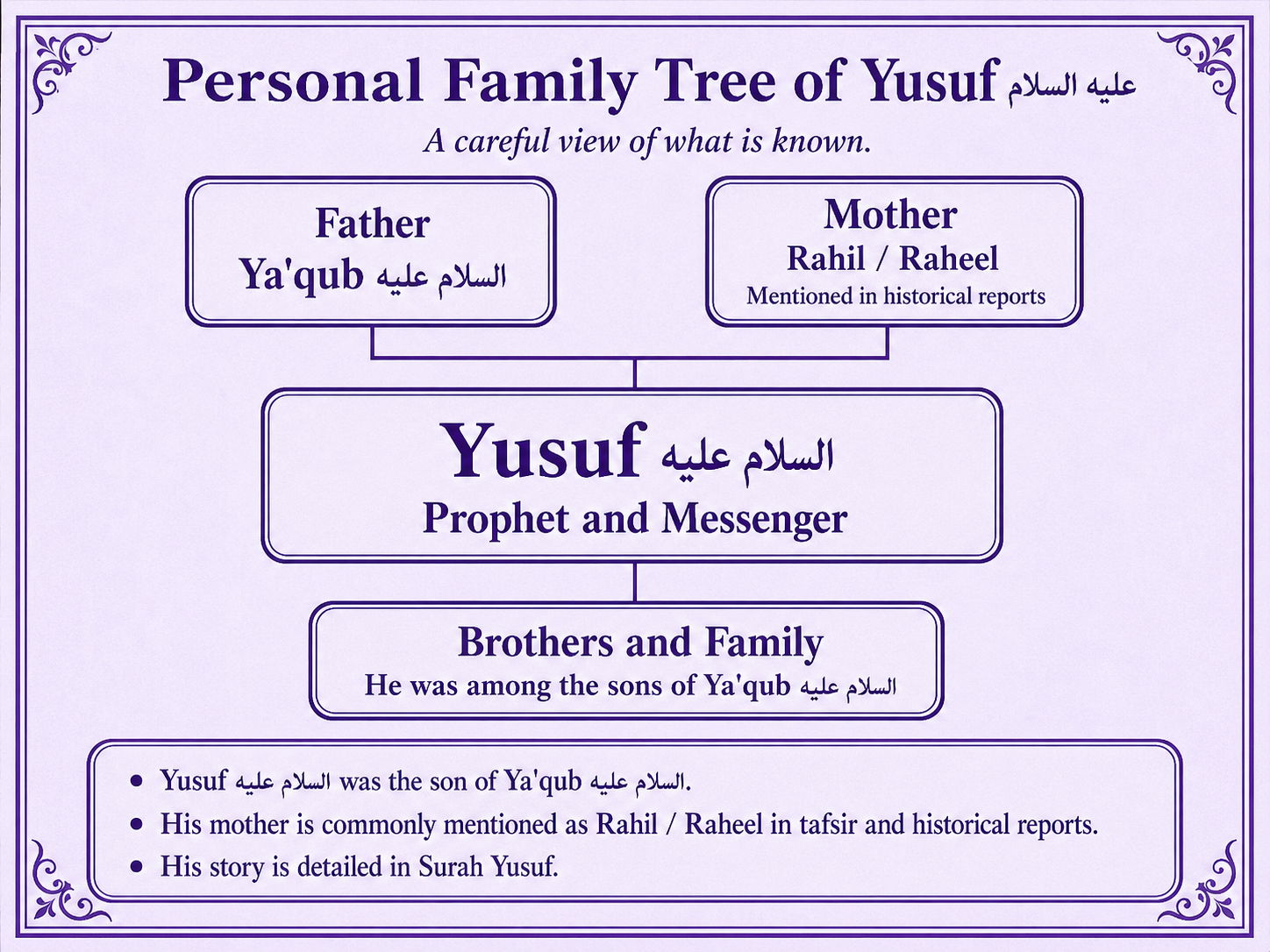
- Use for: Ya'qub عليه السلام → Yusuf عليه السلام and his brothers.
- Confirmed: Yusuf عليه السلام was the son of Ya'qub عليه السلام, and the Qur’an mentions his brothers in the story.
- Keep careful: do not add mother’s name, wife’s name, children’s names, exact ages, or grave details as Qur’an-confirmed facts.
Prophetic Lineage
This visual should show the broader Prophetic lineage context without claiming every missing generation is known.
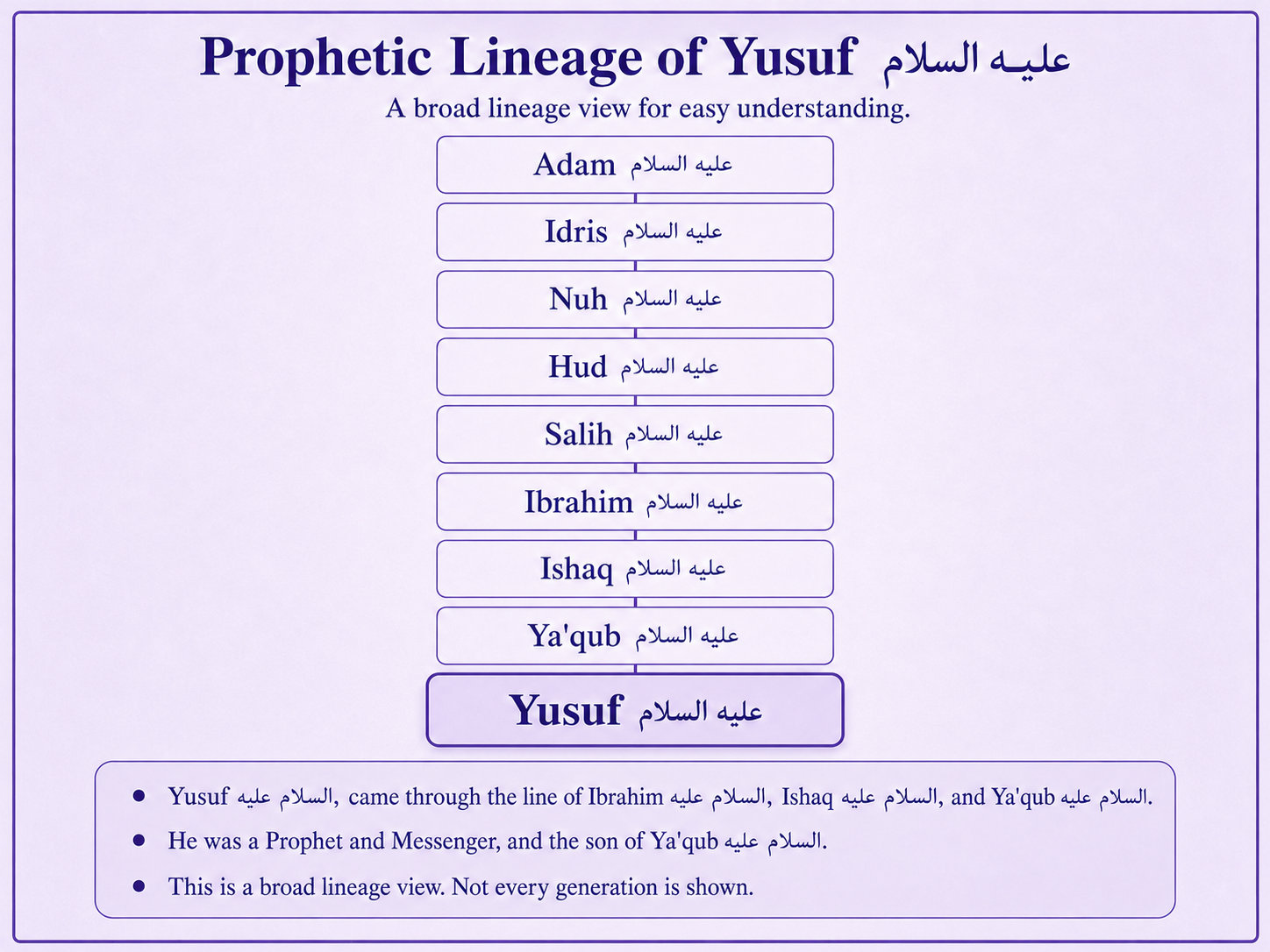
- Use for: Ibrahim عليه السلام → Ishaq عليه السلام → Ya'qub عليه السلام → Yusuf عليه السلام.
- Purpose: show Yusuf عليه السلام in the noble Prophetic family line mentioned in Surah Yusuf.
- Do not invent: exact intermediate generations or extra family details not confirmed in Qur’an and authentic reports.
Why Surah Yusuf is called the best of stories
Allah introduces the story of Yusuf عليه السلام as the best of stories. It is one complete story, moving from childhood pain to public honour, with Allah’s plan quietly connecting every scene.
The story has family jealousy, betrayal, false accusation, beauty, temptation, prison, dreams, economics, political responsibility, forgiveness, and reunion. But beneath all of it is one truth: Allah is in control even when people think they have hidden Yusuf عليه السلام in a well.
Every object returns with meaning: the dream, the shirt, the well, the prison door, the king’s dream, the cup, and the throne. Nothing is wasted when Allah writes the ending.
The best of stories
نَحْنُ نَقُصُّ عَلَيْكَ أَحْسَنَ الْقَصَصِ
Nahnu naqussu 'alayka ahsanal-qasas.
We relate to you the best of stories. Source: Quran 12:3, relevant part.
The dream that held the whole story
Yusuf عليه السلام told his father that he saw eleven stars, the sun, and the moon prostrating to him. Ya'qub عليه السلام understood that this dream carried a future from Allah. He told Yusuf عليه السلام not to tell it to his brothers because Shaytan could push them toward a plan.
Ya'qub عليه السلام also told him that Allah would choose him, teach him the interpretation of events, and complete His favour upon him and the family of Ya'qub عليه السلام.
The dream appears at the beginning, but its fulfilment comes after years of pain. Allah sometimes shows the beginning of a promise long before the road toward it becomes clear.
Eleven stars, the sun, and the moon
إِنِّي رَأَيْتُ أَحَدَ عَشَرَ كَوْكَبًا وَالشَّمْسَ وَالْقَمَرَ رَأَيْتُهُمْ لِي سَاجِدِينَ
Inni ra'aytu ahada 'ashara kawkaban wash-shamsa wal-qamara ra'aytuhum li sajidin.
I saw eleven stars, the sun, and the moon. I saw them prostrating to me. Source: Quran 12:4.
Do not tell the dream
Ya'qub عليه السلام told Yusuf عليه السلام not to tell his vision to his brothers, so they would not plot against him. Source: Quran 12:5, meaning summarized.
Not every blessing should be announced before its time. Wisdom protects what envy may try to harm.
Jealousy enters the home
Yusuf’s brothers felt that their father loved Yusuf and his brother more. Instead of fighting their jealousy, they fed it.
They discussed killing Yusuf عليه السلام or throwing him into some land so their father’s attention would be only for them. One of them suggested not killing him but placing him in the bottom of a well, where a passing caravan might pick him up.
They asked Ya'qub عليه السلام to send Yusuf with them. He feared a wolf might eat him while they were unaware. They promised protection. Then they took Yusuf عليه السلام and placed him in the well.
Allah revealed to Yusuf عليه السلام that one day he would tell them about what they had done while they did not realise. The well looked like an ending, but Allah had already placed a future inside it.
Kill Yusuf or throw him away
They said to kill Yusuf or cast him into another land so their father’s attention would be for them. Source: Quran 12:9, meaning summarized.
Jealousy can make a person think another person’s removal will cure the heart. It only makes the disease darker.
Place him in the bottom of the well
أَلْقُوهُ فِي غَيَابَتِ الْجُبِّ
Alquhu fi ghayabatil-jubb.
Place him in the hidden depth of the well. Source: Quran 12:10, relevant part.
Allah revealed future relief in the well
Allah revealed to Yusuf عليه السلام that he would one day inform them of this matter while they did not realise. Source: Quran 12:15, meaning summarized.
Ya'qub’s beautiful patience
فَصَبْرٌ جَمِيلٌ ۖ وَاللَّهُ الْمُسْتَعَانُ عَلَىٰ مَا تَصِفُونَ
Fa sabrun jamil. Wallahul-musta'anu 'ala ma tasifun.
So beautiful patience. And Allah is the One sought for help against what you describe. Source: Quran 12:18.
From the well to the house of al-Aziz
A caravan came and sent its water-drawer. He lowered his bucket and found Yusuf عليه السلام. They hid him like merchandise and sold him for a small price.
In Egypt, the man who bought him told his wife to honour his stay. Perhaps he would benefit them, or they might take him as a son. Yusuf عليه السلام entered a new home, far from his father, but not far from Allah’s plan.
When Yusuf عليه السلام reached maturity, Allah gave him judgment and knowledge. His brothers thought they had removed him from favour, but Allah was raising him step by step.
Sold for a small price
They sold Yusuf عليه السلام for a reduced price, a few dirhams, and were uninterested in him. Source: Quran 12:20, meaning summarized.
People may undervalue a person whom Allah has chosen. Their price does not define Allah’s plan.
Honour his stay
The one from Egypt who bought him told his wife to honour his stay, perhaps he would benefit them or they would take him as a son. Source: Quran 12:21, meaning summarized.
Allah gave him wisdom and knowledge
When Yusuf عليه السلام reached maturity, Allah gave him judgment and knowledge. Source: Quran 12:22, meaning summarized.
Who was al-Aziz?
The Qur’an calls him al-Aziz, the Egyptian official who bought Yusuf عليه السلام. Popular names for him or his wife appear in some storybooks, but the Qur’an does not make those names the focus.
The locked doors and the heart that chose Allah
The wife of al-Aziz tried to seduce Yusuf عليه السلام. She locked the doors and called him toward sin.
Yusuf عليه السلام said, “I seek refuge in Allah.” He remembered his Lord, refused betrayal, and ran toward the door. She chased him and tore his shirt from behind.
At the door, they found her husband. She accused Yusuf عليه السلام. A witness from her household gave a sign: if his shirt was torn from the front, she spoke truth; if torn from the back, she lied. The shirt was torn from the back, proving his innocence.
This scene teaches that real beauty is not the face people admire. Real beauty is a heart that fears Allah when sin becomes easy and private.
I seek refuge in Allah
مَعَاذَ اللَّهِ
Ma'adh Allah.
I seek refuge in Allah. Source: Quran 12:23, relevant part.
When temptation comes, say it with the tongue and run with the body: seek refuge in Allah and leave the place of sin.
The shirt was torn from behind
The witness said the shirt would show the truth. When the shirt was seen torn from behind, Yusuf’s innocence was clear. Source: Quran 12:26-28, meaning summarized.
Allah can make a small detail expose a great lie.
The women of the city and the choice of prison
The women of the city began speaking about the wife of al-Aziz. She invited them, prepared a gathering, gave each of them a knife, and told Yusuf عليه السلام to appear before them. When they saw him, they were amazed and cut their hands.
The wife of al-Aziz then admitted this was the one they had blamed her about, and she threatened him with prison if he refused her command.
Yusuf عليه السلام chose Allah over desire, reputation, pressure, and comfort. He said prison was more beloved to him than what they were inviting him to. He asked Allah to turn their plot away from him, because without Allah’s help he feared being inclined toward them.
They cut their hands
When the women saw Yusuf عليه السلام, they were amazed and cut their hands, saying he was not a human being but a noble angel. Source: Quran 12:31, meaning summarized.
Prison is more beloved to me
رَبِّ السِّجْنُ أَحَبُّ إِلَيَّ مِمَّا يَدْعُونَنِي إِلَيْهِ
Rabbis-sijnu ahabbu ilayya mimma yad'unani ilayh.
My Lord, prison is more beloved to me than what they invite me to. Source: Quran 12:33, relevant part.
Turn their plot away from me
وَإِلَّا تَصْرِفْ عَنِّي كَيْدَهُنَّ أَصْبُ إِلَيْهِنَّ
Wa illa tasrif 'anni kaydahunna asbu ilayhinna.
And if You do not turn their plot away from me, I may incline toward them. Source: Quran 12:33, relevant part.
Yusuf عليه السلام did not trust his own strength. He asked Allah to protect his heart.
Allah answered him
Allah responded to Yusuf عليه السلام and turned their plot away from him. Source: Quran 12:34, meaning summarized.
Prison becomes a place of dawah
Yusuf عليه السلام entered prison unjustly, but prison did not imprison his mission.
Two young men entered prison with him. Each saw a dream. Before interpreting their dreams, Yusuf عليه السلام called them to Allah. He told them that many scattered lords are not better than Allah, the One, the Subduer.
He explained that worship belongs to Allah alone and that the religion of tawheed was the way of his fathers Ibrahim, Ishaq, and Ya'qub عليهم السلام. Even in prison, Yusuf عليه السلام carried Prophetic light.
Many lords or Allah, the One?
أَأَرْبَابٌ مُّتَفَرِّقُونَ خَيْرٌ أَمِ اللَّهُ الْوَاحِدُ الْقَهَّارُ
A arbabum-mutafarriquna khayrun amillahu al-wahidul-qahhar?
Are separate lords better, or Allah, the One, the Subduer? Source: Quran 12:39.
Judgment belongs only to Allah
إِنِ الْحُكْمُ إِلَّا لِلَّهِ
Inil-hukmu illa lillah.
Judgment belongs only to Allah. Source: Quran 12:40, relevant part.
The dreams of the prisoners
One prisoner would serve wine to his master, and the other would be crucified with birds eating from his head. Source: Quran 12:36-41, meaning summarized.
He gave tawheed before interpretation
Yusuf عليه السلام did not waste the moment. Before answering their worldly concern, he guided them toward the truth of Allah.
The king’s dream and the plan for famine
The king saw a dream: seven fat cows eaten by seven lean cows, and seven green ears of grain and others dry. The saved prisoner finally remembered Yusuf عليه السلام and came to ask him for interpretation.
Yusuf عليه السلام did not only interpret the dream. He gave a plan: seven years of sowing, storing most of the harvest, then seven hard years that would consume what had been stored, then a year of relief.
His knowledge became a mercy for an entire society. The prison door had not blocked Allah’s plan. It had placed Yusuf عليه السلام exactly where the king’s dream would one day reach him.
The king’s dream
The king saw seven fat cows eaten by seven lean ones, and seven green ears of grain and others dry. Source: Quran 12:43, meaning summarized.
Seven years of planning
Yusuf عليه السلام told them to sow for seven years, leave what they harvested in its ears except a little to eat, then prepare for seven hard years. Source: Quran 12:47-48, meaning summarized.
Tawakkul does not cancel planning. Yusuf عليه السلام used knowledge, storage, and administration to protect people from famine.
He refuses to leave prison until truth is clear
When the king called for Yusuf عليه السلام, Yusuf عليه السلام did not rush out silently.
He asked the messenger to return to the king and ask about the women who cut their hands. He wanted the truth of his case to be known. He had been imprisoned unjustly, and his honour mattered.
The women admitted that they knew no evil against him, and the wife of al-Aziz admitted that she had tried to seduce him and that he was truthful. Yusuf عليه السلام was publicly cleared before he left the prison behind.
Ask about the women
ارْجِعْ إِلَىٰ رَبِّكَ فَاسْأَلْهُ مَا بَالُ النِّسْوَةِ اللَّاتِي قَطَّعْنَ أَيْدِيَهُنَّ
Irji' ila rabbika fas'alhu ma balun-niswatil-lati qatta'na aydiyahunna.
Return to your master and ask him about the women who cut their hands. Source: Quran 12:50, relevant meaning.
The truth became clear
The women said they knew no evil against Yusuf عليه السلام, and the wife of al-Aziz admitted that she had sought to seduce him and that he was truthful. Source: Quran 12:51, meaning summarized.
From prisoner to treasurer
The king recognised Yusuf’s rank and brought him close. Yusuf عليه السلام asked to be placed over the storehouses of the land because he was trustworthy and knowledgeable.
This was not love of status. It was responsibility during a crisis. Yusuf عليه السلام had the knowledge needed to protect people from famine, and he placed his ability in the service of public good.
Allah had taken him from the well to the palace, from false accusation to public innocence, from prison to authority. The plan was never broken.
Trustworthy and knowledgeable
اجْعَلْنِي عَلَىٰ خَزَائِنِ الْأَرْضِ ۖ إِنِّي حَفِيظٌ عَلِيمٌ
Ij'alni 'ala khaza'inil-ard. Inni hafizun 'alim.
Place me over the storehouses of the land. Indeed, I am a knowing guardian. Source: Quran 12:55.
A capable believer may ask for a role when the need is real and the intention is service, not ego.
The brothers come to Egypt
The famine brought Yusuf’s brothers to Egypt seeking food. They entered upon him, and he recognised them, but they did not recognise him.
Yusuf عليه السلام treated them with measure and planning. He asked them to bring their brother from their father. He returned their goods in their saddlebags so they would come back.
When they returned with Binyamin, Yusuf عليه السلام took his brother aside and told him that he was his brother, and that he should not grieve over what they had done.
He recognised them
Yusuf’s brothers came and entered upon him. He recognised them, but they did not recognise him. Source: Quran 12:58, meaning summarized.
I am your brother
When Yusuf عليه السلام took his brother to himself, he told him: I am your brother, so do not grieve over what they used to do. Source: Quran 12:69, meaning summarized.
The cup in the saddlebag
Yusuf عليه السلام placed the king’s drinking cup in his brother’s saddlebag. Then a caller announced that the caravan was guilty of theft. The brothers denied stealing.
According to their own law, the one in whose bag the cup was found would be kept as recompense. The cup was found in Binyamin’s bag, so Yusuf عليه السلام kept him by Allah’s plan.
The Qur’an says Allah planned for Yusuf عليه السلام. He could not have taken his brother under the king’s law unless Allah willed. This was not injustice. It was a lawful plan by which Allah brought the family story toward its ending.
Allah planned for Yusuf عليه السلام
كَذَٰلِكَ كِدْنَا لِيُوسُفَ
Kadhalika kidna li Yusuf.
Thus did We plan for Yusuf. Source: Quran 12:76, relevant part.
Allah forbid that we take anyone except the one with whom we found our property
مَعَاذَ اللَّهِ أَن نَّأْخُذَ إِلَّا مَن وَجَدْنَا مَتَاعَنَا عِندَهُ
Ma'adhallahi an na'khudha illa man wajadna mata'ana 'indah.
Allah forbid that we take anyone except the one with whom we found our property. Source: Quran 12:79, relevant meaning.
Do you know what you did to Yusuf?
The brothers returned again, poor and desperate. They asked for full measure and charity. Then Yusuf عليه السلام asked the question that opened the locked past: did they know what they did to Yusuf and his brother when they were ignorant?
They realised the truth: “Are you indeed Yusuf?” He answered: “I am Yusuf, and this is my brother.” Then he gave the meaning of the whole story: whoever fears Allah and is patient, Allah does not allow the reward of the good-doers to be lost.
The brothers admitted that Allah had favoured Yusuf عليه السلام over them and that they had been sinners. Yusuf عليه السلام forgave them with words that still soften hearts: “No blame upon you today. May Allah forgive you.”
I am Yusuf
أَنَا يُوسُفُ وَهَٰذَا أَخِي
Ana Yusuf wa hadha akhi.
I am Yusuf, and this is my brother. Source: Quran 12:90, relevant part.
Allah does not waste the reward
إِنَّهُ مَن يَتَّقِ وَيَصْبِرْ فَإِنَّ اللَّهَ لَا يُضِيعُ أَجْرَ الْمُحْسِنِينَ
Innahu man yattaqi wa yasbir fa innallaha la yudi'u ajral-muhsinin.
Indeed, whoever fears Allah and is patient, Allah does not allow the reward of the good-doers to be lost. Source: Quran 12:90, relevant meaning.
No blame upon you today
لَا تَثْرِيبَ عَلَيْكُمُ الْيَوْمَ ۖ يَغْفِرُ اللَّهُ لَكُمْ
La tathriba 'alaykumul-yawm. Yaghfirullahu lakum.
No blame upon you today. May Allah forgive you. Source: Quran 12:92, relevant meaning.
Power did not make him cruel
Yusuf عليه السلام had authority over the same brothers who had thrown him into the well. He chose forgiveness, not revenge.
The shirt returns to Ya'qub عليه السلام
Yusuf عليه السلام sent his shirt with his brothers and told them to place it over his father’s face. Before the caravan arrived, Ya'qub عليه السلام said he could smell the scent of Yusuf عليه السلام.
When the bearer of good news came and placed the shirt over Ya'qub’s face, his sight returned. The brothers asked their father to seek forgiveness for them, and Ya'qub عليه السلام promised to do so.
The shirt appears at the beginning with false blood and returns at the end with healing. Allah can take the object of pain and make it a sign of relief.
Place my shirt over my father’s face
Yusuf عليه السلام told them to take his shirt and place it over his father’s face, and he would regain sight. Source: Quran 12:93, meaning summarized.
I smell Yusuf
إِنِّي لَأَجِدُ رِيحَ يُوسُفَ
Inni la ajidu riha Yusuf.
Indeed, I find the scent of Yusuf. Source: Quran 12:94, relevant part.
Ya'qub عليه السلام seeks forgiveness for them
سَوْفَ أَسْتَغْفِرُ لَكُمْ رَبِّي
Sawfa astaghfiru lakum rabbi.
I will ask forgiveness for you from my Lord. Source: Quran 12:98, relevant part.
The same family is healed
The brothers sinned, Ya'qub عليه السلام grieved, Yusuf عليه السلام suffered, and Allah brought them back through repentance, forgiveness, and truth.
The dream fulfilled in Egypt
Yusuf عليه السلام received his parents and said, “Enter Egypt, if Allah wills, safe.” He raised his parents upon the throne, and the family fell in prostration before him. Yusuf عليه السلام said this was the interpretation of his old dream.
The prostration was not worship of Yusuf عليه السلام. It was a form of honour allowed in earlier law. In Islam, prostration is worship and belongs to Allah alone.
Then Yusuf عليه السلام remembered the whole journey: Allah had been good to him when He brought him out of prison and brought his family from the desert after Shaytan had stirred between him and his brothers.
Enter Egypt safely
ادْخُلُوا مِصْرَ إِن شَاءَ اللَّهُ آمِنِينَ
Udkhulu Misra in sha Allahu aminin.
Enter Egypt, if Allah wills, safe. Source: Quran 12:99, relevant meaning.
The old dream came true
Yusuf عليه السلام raised his parents upon the throne, and the family fell in prostration before him. He said this was the interpretation of his dream from before. Source: Quran 12:100, meaning summarized.
Duas and powerful words of Yusuf عليه السلام
مَعَاذَ اللَّهِ
Ma'adh Allah.
I seek refuge in Allah. Source: Quran 12:23.
رَبِّ السِّجْنُ أَحَبُّ إِلَيَّ مِمَّا يَدْعُونَنِي إِلَيْهِ
Rabbis-sijnu ahabbu ilayya mimma yad'unani ilayh.
My Lord, prison is more beloved to me than what they invite me to. Source: Quran 12:33, relevant part.
وَإِلَّا تَصْرِفْ عَنِّي كَيْدَهُنَّ أَصْبُ إِلَيْهِنَّ
Wa illa tasrif 'anni kaydahunna asbu ilayhinna.
If You do not turn their plot away from me, I may incline toward them. Source: Quran 12:33, relevant part.
إِنَّهُ مَن يَتَّقِ وَيَصْبِرْ فَإِنَّ اللَّهَ لَا يُضِيعُ أَجْرَ الْمُحْسِنِينَ
Innahu man yattaqi wa yasbir fa innallaha la yudi'u ajral-muhsinin.
Whoever fears Allah and is patient, Allah does not allow the reward of the good-doers to be lost. Source: Quran 12:90.
لَا تَثْرِيبَ عَلَيْكُمُ الْيَوْمَ ۖ يَغْفِرُ اللَّهُ لَكُمْ
La tathriba 'alaykumul-yawm. Yaghfirullahu lakum.
No blame upon you today. May Allah forgive you. Source: Quran 12:92, relevant meaning.
تَوَفَّنِي مُسْلِمًا وَأَلْحِقْنِي بِالصَّالِحِينَ
Tawaffani musliman wa alhiqni bis-salihin.
Cause me to die as a Muslim and join me with the righteous. Source: Quran 12:101, relevant part.
The ending is not power, but surrender
At the end of the story, Yusuf عليه السلام is not drunk on success. He turns to Allah.
He says Allah gave him authority and taught him interpretation. Then he calls Allah the Creator of the heavens and earth, his Protector in this world and the Hereafter. His final request is not for more power, palace, or praise. He asks to die as a Muslim and be joined with the righteous.
This is the crown of the story. After the dream, the well, slavery, temptation, prison, authority, and reunion, Yusuf عليه السلام wants the ending that matters: Islam until death and companionship with the righteous.
You are my Protector in this world and the Hereafter
فَاطِرَ السَّمَاوَاتِ وَالْأَرْضِ أَنتَ وَلِيِّي فِي الدُّنْيَا وَالْآخِرَةِ
Fatiras-samawati wal-ardi anta waliyyi fid-dunya wal-akhirah.
Creator of the heavens and the earth, You are my Protector in this world and the Hereafter. Source: Quran 12:101, relevant part.
Common questions about Yusuf عليه السلام
These points are often mixed with storybook details, so they need clean wording.
Do we know the names of the brothers from the Qur’an?
The Qur’an mentions Yusuf’s brothers but does not list all of their names in Surah Yusuf. Names may appear in historical discussions, but should not be presented as Qur’anic wording.
Do we know the name of the wife of al-Aziz?
Many people call her Zulaikha, but the Qur’an does not name her. The page should say the wife of al-Aziz, following Qur’anic wording.
Was Yusuf عليه السلام given great beauty?
Yes, the Qur’an shows the women’s amazement, and authentic hadith mention that Yusuf عليه السلام was given a great share of beauty. His beauty was a test, and his taqwa was greater.
Why did he stay in prison after innocence was clear?
Allah’s plan unfolded through prison. Yusuf عليه السلام interpreted dreams there, gave dawah, and later the king’s dream became the path to public innocence and authority.
Did his family worship him?
No. Their prostration was not worship. It was an honouring gesture allowed in earlier law. Worshipful prostration is only for Allah.
Do we know his grave?
There are historical claims about the grave of Yusuf عليه السلام, but the exact grave location is not established from the Qur’an or authentic hadith. It should not be taught as required belief.
Allah’s plan can begin in a well
The brothers thought they buried Yusuf’s future, but Allah used the well as the first step toward Egypt.
Run from sin
Yusuf عليه السلام did not discuss temptation with comfort. He sought refuge in Allah and ran to the door.
Ask Allah to protect your heart
Yusuf عليه السلام knew that protection from temptation is from Allah, not self-confidence.
Use hardship for dawah
Prison became a place where Yusuf عليه السلام taught tawheed.
Power should serve people
Yusuf عليه السلام used authority to protect society from famine.
Forgiveness is stronger than revenge
He forgave the brothers who had thrown him into the well.
Common mistakes about this story
- Naming people as Qur’an fact: the Qur’an does not name the wife of al-Aziz or all the brothers.
- Making beauty the main lesson: Yusuf’s taqwa is greater than his beauty.
- Thinking prison was failure: prison became part of Allah’s route to authority.
- Forgetting his dawah: Yusuf عليه السلام called to tawheed before interpreting prison dreams.
- Misreading the prostration: his family did not worship him.
- Teaching exact dates and grave claims: these are not established from Qur’an or authentic hadith.
The whole story in eight lines
- Yusuf عليه السلام saw a dream that pointed to future honour.
- His brothers became jealous and threw him into the well.
- He was taken to Egypt, sold, and raised in the house of al-Aziz.
- He refused temptation and chose prison over sin.
- In prison he gave dawah and interpreted dreams.
- The king’s dream led to Yusuf’s public innocence and authority.
- His brothers returned, he forgave them, and his father’s sight was restored.
- The family reunited in Egypt, the dream was fulfilled, and Yusuf عليه السلام ended with dua.
Main references used
- Qur’an: The full story of Yusuf عليه السلام is in Surah Yusuf: Quran 12:1-111.
- Qur’an: Best of stories: Quran 12:3.
- Qur’an: Dream and Ya'qub’s advice: Quran 12:4-6.
- Qur’an: Brothers’ plot, well, false blood, and beautiful patience: Quran 12:7-18.
- Qur’an: Egypt, al-Aziz, temptation, shirt evidence, women, and prison: Quran 12:19-35.
- Qur’an: Prison dawah and dream interpretation: Quran 12:36-42.
- Qur’an: King’s dream, public innocence, and authority: Quran 12:43-57.
- Qur’an: Brothers return, Binyamin, revelation, forgiveness, shirt, reunion, and final dua: Quran 12:58-101.
- Hadith: Yusuf عليه السلام described as noble son of noble son of noble son of noble is reported in Sahih al-Bukhari, meaning summarized.
- Extra details: Exact date, death age, grave location, names of all brothers, and the name of al-Aziz’s wife are not established as Qur’anic facts.
Yusuf عليه السلام teaches that Allah never loses the thread
The brothers saw a well. Allah saw Egypt. The wife of al-Aziz saw temptation. Allah saw purity. The prison looked like delay. Allah made it a doorway. The shirt first carried a lie, then returned with healing. Yusuf عليه السلام walked through betrayal, slavery, temptation, prison, and power, yet his heart stayed with Allah. His final dua shows the real ending: to die as a Muslim and be joined with the righteous.