

Story of Salih عليه السلام
The Prophet sent to Thamud, a people who carved homes into mountains and felt safe inside stone. Salih عليه السلام called them to Allah, and Allah sent the she-camel as a clear sign. They touched the sign with arrogance, and the mountain homes could not protect them from a cry that shook their world.
The journey of Salih عليه السلام
A clear path through Thamud, their mountain homes, the she-camel, the crime, the warning, and the punishment.
Thamud come after ‘Ad
Allah made them successors after ‘Ad and gave them homes, skill, strength, and land.
They carve homes into mountains
Their stone dwellings made them feel secure, but carved rock cannot protect a heart from disbelief.
Allah sends Salih عليه السلام
He calls them to worship Allah alone and reminds them of the blessings around them.
The she-camel comes as a sign
They are told to leave her to graze and not harm her.
The water is shared by command
The Qur’an mentions a divided drinking share: a day for the she-camel and a day for them.
They kill the she-camel
A wretched man moves against her, and the people approve the crime.
Three days remain
Salih عليه السلام tells them to enjoy themselves in their homes for three days before the punishment comes.
The cry and quake strike
The punishment overtakes them, and they fall lifeless in their homes.
Time and place
The Qur’an gives Salih’s people and place clearly, while exact calendar dates are not given.
Exact year is not given
No confirmed birth year, death year, age, or BC/CE date of Salih عليه السلام is given in the Qur’an or authentic hadith. He belongs to the ancient Prophetic period after Hud عليه السلام and the people of ‘Ad.
After ‘Ad
Salih عليه السلام reminded Thamud that Allah made them successors after ‘Ad. This places them after the people of Hud عليه السلام in the Qur’anic story flow.
Thamud after ‘Ad: Quran 7:74.
Al-Hijr
The Qur’an mentions the people of al-Hijr and connects them to carving secure homes from mountains. This is commonly associated with the area known as al-Hijr or Mada’in Salih in northwestern Arabia, but the lesson is not tourism. The lesson is that stone could not save them from Allah.
The people of al-Hijr and their mountain homes are mentioned in Quran 15:80-84.
Family Tree / Lineage
Personal Family Tree
This visual should show only the reliable close family details connected to Salih عليه السلام.
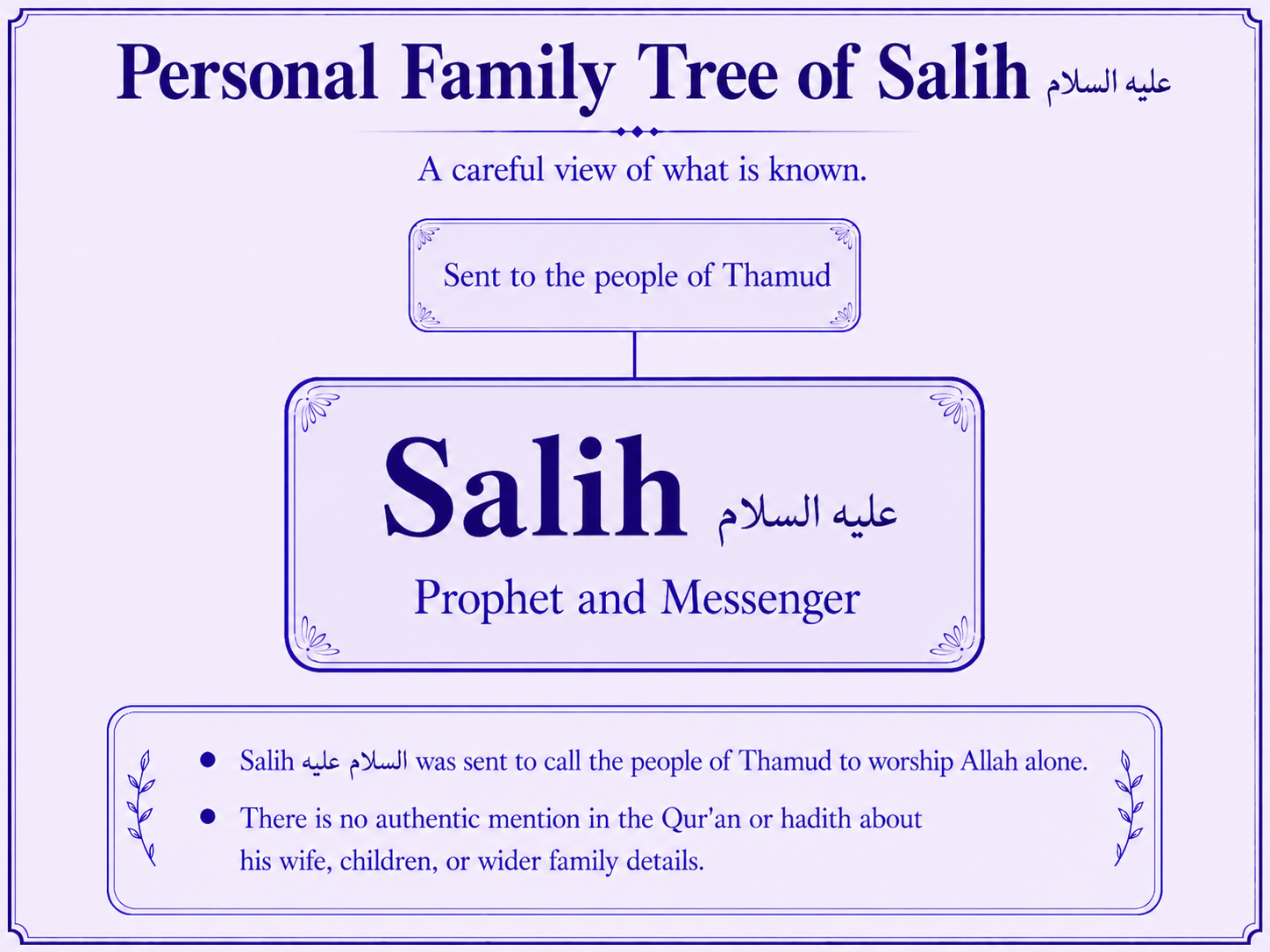
- Use for: Salih عليه السلام only, unless reliable close family details are added later.
- Not confirmed: parents, mother’s name, spouse, children, exact tribal chain, and grave location are not named in the Qur’an.
- Keep simple: the image can clearly state that personal family details are not confirmed.
Prophetic Lineage
This visual should show the broader Prophetic lineage context without claiming every missing generation is known.

- Use for: Adam عليه السلام → Nuh عليه السلام → early nations after Nuh → Salih عليه السلام and the people of Thamud.
- Purpose: show Salih عليه السلام as a Prophet sent to Thamud after the time of Nuh عليه السلام.
- Do not invent: exact intermediate generations or detailed ancestry not confirmed in the Qur’an or authentic hadith.
The people who felt safe inside stone
After the people of ‘Ad came Thamud. They were not a helpless people. Allah gave them skill, land, homes, and the ability to carve into mountains.
They built in the plains and cut houses from the mountains with confidence. Their homes looked firm. Their surroundings looked controlled. Their hands could shape stone, and that skill became a reason for pride instead of gratitude.
But a mountain home can hide a body, not a soul. It can block heat, wind, and enemies, but it cannot block Allah’s command. Thamud lived inside carved rock, yet their hearts became softer toward idols than toward the Lord who gave them rock, hands, minds, water, and life.
Into that nation Allah sent their brother Salih عليه السلام.
Thamud carved homes from mountains
وَتَنْحِتُونَ مِنَ الْجِبَالِ بُيُوتًا فَارِهِينَ
Wa tanhituna minal-jibali buyutan farihin.
And you carve from the mountains, homes, with skill and pride. Source: Quran 26:149, meaning.
Skill is a blessing, but when skill becomes pride, the same achievement becomes a witness against the person.
They felt secure
The people of al-Hijr carved homes from the mountains, feeling secure. Source: Quran 15:82, meaning summarized.
False security is one of the traps of dunya. A person may feel protected by money, walls, status, or land, while forgetting Allah.
Salih عليه السلام calls them to worship Allah alone
Salih عليه السلام came from among them. He was their brother, not a stranger trying to humiliate them. He reminded them that Allah created them from the earth and settled them in it. Their land, homes, water, strength, and skill were not self-made gods. They were gifts from Allah.
His message was clear: worship Allah alone, seek forgiveness, and repent to Him. He did not ask them for wages. He did not want their throne, their carved homes, or their applause. He wanted them to wake up before the stone around them became a grave of warning.
The people remembered that Salih عليه السلام had once been someone they expected good from. Then when he called them away from the worship of their fathers, they acted as if truth itself had become strange.
Worship Allah alone
يَا قَوْمِ اعْبُدُوا اللَّهَ مَا لَكُم مِّنْ إِلَٰهٍ غَيْرُهُ
Ya qawmi'budullaha ma lakum min ilahin ghayruh.
O my people, worship Allah; you have no deity other than Him. Source: Quran 7:73 and Quran 11:61, relevant meaning.
The first message was not architecture, politics, or wealth. It was tawheed: worship Allah alone.
Seek forgiveness and repent
فَاسْتَغْفِرُوهُ ثُمَّ تُوبُوا إِلَيْهِ
Fastaghfiruhu thumma tubu ilayh.
So seek His forgiveness, then repent to Him. Source: Quran 11:61, relevant part.
A person may have built a strong life outside, but still needs forgiveness inside. Repentance is returning to the Owner of life.
They knew him before the message
They said: O Salih, you were among us someone hoped for before this. Source: Quran 11:62, meaning summarized.
People may praise you until you tell them the truth they do not want to hear. Then praise can turn into suspicion.
Salih or Saleh?
The Arabic name is صالح. For this website we use Salih عليه السلام as the simple transliteration. Some people write Saleh in English, but Salih is closer for our page style and slugs.
The she-camel of Allah
Allah gave Thamud a visible sign: the she-camel.
Salih عليه السلام told them this was the she-camel of Allah, a sign for them. They were commanded to let her eat in Allah’s land and not harm her. The Qur’an also mentions a drinking share: the she-camel had her appointed day for water, and they had theirs.
This sign tested more than their eyes. It tested obedience. Would they accept Allah’s boundary when it entered their daily life, their water, their routine, and their pride?
Some stories mention that the she-camel came out from a rock after they demanded a miracle. The Qur’an confirms that she was a clear sign, but the exact dramatic scene of her emergence is not stated in the Qur’an. The public lesson should remain where the Qur’an places it: Allah gave them a sign, they were ordered not to harm it, and they violated the command.
A clear sign from Allah
هَٰذِهِ نَاقَةُ اللَّهِ لَكُمْ آيَةً
Hadhihi naqatullahi lakum ayah.
This is the she-camel of Allah, a sign for you. Source: Quran 7:73, relevant part.
A sign from Allah is not entertainment. It brings responsibility. Seeing truth and then rejecting it is heavier than ignorance.
Do not harm her
فَذَرُوهَا تَأْكُلْ فِي أَرْضِ اللَّهِ وَلَا تَمَسُّوهَا بِسُوءٍ
Fadharuha ta'kul fi ardillahi wa la tamassuha bisu'.
So leave her to eat in Allah’s land and do not touch her with harm. Source: Quran 7:73, relevant part.
A day for her and a day for them
لَّهَا شِرْبٌ وَلَكُمْ شِرْبُ يَوْمٍ مَّعْلُومٍ
Laha shirbun wa lakum shirbu yawmin ma'lum.
For her is a share of drink, and for you is a share of drink on a known day. Source: Quran 26:155.
Did the she-camel come out of a rock?
This detail is famous in many storybooks and tafsir discussions, but it is not stated clearly in the Qur’an. The Qur’an confirms the she-camel as Allah’s sign and focuses on their duty not to harm her.
The day they attacked the sign
Thamud did not merely ignore a lecture. They attacked a sign of Allah. The Qur’an describes a most wretched person rising against the she-camel, and it also describes the people as denying and hamstringing her. This shows that even if one man directly carried out the act, the society shared guilt through approval, support, and rebellion.
Sin becomes darker when a community cheers for it. One hand may strike, but many hearts may be guilty when they wanted, approved, planned, or celebrated the strike.
Salih عليه السلام had warned them not to harm the she-camel. But arrogance does not like boundaries. They killed her, then acted bold before the punishment, telling Salih عليه السلام to bring what he had threatened if he was truly among the Messengers.
The most wretched rose against her
إِذِ انبَعَثَ أَشْقَاهَا
Idhinba'atha ashqaha.
When the most wretched of them rose up. Source: Quran 91:12.
They hamstrung the she-camel
فَعَقَرُوا النَّاقَةَ وَعَتَوْا عَنْ أَمْرِ رَبِّهِمْ
Fa'aqarun-naqata wa 'ataw 'an amri rabbihim.
So they hamstrung the she-camel and were insolent toward the command of their Lord. Source: Quran 7:77, relevant part.
One killer, shared guilt
The Qur’an mentions the most wretched person rising against her, and also speaks of the people collectively rejecting and hamstringing. Sources: Quran 91:12-14, Quran 7:77, Quran 26:157.
A society can become guilty by supporting evil, even if one person performs the final act.
Do we know the killer’s name?
Some historical reports mention a name for the man who killed the she-camel, but the Qur’an does not name him. The Qur’an calls him the most wretched of them. That is the label that matters most.
Three days in their homes
After the crime, Salih عليه السلام told them they had three days to enjoy themselves in their homes.
Imagine that: the same homes they carved into mountains, the same rooms they trusted, the same dwellings they thought made them safe. They were given three days inside them. Not three days of victory. Three days of waiting under a promise that would not be false.
The three-day warning
تَمَتَّعُوا فِي دَارِكُمْ ثَلَاثَةَ أَيَّامٍ ۖ ذَٰلِكَ وَعْدٌ غَيْرُ مَكْذُوبٍ
Tamatta'u fi darikum thalathata ayyam. Dhalika wa'dun ghayru makdhub.
Enjoy yourselves in your homes for three days. That is a promise not to be denied. Source: Quran 11:65.
The nine men who spread corruption
The Qur’an also tells us there were nine men in the city who spread corruption and did not reform. They plotted by Allah to attack Salih عليه السلام and his family, then deny responsibility afterward.
This is how corruption often works: a small group plans the evil, a larger society fears or supports them, and truth is treated like the problem. But Allah knew their plan before they whispered it.
Nine men in the city
وَكَانَ فِي الْمَدِينَةِ تِسْعَةُ رَهْطٍ يُفْسِدُونَ فِي الْأَرْضِ وَلَا يُصْلِحُونَ
Wa kana fil-madinati tis'atu rahtin yufsiduna fil-ardi wa la yuslihun.
There were in the city nine men who spread corruption in the land and did not reform. Source: Quran 27:48.
They planned, and Allah planned
وَمَكَرُوا مَكْرًا وَمَكَرْنَا مَكْرًا وَهُمْ لَا يَشْعُرُونَ
Wa makaru makran wa makarna makran wa hum la yash'urun.
They planned a plan, and We planned a plan, while they did not perceive. Source: Quran 27:50.
The cry, the quake, and the empty homes
Then the punishment came. The Qur’an describes it with powerful words: the earthquake seized them, the cry overtook them, and they became lifeless in their homes.
The people who carved homes from mountains could not stand before a sound by Allah’s command. Their dwellings remained, but the people were gone. The stone survived as a warning, while the arrogance inside it collapsed.
Salih عليه السلام turned away from them after conveying the message. His words carry the sadness of a Prophet who wanted good for his people: he had advised them sincerely, but they did not love sincere advisers.
The quake seized them
فَأَخَذَتْهُمُ الرَّجْفَةُ فَأَصْبَحُوا فِي دَارِهِمْ جَاثِمِينَ
Fa akhadhathumur-rajfatu fa asbahu fi darihim jathimin.
So the earthquake seized them, and they became within their home fallen lifeless. Source: Quran 7:78, meaning.
The cry overtook them
The cry seized those who wronged, and they became lifeless in their homes. Source: Quran 11:67, meaning summarized.
A nation that feels safe in stone can be ended by a sound when Allah commands it.
Like dry broken stalks
Allah sent one blast, and they became like dry twigs or broken stalks used by a fence-maker. Source: Quran 54:31, meaning summarized.
Salih عليه السلام had advised them
لَقَدْ أَبْلَغْتُكُمْ رِسَالَةَ رَبِّي وَنَصَحْتُ لَكُمْ
Laqad ablaghtukum risalata rabbi wa nasahtu lakum.
I had certainly conveyed to you the message of my Lord and advised you. Source: Quran 7:79, relevant part.
Visiting the dwellings of Thamud
The Prophet ﷺ taught believers not to treat places of punishment like ordinary sightseeing.
Do not enter except with tears
When the Prophet ﷺ passed by the dwellings of Thamud, he told the companions not to enter upon those who were punished except while weeping, fearing that what struck them could strike others. This teaches that ancient ruins of punished nations are places of reflection, not entertainment.
Reported in Sahih al-Bukhari and Sahih Muslim, meaning summarized.
How to look at ruins
The believer does not look at such places only with a camera. The believer looks with the heart: people lived here, ignored a Prophet, harmed a sign of Allah, and were overtaken. Every stone becomes a quiet warning.
Common questions about Salih عليه السلام and Thamud
Some details are famous, but the Qur’an gives the details needed for guidance.
Did they demand a camel from a rock?
This is widely mentioned in storybooks and tafsir discussions. The Qur’an confirms the she-camel as Allah’s sign, but does not describe the full rock scene in clear detail. So the lesson should not depend on that extra scene.
How many people believed?
The Qur’an says Salih عليه السلام and the believers were saved, but it does not give a confirmed number of believers. The point is not the count. The point is that Allah saved those who believed and feared Him.
Salih عليه السلام and the believers were saved: Quran 11:66 and Quran 27:53.
Do we know the grave of Salih عليه السلام?
No confirmed grave location of Salih عليه السلام is established from the Qur’an or authentic hadith. Local claims should not be presented as Islamic fact.
Is Mada’in Salih the same place?
The area known as al-Hijr or Mada’in Salih is widely connected with the dwellings of Thamud. The Qur’an confirms the people of al-Hijr and their mountain homes. A Muslim should remember the warning of the story and follow the Prophetic adab when passing such places.
Powerful words from the story
يَا قَوْمِ اعْبُدُوا اللَّهَ مَا لَكُم مِّنْ إِلَٰهٍ غَيْرُهُ
Ya qawmi'budullaha ma lakum min ilahin ghayruh.
O my people, worship Allah; you have no deity other than Him. Source: Quran 7:73 and 11:61, relevant meaning.
وَلَا تَمَسُّوهَا بِسُوءٍ
Wa la tamassuha bisu'.
And do not touch her with harm. Source: Quran 7:73, relevant part.
وَلَٰكِن لَّا تُحِبُّونَ النَّاصِحِينَ
Wa lakil-la tuhibbun an-nasihin.
But you do not love sincere advisers. Source: Quran 7:79, relevant part.
Security can become a test
Thamud felt safe inside carved mountains, but no wall protects a person from Allah’s command.
Signs bring responsibility
The she-camel was not entertainment. A sign from Allah demands humility and obedience.
One crime can carry shared guilt
The Qur’an mentions one wretched person, but the people carried guilt because they rejected and approved rebellion.
Do not hate sincere advice
Salih عليه السلام advised them, but they did not love sincere advisers. A proud heart treats advice like an attack.
Small corrupt groups can destroy a society
The nine men spread corruption and did not reform. A society must not let corrupters lead its moral direction.
Allah saves believers by mercy
Salih عليه السلام and the believers were saved, while the mountain homes of the arrogant became a warning.
Common mistakes about this story
- Making the rock scene the main lesson: the Qur’an confirms the she-camel as a sign, but does not make the rock-detail central.
- Trusting exact names without proof: the Qur’an does not name the killer of the she-camel.
- Turning al-Hijr into casual tourism: the Prophet ﷺ taught believers to pass such places with fear and reflection.
- Thinking strong homes mean safety: Thamud carved mountains, but the cry still reached them.
- Ignoring shared guilt: supporting evil can make a community guilty even when one person performs the act.
The whole story in six lines
- Thamud came after ‘Ad and were given skill, land, and mountain homes.
- Allah sent Salih عليه السلام to call them to worship Allah alone.
- Allah gave them the she-camel as a clear sign.
- They were told not to harm her and to respect the water-share.
- They killed the she-camel, plotted evil, and were warned for three days.
- The cry and quake overtook them, while Salih عليه السلام and the believers were saved.
Main references used
- Qur’an: Salih عليه السلام and Thamud: Quran 7:73-79, 11:61-68, 26:141-159, 27:45-53, 54:23-31, 91:11-15.
- Qur’an: Thamud after ‘Ad: Quran 7:74.
- Qur’an: The people of al-Hijr and mountain homes: Quran 15:80-84.
- Qur’an: Three-day warning after killing the she-camel: Quran 11:65.
- Qur’an: Nine corrupt men plotting: Quran 27:48-50.
- Hadith: Prophetic instruction about passing the dwellings of those punished is reported in Sahih al-Bukhari and Sahih Muslim, meaning summarized.
- Dates and extra details: Exact dates, age, grave location, killer’s name, and full rock-emergence scene are not established as clear Qur’an or authentic hadith facts.
Salih عليه السلام teaches that signs are not toys
Thamud had stone homes, strong hands, and a clear sign in front of them. But when pride entered the heart, even a sign from Allah became something they wanted to control, harm, and remove. Salih عليه السلام called them with sincerity, but they chose the road of the she-camel’s killer. The story leaves a warning carved deeper than their mountains: do not feel safe in what you have built if your heart is at war with Allah.