

Story of Hud عليه السلام
The Prophet sent to the people of ‘Ad, a powerful nation that built, boasted, and forgot the One who gave them strength. Hud عليه السلام called them back to Allah, but pride made them ask, “Who is stronger than us?” Then the wind answered by the command of Allah.
The journey of Hud عليه السلام
A clear path through the people of ‘Ad, their strength, their arrogance, Hud’s call, and the wind that ended their pride.
‘Ad rise after the people of Nuh عليه السلام
Allah made them successors after Nuh’s people and gave them strength, bodies, buildings, and worldly power.
They worship besides Allah
Their blessings became a test, and they forgot the Lord who gave them everything.
Allah sends Hud عليه السلام
He calls them to worship Allah alone, seek forgiveness, and return before punishment comes.
The chiefs reject him
They accuse him of foolishness and lies, while Hud عليه السلام answers with calm truth.
They boast about strength
They say, “Who is stronger than us?” but forget that Allah created them.
They see a cloud coming
They think it is rain, but it is the punishment they had rushed to deny.
The wind destroys them
A violent wind is sent for seven nights and eight days, leaving them like hollow palm trunks.
Hud عليه السلام and the believers are saved
Allah saves Hud عليه السلام and those who believed with him by mercy from Him.
Time in history
The Qur’an gives Hud’s position in the Prophetic timeline, but it does not give a BC or CE calendar year.
Exact year is not given
No confirmed birth year, death year, age, or calendar date of Hud عليه السلام is given in the Qur’an or authentic hadith. So the date should be written as: ancient Prophetic period, after Nuh عليه السلام.
After Nuh عليه السلام
Hud عليه السلام was sent to ‘Ad after the people of Nuh عليه السلام. This order is clearly mentioned in the Qur’an when Hud عليه السلام reminds his people that Allah made them successors after Nuh’s people.
‘Ad came after Nuh’s people: Quran 7:69.
Al-Ahqaf
The Qur’an mentions that Hud عليه السلام warned his people at al-Ahqaf, meaning sandy tracts or dunes. Many scholars connect this with southern Arabia, but exact modern borders should not be stated as revelation.
Hud عليه السلام warned his people at al-Ahqaf: Quran 46:21.
Family Tree / Lineage
Personal Family Tree
This visual should show only the reliable close family details connected to Hud عليه السلام.
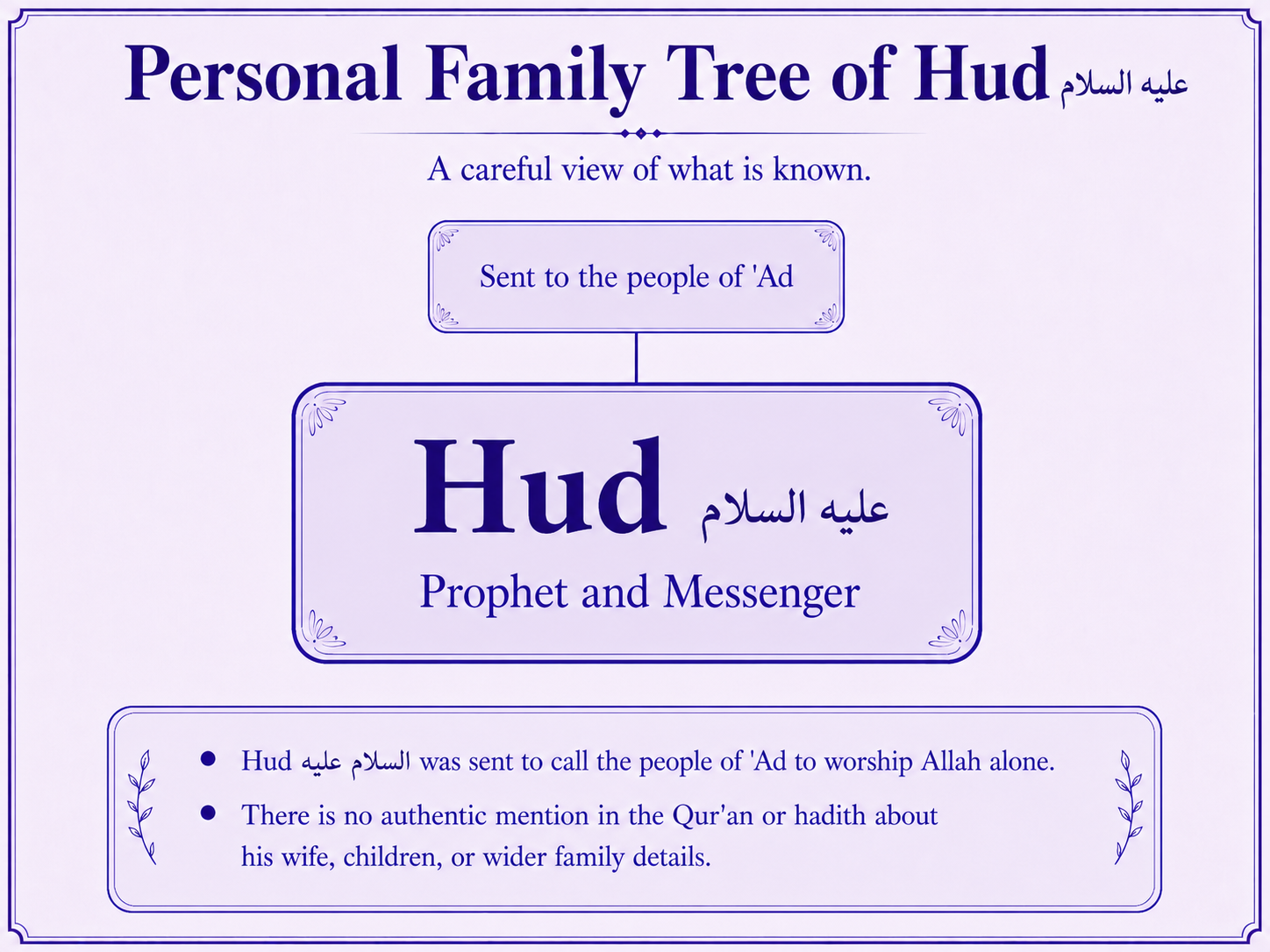
- Use for: Hud عليه السلام only, unless reliable close family details are added later.
- Not confirmed: parents, mother’s name, spouse, children, exact tribal chain, and grave location are not named in the Qur’an.
- Keep simple: the image can clearly state that personal family details are not confirmed.
Prophetic Lineage
This visual should show the broader Prophetic lineage context without claiming every missing generation is known.

- Use for: Adam عليه السلام → Nuh عليه السلام → early nations after Nuh → Hud عليه السلام and the people of ‘Ad.
- Purpose: show Hud عليه السلام as a Prophet sent to ‘Ad after the time of Nuh عليه السلام.
- Do not invent: exact intermediate generations or detailed ancestry not confirmed in the Qur’an or authentic hadith.
Simple timeline placement
Adam عليه السلام → Idris عليه السلام → Nuh عليه السلام → Hud عليه السلام and the people of ‘Ad → Salih عليه السلام and the people of Thamud. This order helps the reader understand the flow, but exact ancient dates are not established.
Do we know the grave of Hud عليه السلام?
There is a well-known local tradition that connects the grave of Hud عليه السلام with Hadramawt in Yemen. But the exact grave location of Hud عليه السلام is not proven from the Qur’an or authentic hadith. A Muslim does not need to believe a specific grave claim to believe in Hud عليه السلام.
The people who inherited the earth and forgot the Giver
After the flood of Nuh عليه السلام, humanity began again. Among the nations that came later were the people of ‘Ad. They were not weak people hiding in the corners of history. They were a nation of power.
Allah gave them strength in their bodies, skill in building, and authority in the land. They carved out a life of height, walls, monuments, and force. Their world looked solid. Their buildings looked permanent. Their bodies looked unbeatable.
But blessings become dangerous when they make a person forget the One who gave them. ‘Ad looked at strength and saw themselves. Hud عليه السلام looked at strength and reminded them of Allah.
Their story is the story of people who had power but lost humility. They could build tall structures, but could not lower their hearts before Allah.
Allah made them successors after Nuh’s people
وَاذْكُرُوا إِذْ جَعَلَكُمْ خُلَفَاءَ مِن بَعْدِ قَوْمِ نُوحٍ وَزَادَكُمْ فِي الْخَلْقِ بَسْطَةً
Wadhkuru idh ja'alakum khulafa'a mim ba'di qawmi Nuhin wa zadakum fil-khalqi bastah.
Remember when He made you successors after the people of Nuh and increased you greatly in stature. Source: Quran 7:69, relevant part.
Strength is not proof that Allah is pleased. Strength is a test. The stronger the blessing, the heavier the accountability.
They built and acted like they would live forever
Hud عليه السلام questioned them for building on every elevation as a sign and taking strongholds as though they would live forever. Source: Quran 26:128-129, meaning summarized.
Buildings are not wrong by themselves. The danger is when construction becomes pride, waste, show, or the illusion that death will never arrive.
Hud عليه السلام calls them back to Allah
Hud عليه السلام did not come as a stranger hungry for power. He came as their brother, from among them, knowing their language, their ways, their arrogance, and their wounds. He called them with the same foundation every Prophet called to: worship Allah alone.
He reminded them that he was not asking for payment. He was not selling religion. He was not building a personal empire. His reward was with Allah. This is the purity of Prophetic da'wah: truth is delivered for Allah, not for applause, money, or status.
He told them to seek forgiveness and repent. If they returned to Allah, Allah would send rain upon them and increase them in strength. But they turned strength into a wall around their hearts. They wanted blessings without surrender.
Worship Allah alone
يَا قَوْمِ اعْبُدُوا اللَّهَ مَا لَكُم مِّنْ إِلَٰهٍ غَيْرُهُ
Ya qawmi'budullaha ma lakum min ilahin ghayruh.
O my people, worship Allah; you have no deity other than Him. Source: Quran 7:65, relevant part.
The first cure for a proud society is tawheed. A heart that knows Allah cannot worship its own strength.
Seek forgiveness and strength will be blessed
وَيَا قَوْمِ اسْتَغْفِرُوا رَبَّكُمْ ثُمَّ تُوبُوا إِلَيْهِ
Wa ya qawmi istaghfiru rabbakum thumma tubu ilayh.
O my people, seek forgiveness from your Lord, then repent to Him. Source: Quran 11:52, relevant part.
Repentance does not weaken a nation. It brings blessing. Sin may decorate power for a while, but repentance protects power from becoming punishment.
Hud عليه السلام asked for no payment
يَا قَوْمِ لَا أَسْأَلُكُمْ عَلَيْهِ أَجْرًا
Ya qawmi la as'alukum 'alayhi ajra.
O my people, I do not ask you for any reward for it. Source: Quran 11:51, relevant part.
Religious advice should not be dismissed by assuming every caller wants worldly gain. Hud عليه السلام wanted their salvation, not their wealth.
Strength needed forgiveness
Hud عليه السلام did not tell a weak nation to become strong. He told a strong nation to repent. Their problem was not lack of power. Their problem was power without humility.
They called guidance foolishness
When arrogance cannot answer truth, it insults the messenger.
The chiefs from the people of ‘Ad told Hud عليه السلام that they saw him in foolishness and thought he was a liar. This is an old weapon of denial: do not answer the message, attack the person carrying it.
Hud عليه السلام did not lose his dignity. He replied that there was no foolishness in him. He was a Messenger from the Lord of the worlds. He was delivering the messages of his Lord and was a trustworthy adviser.
Then they made another claim: perhaps their gods had harmed him. Hud عليه السلام stood firm. He declared himself free from their false gods and placed his trust fully in Allah.
They accused him of foolishness
The chiefs who disbelieved from his people said they saw him in foolishness and thought he was among the liars. Source: Quran 7:66, meaning summarized.
When truth threatens pride, arrogant people often rename wisdom as foolishness.
Hud عليه السلام stood on trust in Allah
إِنِّي تَوَكَّلْتُ عَلَى اللَّهِ رَبِّي وَرَبِّكُم
Inni tawakkaltu 'alallahi rabbi wa rabbikum.
Indeed, I have placed my trust in Allah, my Lord and your Lord. Source: Quran 11:56, relevant part.
True courage is not loudness. Hud عليه السلام stood alone before a powerful nation because his heart leaned on Allah.
“Who is stronger than us?”
The people of ‘Ad were deceived by their bodies and power. They said, “Who is stronger than us?” It is a frightening sentence, because it shows a heart that can see muscle but not the Creator of muscle, buildings but not the Owner of earth, wind but not the Lord of wind.
Allah answered this pride in the Qur’an: did they not see that Allah, who created them, was stronger than them?
Every age has its own version of this sentence. Sometimes it is said by nations, sometimes by rulers, sometimes by businesses, sometimes by families, sometimes by one person in a locked room thinking no one can stop them. The story of ‘Ad tears that illusion apart.
They boasted about strength
مَنْ أَشَدُّ مِنَّا قُوَّةً
Man ashaddu minna quwwah?
Who is stronger than us in power? Source: Quran 41:15, relevant part.
Allah reminds them that He created them and was stronger than them. Source: Quran 41:15, meaning summarized.
They thought the punishment was rain
When the punishment approached, it came in a form they misread.
They saw a cloud heading toward their valleys and said it was bringing rain. A people who had rejected warning now interpreted danger as blessing. What they thought was relief was the very punishment they had challenged.
The Qur’an says it was a wind carrying a painful punishment. It would destroy everything by the command of its Lord. By morning, nothing could be seen except their dwellings.
This is one of the most chilling scenes in the Qur’an: a nation waiting for rain, not realising their arrogance had turned the sky against them.
They saw it as a cloud
When they saw it as a cloud approaching their valleys, they said it was a cloud bringing rain. But it was the punishment they had sought to hasten. Source: Quran 46:24, meaning summarized.
A person can misread Allah’s signs when arrogance blinds the heart. Not every incoming cloud is mercy.
Only their dwellings remained visible
The wind destroyed everything by the command of its Lord, and they became such that nothing was seen except their dwellings. Source: Quran 46:25, meaning summarized.
Buildings can remain after people are gone. A home without obedience can become a museum of warning.
The wind that uprooted pride
Allah sent a furious, violent wind upon ‘Ad. It continued for seven nights and eight days. Their bodies were left like hollow trunks of palm trees. The nation that asked who was stronger than them was thrown down by something they could not hold, punch, bribe, or command.
Wind is invisible to the hand but powerful by Allah’s permission. That is part of the lesson. A person may be destroyed by what they cannot even grip. Strength without Allah is not strength. It is a decorated weakness waiting for command.
Hud عليه السلام and those who believed were saved by mercy from Allah. The same event that was punishment for the arrogant became rescue for the believers.
Seven nights and eight days
سَخَّرَهَا عَلَيْهِمْ سَبْعَ لَيَالٍ وَثَمَانِيَةَ أَيَّامٍ حُسُومًا
Sakhkharaha 'alayhim sab'a layalin wa thamaniyata ayyamin husuma.
He imposed it upon them for seven nights and eight days, continuously. Source: Quran 69:7, relevant part.
Like hollow palm trunks
The people were left as if they were hollow trunks of palm trees. Source: Quran 69:7 and Quran 54:20, meaning summarized.
The Qur’an shows the end of arrogance with an image no heart forgets: bodies that once boasted of strength lying empty and uprooted.
Hud عليه السلام and believers were saved
نَجَّيْنَا هُودًا وَالَّذِينَ آمَنُوا مَعَهُ بِرَحْمَةٍ مِّنَّا
Najjayna Hudan walladhina amanu ma'ahu birahmatim-minna.
We saved Hud and those who believed with him by mercy from Us. Source: Quran 11:58, relevant part.
The believers were not saved by numbers
The Qur’an does not make their rescue about popularity, wealth, or worldly strength. They were saved by Allah’s mercy because they believed and followed the Messenger sent to them.
Common questions about ‘Ad and Hud عليه السلام
Some details are popular, but the Qur’an gives the part that matters for guidance.
Was Iram the city of ‘Ad?
The Qur’an mentions ‘Ad, Iram of the pillars, the like of whom had not been created in the lands. Scholars discuss its meaning and connection to the people of ‘Ad. The Qur’an confirms their greatness and power, but exact maps, ruins, and modern identifications should not be presented as definite unless proven.
Iram of the pillars is mentioned in Quran 89:6-8.
Were the people of ‘Ad giants?
The Qur’an says Allah increased them greatly in stature and describes their bodies after destruction like hollow palm trunks. This confirms unusual strength and stature. Exact measurements, dramatic giant stories, and viral skeleton claims are not proven from the Qur’an or authentic hadith.
Do we know the names of their idols?
The Qur’an tells us that they worshipped besides Allah, but it does not give a famous list of idol names for ‘Ad like it does for the people of Nuh عليه السلام. So their idol names should not be invented or made central.
Who survived from ‘Ad?
The Qur’an says Hud عليه السلام and those who believed with him were saved. It does not give a full list of names or exact number of believers. The lesson is that faith, not tribe or strength, decided who was saved.
Words from the stand of Hud عليه السلام
إِنِّي تَوَكَّلْتُ عَلَى اللَّهِ رَبِّي وَرَبِّكُم
Inni tawakkaltu 'alallahi rabbi wa rabbikum.
Indeed, I have placed my trust in Allah, my Lord and your Lord. Source: Quran 11:56, relevant part.
اسْتَغْفِرُوا رَبَّكُمْ ثُمَّ تُوبُوا إِلَيْهِ
Istaghfiru rabbakum thumma tubu ilayh.
Seek forgiveness from your Lord, then repent to Him. Source: Quran 11:52, relevant part.
Power is a test
‘Ad were strong, but strength without humility became the path to destruction.
Tawheed protects the heart
Hud عليه السلام called them first to worship Allah alone, because shirk corrupts every other blessing.
Arrogance misreads mercy
They saw a cloud and thought rain was coming. A blind heart can mistake punishment for blessing.
Trust in Allah gives courage
Hud عليه السلام stood before a powerful people with calm certainty because his trust was in Allah.
Buildings do not make people permanent
They built as if they would live forever, but the wind left only their dwellings as a warning.
Mercy saves believers
Hud عليه السلام and the believers were saved by Allah’s mercy, not by worldly power.
Common mistakes about this story
- Making exact maps the main issue: the Qur’an mentions al-Ahqaf, but exact modern borders are not the heart of the story.
- Believing giant skeleton images: the Qur’an confirms strength and stature, not viral picture claims.
- Claiming a confirmed grave: Hud’s exact grave is not proven from Qur’an or authentic hadith.
- Thinking buildings are wrong: the problem was arrogance, waste, oppression, and forgetting Allah, not useful construction itself.
- Missing the warning: a nation can be advanced and still ruined if it fights tawheed.
The whole story in six lines
- ‘Ad came after the people of Nuh عليه السلام and were given great strength.
- They worshipped besides Allah and became arrogant with their power.
- Allah sent Hud عليه السلام to call them to tawheed, forgiveness, and repentance.
- The chiefs rejected him, insulted him, and boasted about their strength.
- They saw a cloud and thought rain was coming, but it was punishment.
- Allah destroyed them with a violent wind and saved Hud عليه السلام and the believers.
Main references used
- Qur’an: Hud عليه السلام and the people of ‘Ad: Quran 7:65-72, 11:50-60, 26:123-140, 46:21-26.
- Qur’an: ‘Ad after the people of Nuh and their strength: Quran 7:69.
- Qur’an: Their building and worldly pride: Quran 26:128-130.
- Qur’an: Their boast “Who is stronger than us?”: Quran 41:15.
- Qur’an: The wind punishment: Quran 41:16, 46:24-25, 54:18-22, 69:6-8.
- Qur’an: Iram of the pillars: Quran 89:6-8.
- Dates: No confirmed BC/CE date, birth year, death year, or exact age of Hud عليه السلام is established from the Qur’an or authentic hadith.
- Grave and ruin claims: Exact grave location, exact city ruins, and modern viral claims are not established from the Qur’an or authentic hadith.
Hud عليه السلام teaches that strength must bow
The people of ‘Ad had bodies, buildings, valleys, and confidence. But when strength refused to bow to Allah, Allah sent what they could not fight: wind. Hud عليه السلام stood with tawheed when his people stood with pride. The story leaves a warning in the air: the strongest person is not the one who asks, “Who can defeat me?” The strongest person is the one who lowers their heart before Allah.