

Story of Nuh عليه السلام
The Prophet who called his people to Allah for nine hundred and fifty years, while doors closed, hearts hardened, mockery increased, and only a small group believed. His story is not only about a flood. It is about tawheed, patience, da'wah, family, grief, and the rescue that comes by Allah’s command.
Family Tree / Lineage
Personal Family Tree
This visual should show only the reliable close family details connected to Nuh عليه السلام.
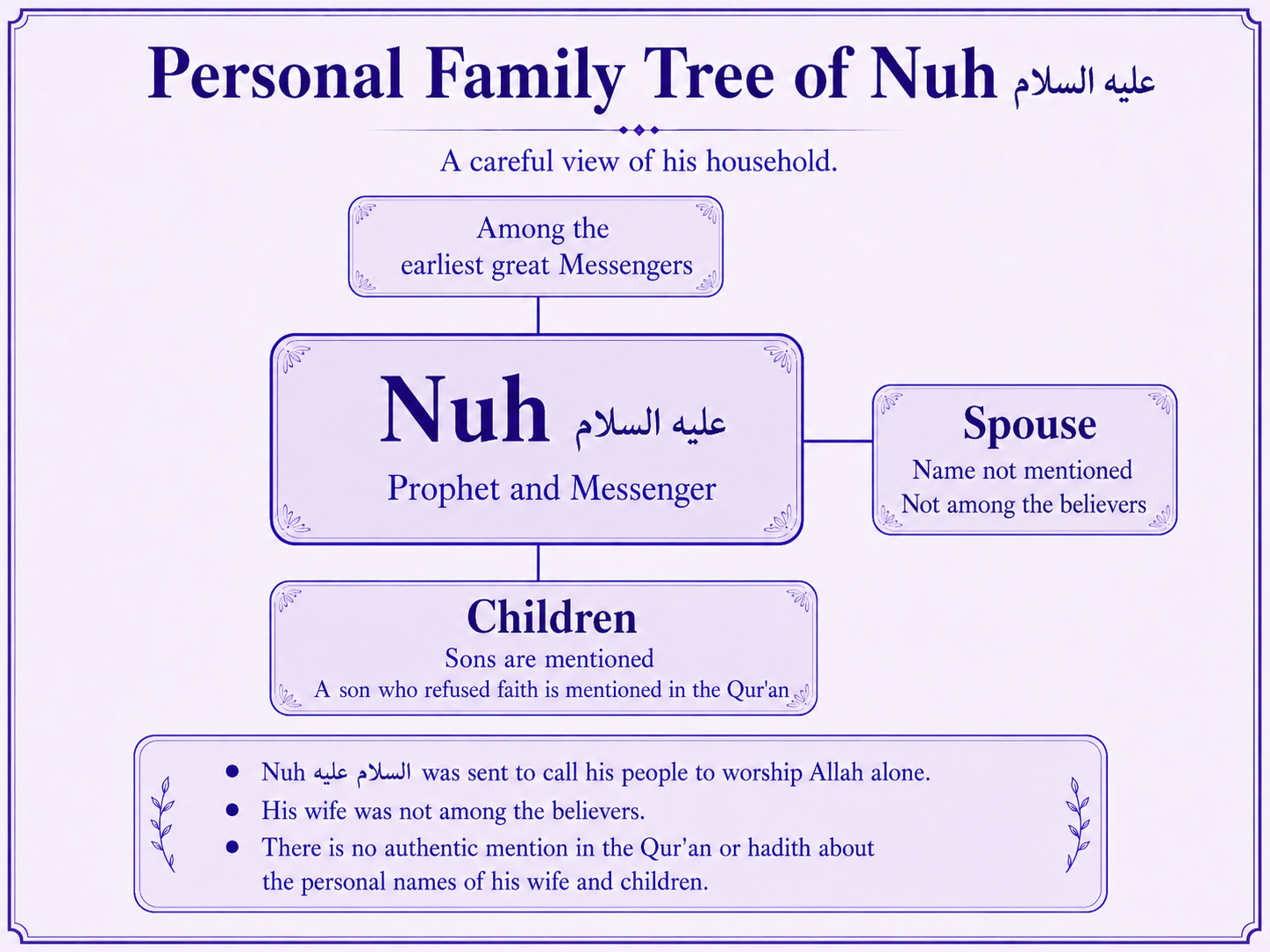
- Use for: Nuh عليه السلام, his wife, his son who refused to board the Ark, and the believing family saved with him.
- Confirmed: the Qur’an mentions his wife as an example of disbelief and mentions his son who was not saved.
- Keep careful: do not add wife’s name, son’s name, number of children, exact descendants, or grave location as Qur’an-confirmed facts.
Prophetic Lineage
This visual should show the broader Prophetic lineage context without claiming every missing generation is known.
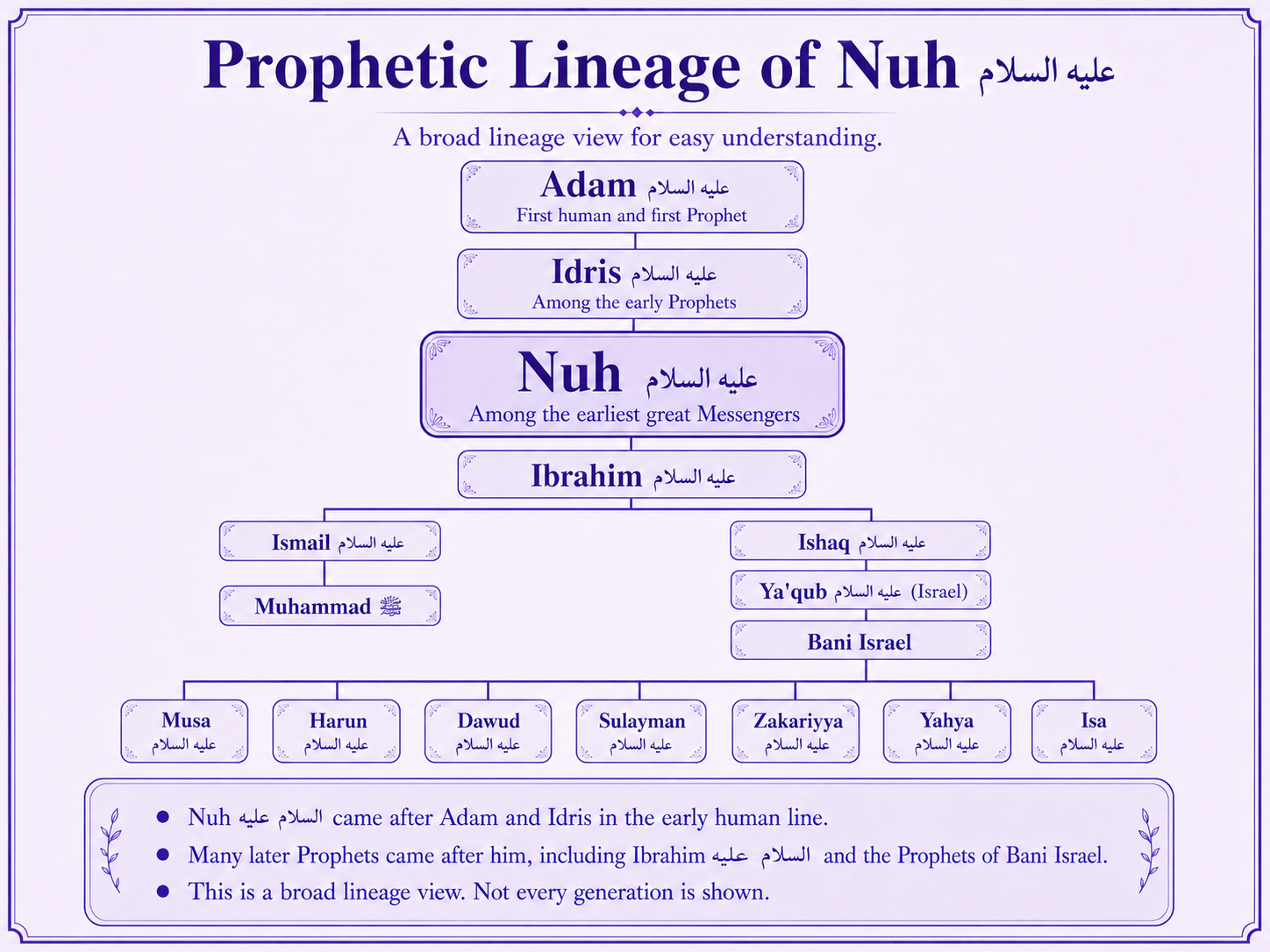
- Use for: Adam عليه السلام → early generations → Nuh عليه السلام → later nations and Prophets after the flood.
- Purpose: show Nuh عليه السلام as one of the earliest major Messengers and the Prophet after whom later human generations continued.
- Do not invent: exact intermediate generations, dates, or detailed ancestry not confirmed in the Qur’an or authentic hadith.
The journey of Nuh عليه السلام
A clear path through his call, his people, the Ark, the flood, his son, and the beginning after the storm.
Shirk slowly enters the people
Righteous people were remembered, then honoured wrongly, until later generations turned remembrance into worship.
Allah sends Nuh عليه السلام
He calls his people to worship Allah alone and leave false gods.
He calls for nine hundred and fifty years
He calls by night and day, openly and privately, with hope, warning, and patience.
The leaders reject him
They mock him, insult the believers, and treat worldly status as proof of truth.
Allah commands him to build the Ark
He builds under Allah’s instruction while his people laugh at him.
The flood begins
Water pours from the sky and bursts from the earth, and the Ark moves by Allah’s name.
His son refuses the Ark
Nuh عليه السلام calls his son, but his son trusts a mountain instead of Allah’s command.
The Ark rests and a new beginning opens
The flood ends by Allah’s command, and the believers are saved.
When did Nuh عليه السلام live?
The Qur’an does not give a calendar date for Nuh عليه السلام. He belongs to the ancient early Prophetic period after Adam عليه السلام. What the Qur’an clearly tells us is that he stayed among his people calling them for nine hundred and fifty years before the flood overtook them.
His da'wah period of nine hundred and fifty years is mentioned in Quran 29:14.
Nuh عليه السلام was the first Messenger to the people of earth
In the hadith of intercession, people will come to Nuh عليه السلام and mention that he was the first Messenger whom Allah sent to the people of the earth. This does not mean Adam عليه السلام was not a Prophet. It means Nuh عليه السلام was the first Messenger sent to a people after shirk had spread among them.
Sahih al-Bukhari 3340 and Sahih Muslim 194, meaning summarized.
When respect became worship
After Adam عليه السلام, people lived for generations upon tawheed. The danger did not arrive all at once. It crept in dressed as respect.
Names such as Wadd, Suwa', Yaghuth, Ya'uq, and Nasr were connected to righteous people. When those righteous people died, later people made images and memorials connected to them. At first, it may have looked like remembrance. Then time passed, knowledge weakened, Shaytan whispered, and later generations began worshipping what earlier people had only remembered.
This is one of the most important lessons in the story of Nuh عليه السلام: shirk can begin when love is not guided by revelation. Honouring the righteous is good, but worshipping them, calling upon them, making them intermediaries, or believing they control benefit and harm is darkness.
The names of the idols are mentioned in Quran 71:23.
Ibn 'Abbas رضي الله عنهما explained that these names were connected to righteous men, and later people took them as idols. This explanation is mentioned in Sahih al-Bukhari in the tafsir of Surah Nuh, meaning summarized.
The idols of the people of Nuh
وَقَالُوا لَا تَذَرُنَّ آلِهَتَكُمْ وَلَا تَذَرُنَّ وَدًّا وَلَا سُوَاعًا وَلَا يَغُوثَ وَيَعُوقَ وَنَسْرًا
Wa qalu la tadharunna alihatakum wa la tadharunna Waddan wa la Suwa'an wa la Yaghutha wa Ya'uqa wa Nasra.
And they said: Do not leave your gods, and do not leave Wadd, Suwa', Yaghuth, Ya'uq, and Nasr. Source: Quran 71:23, meaning.
Love must stay inside tawheed
Islam teaches love for Prophets, righteous people, scholars, parents, and elders. But love must never become worship. Graves, saints, ancestors, angels, jinn, stars, and objects cannot be called upon besides Allah.
Nuh عليه السلام begins calling his people
Allah sent Nuh عليه السلام to call his people back to the foundation every Prophet taught: worship Allah alone. He did not begin with politics, wealth, tribal pride, or personal glory. He began with tawheed.
He warned them about a painful punishment if they continued in disbelief. He also opened the door of mercy: seek forgiveness from Allah, return to Him, and He will send blessings, rain, wealth, children, gardens, and rivers. His message was not dry preaching. It was a rescue call.
But the people did not simply disagree. They resisted. They covered their ears. They wrapped themselves in their garments. They insisted. They became arrogant. They treated the truth like noise and their idols like identity.
Worship Allah alone
يَا قَوْمِ اعْبُدُوا اللَّهَ مَا لَكُم مِّنْ إِلَٰهٍ غَيْرُهُ
Ya qawmi'budullaha ma lakum min ilahin ghayruh.
O my people, worship Allah; you have no deity other than Him. Source: Quran 7:59, relevant part.
Every rescue begins with tawheed. No social reform is complete if people are still worshipping other than Allah.
Seek forgiveness and return
فَقُلْتُ اسْتَغْفِرُوا رَبَّكُمْ إِنَّهُ كَانَ غَفَّارًا
Faqultu istaghfiru rabbakum innahu kana ghaffara.
I said: Seek forgiveness from your Lord. Indeed, He is ever Forgiving. Source: Quran 71:10.
Nuh عليه السلام did not call people only with warning. He invited them through forgiveness, mercy, and hope.
Nine hundred and fifty years of da'wah
The Qur’an tells us that Nuh عليه السلام remained among his people for nine hundred and fifty years. Imagine a lifetime of calling, then another, then another, while most hearts stayed closed.
He called them at night and during the day. He called them openly. He spoke privately. He warned them. He gave them hope. He reminded them of rain, wealth, children, gardens, and rivers. He pointed them to the sky, the moon, the sun, the earth, and their own creation. Every door of reminder was opened.
But most of them did not only reject. They became more stubborn. They placed their fingers in their ears. They covered themselves with their garments. They chose their leaders over revelation and inherited customs over truth.
Patience is not quiet weakness. In the story of Nuh عليه السلام, patience is a Prophet standing for centuries at the door of mercy while people keep shutting it.
950 years among his people
فَلَبِثَ فِيهِمْ أَلْفَ سَنَةٍ إِلَّا خَمْسِينَ عَامًا
Falabitha fihim alfa sanatin illa khamsina 'ama.
He remained among them a thousand years minus fifty years. Source: Quran 29:14, relevant part.
This verse confirms the length of his stay among his people before the flood. It does not necessarily give his complete lifespan from birth to death.
He called in every way
Nuh عليه السلام said that he called his people night and day, openly and privately. Source: Quran 71:5-9, meaning summarized.
Da'wah needs patience, variety, wisdom, public reminder, private advice, and a heart that keeps hoping for guidance.
The leaders looked down on the believers
The leaders of Nuh’s people did not measure truth by evidence. They measured it by class. They looked at the believers and said they were lowly people. They thought poverty was a weakness in faith and social status was a proof of correctness.
This disease appears again and again in history. A person rejects truth because the first followers are poor, simple, unknown, or socially weak. But Allah does not weigh people by clothes, houses, family names, or followers. Allah looks at hearts and deeds.
Nuh عليه السلام did not throw away the poor believers to please arrogant leaders. A Prophet does not sell sincere believers for elite approval.
They mocked the followers
The chiefs of his people said they saw only ordinary people following him, whom they considered lowly at first glance. Source: Quran 11:27, meaning summarized.
Looking down on believers because of poverty or social position is a sign of arrogance, not intelligence.
Nuh عليه السلام would not drive believers away
Nuh عليه السلام said he would not drive away those who believed, and that their account was with Allah. Source: Quran 11:29-31 and Quran 26:111-115, meaning summarized.
Religious spaces should not become clubs for status. The sincere poor believer may be higher with Allah than the admired rich person.
Build the Ark
Then came the command that must have looked strange to the eyes of his people: build the Ark.
Nuh عليه السلام began building under Allah’s instruction. His people passed by and mocked him. Yesterday they mocked his message. Now they mocked his obedience. They saw wood, tools, and labour. They did not see the coming water.
Nuh عليه السلام answered with dignity. If they mocked him now, a time would come when the truth would become visible. The Ark was not only a ship. It was obedience before the evidence became obvious.
When Allah’s command came and the oven overflowed, Nuh عليه السلام was told to carry pairs, his family except those against whom the word had already passed, and the believers. But only a few had believed.
Build under Allah’s eyes
وَاصْنَعِ الْفُلْكَ بِأَعْيُنِنَا وَوَحْيِنَا
Wasna'il-fulka bi a'yunina wa wahyina.
Build the Ark under Our eyes and Our revelation. Source: Quran 11:37, relevant part.
Only a few believed
وَمَا آمَنَ مَعَهُ إِلَّا قَلِيلٌ
Wa ma amana ma'ahu illa qalil.
And none had believed with him except a few. Source: Quran 11:40, relevant part.
Truth is not measured by numbers. A small group upon truth is better than a crowd upon arrogance.
The water rises
Then the sky opened with pouring rain, and the earth burst with springs. The Ark moved upon waves like mountains. The believers were inside by Allah’s mercy, carried not by wood alone, but by the command of the Lord of the worlds.
Nuh عليه السلام said: In the name of Allah is its sailing and its anchoring. Even in the middle of a storm, tawheed remained the language of safety.
The flood was not random weather. It came after centuries of da'wah, warning, rejection, arrogance, and disbelief. Allah does not wrong people. They had been called again and again.
In the name of Allah it sails
بِسْمِ اللَّهِ مَجْرَاهَا وَمُرْسَاهَا
Bismillahi majraha wa mursaha.
In the name of Allah is its sailing and its anchoring. Source: Quran 11:41, relevant part.
Water from sky and earth
Allah opened the gates of the sky with pouring water and caused the earth to burst with springs, so the waters met for a matter already decreed. Source: Quran 54:11-12, meaning summarized.
When Allah’s command comes, the sky and earth obey. The one who refuses Allah is weaker than a drop of water when Allah sends it as judgment.
A son on the mountain
One of the most painful scenes in the story is not the water. It is a father calling his son.
The Ark moved through waves like mountains, and Nuh عليه السلام saw his son away from the believers. He called him with the tenderness of a father: “O my son, come aboard with us and do not be with the disbelievers.”
But the son trusted height instead of guidance. He said he would take refuge on a mountain that would protect him from the water. Nuh عليه السلام told him there was no protection that day from Allah’s command except for the one upon whom Allah had mercy. Then a wave came between them, and he was among those drowned.
After that, Nuh عليه السلام called upon Allah regarding his son. Allah corrected him: the true family that matters for salvation is not blood without faith. His son was not from the saved family because his conduct was not righteous.
Come aboard with us
يَا بُنَيَّ ارْكَب مَّعَنَا وَلَا تَكُن مَّعَ الْكَافِرِينَ
Ya bunayya irkab ma'ana wa la takum ma'al-kafirin.
O my son, come aboard with us and do not be with the disbelievers. Source: Quran 11:42, relevant part.
No mountain can save without Allah
His son said he would take refuge on a mountain. Nuh عليه السلام said there was no protection that day from Allah’s command except for whom Allah had mercy. Source: Quran 11:43, meaning summarized.
Worldly strength cannot save a person from Allah’s command. Safety is not in height, wealth, family name, or intelligence. Safety is in Allah’s mercy.
Faith is deeper than blood
Allah told Nuh عليه السلام that his son was not of his saved family because his conduct was not righteous, and warned him not to ask about what he had no knowledge of. Source: Quran 11:45-46, meaning summarized.
Love for family is natural, but salvation is not inherited through blood. Every soul must answer Allah.
Nuh عليه السلام seeks refuge from asking wrongly
رَبِّ إِنِّي أَعُوذُ بِكَ أَنْ أَسْأَلَكَ مَا لَيْسَ لِي بِهِ عِلْمٌ
Rabbi inni a'udhu bika an as'alaka ma laysa li bihi 'ilm.
My Lord, I seek refuge in You from asking You for that about which I have no knowledge. Source: Quran 11:47, relevant part.
The earth is commanded to swallow, the sky is commanded to stop
Then Allah commanded the earth to swallow its water and the sky to stop. The water subsided, the matter was completed, and the Ark rested upon al-Judi. The scene is majestic: the same earth and sky that carried the punishment now obey the command to become still.
Nuh عليه السلام and the believers were told to descend with peace and blessings. A new beginning opened, but the memory of the flood remained as a sign. Allah made the descendants of Nuh عليه السلام the survivors.
The story does not end with destruction. It ends with survival, warning, mercy, and a new human chapter under Allah’s command.
The Ark rested on al-Judi
وَقِيلَ يَا أَرْضُ ابْلَعِي مَاءَكِ وَيَا سَمَاءُ أَقْلِعِي
Wa qila ya ardu ibla'i ma'aki wa ya sama'u aqli'i.
And it was said: O earth, swallow your water, and O sky, withhold. Source: Quran 11:44, relevant part.
His descendants survived
وَجَعَلْنَا ذُرِّيَّتَهُ هُمُ الْبَاقِينَ
Wa ja'alna dhurriyyatahu humul-baqin.
And We made his descendants the survivors. Source: Quran 37:77.
Family details and common questions
The Qur’an gives powerful family lessons in this story, especially about faith, blood ties, and betrayal.
The wife of Nuh عليه السلام did not believe
The Qur’an mentions the wife of Nuh عليه السلام as an example for disbelievers. Her betrayal was betrayal in religion and faith, not sexual immorality. The wives of Prophets are not accused of indecency. She lived near prophethood, but nearness without faith did not save her.
The wife of Nuh عليه السلام and the wife of Lut عليه السلام are mentioned in Quran 66:10.
Do we know the names of his wife and children?
Names of Nuh’s wife and sons are mentioned in historical reports and earlier traditions, but the Qur’an does not name them. The son who drowned is not named in the Qur’an. A teaching page should focus on the lesson Allah revealed rather than making unproven names the centre.
Do we know the Ark’s size and exact shape?
The Qur’an does not give measurements, wood type, floor count, or exact design of the Ark. Such details may appear in history or earlier scriptures, but they should not be taught as confirmed Islamic fact.
Has the Ark been found?
The Qur’an tells us the Ark rested on al-Judi. Modern claims about finding the Ark should not be treated as Qur’anic proof unless they are genuinely established. A Muslim’s belief in the story does not depend on viral pictures or archaeological claims.
Duas of Nuh عليه السلام
رَبِّ إِنِّي مَغْلُوبٌ فَانتَصِرْ
Rabbi inni maghlubun fantasir.
My Lord, I am overcome, so help. Source: Quran 54:10.
رَبِّ اغْفِرْ لِي وَلِوَالِدَيَّ وَلِمَن دَخَلَ بَيْتِيَ مُؤْمِنًا وَلِلْمُؤْمِنِينَ وَالْمُؤْمِنَاتِ
Rabbighfir li wa liwalidayya wa liman dakhala baytiya mu'minan wa lil-mu'minina wal-mu'minat.
My Lord, forgive me, my parents, whoever enters my house as a believer, and the believing men and believing women. Source: Quran 71:28, relevant part.
Tawheed comes first
Nuh عليه السلام began with worshipping Allah alone. Every reform without tawheed is missing its foundation.
Patience can last longer than results
He called for nine hundred and fifty years, while only a few believed. Success is obedience, not numbers.
Status does not decide truth
The leaders mocked the poor believers, but Allah honoured faith, not class.
Obey before the storm is visible
Nuh عليه السلام built the Ark before the water came. Faith acts before worldly eyes understand.
Family cannot replace faith
A Prophet’s son was not saved without faith. Blood ties matter, but they do not overrule Allah’s judgment.
Allah’s rescue is real
The believers were few, mocked, and surrounded by water, but Allah carried them when the world could not.
Common mistakes about this story
- Thinking the flood came suddenly without warning: Nuh عليه السلام called for centuries before judgment came.
- Making Ark details central: measurements, design, and exact materials are not given in the Qur’an.
- Trusting viral Ark claims: the story is true because Allah revealed it, not because of internet images.
- Accusing the wife of indecency: her betrayal was religious disbelief, not sexual immorality.
- Forgetting the main lesson: the story is about tawheed, patience, rejection, rescue, and family being tested by faith.
The whole story in six lines
- Shirk spread among people after earlier generations of tawheed.
- Allah sent Nuh عليه السلام to call them back to worshipping Allah alone.
- He called for nine hundred and fifty years, but only a few believed.
- Allah commanded him to build the Ark under revelation.
- The flood came, the believers were saved, and his disbelieving son drowned.
- The Ark rested by Allah’s command, and a new beginning opened for the believers.
Main authentic references used
- Qur’an: Nuh’s call and people: Quran 7:59-64, 10:71-73, 11:25-49, 23:23-30, 26:105-122, 29:14-15, 37:75-82, 54:9-17, Surah Nuh 71:1-28.
- Qur’an: Nuh’s wife as an example of disbelief: Quran 66:10.
- Qur’an: His descendants as survivors: Quran 37:77.
- Hadith: Nuh عليه السلام as the first Messenger sent to the people of earth: Sahih al-Bukhari 3340; Sahih Muslim 194, meaning summarized.
- Early explanation: Ibn 'Abbas رضي الله عنهما on the idols of Nuh’s people is mentioned in Sahih al-Bukhari in tafsir of Surah Nuh, meaning summarized.
Nuh عليه السلام teaches patience that survives the storm
He called while people laughed. He built while people mocked. He loved his son, but could not save him without faith. He entered the Ark with a few believers, and Allah carried them over a world that had refused guidance. The story of Nuh عليه السلام is a storm in the Qur’an, but at its centre is a servant who never stopped calling to Allah.