
بِسْمِ اللَّهِ الرَّحْمَٰنِ الرَّحِيمِ
Learn Salah / Namaz

Learn Salah for Women

A simple step-by-step guide to help women learn how to perform Salah with the correct order, modest posture, essential recitations, and important duas inside the prayer.

Before You Begin

Make sure you have Wudu, clean clothing, a clean place, and you are facing the Qibla. Wear loose, opaque clothing that covers the body properly for Salah. Begin calmly and remember that you are standing before Allah.

What This Guide Teaches

This page teaches the order of Salah, the main postures for women, what to recite in each step, where duas are made, and how the rak‘ahs work in daily prayers.

Rak‘ah Guide for Daily Salah

This is a beginner guide to the common daily structure. Fard prayers are compulsory. Sunnah mu’akkadah are emphasised Sunnah prayers. Sunnah ghair mu’akkadah, such as the 4 rak‘ahs before Asr and the 4 rak‘ahs before Isha, are recommended but less emphasised. In the Hanafi school, Witr is Wajib.

Fajr

2 Sunnah + 2 Fard

The 2 Fard are compulsory. The 2 Sunnah before Fajr are highly emphasised and should be guarded carefully.

Dhuhr

4 Sunnah + 4 Fard + 2 Sunnah

The 4 Fard are compulsory. The Sunnah prayers before and after Dhuhr are part of the regular daily Sunnah routine. Optional Nafl may be prayed after this.

Asr

4 Fard

The 4 Fard are compulsory. Before them, 4 Sunnah ghair mu’akkadah may be prayed. They are recommended and rewarded, but they are not emphasised like Sunnah mu’akkadah.

Maghrib

3 Fard + 2 Sunnah

The 3 Fard are compulsory. The 2 Sunnah after Maghrib are part of the regular Sunnah routine. Optional Nafl may be prayed after this.

Isha

4 Fard + 2 Sunnah + 3 Witr Wajib

The 4 Fard are compulsory. The 2 Sunnah after Isha are Sunnah mu’akkadah, and 3 Witr are Wajib in the Hanafi school. Before the Fard, 4 Sunnah ghair mu’akkadah may also be prayed.

Step-by-Step Salah Guide for Women

Follow the steps in order. Each step combines the posture, the image space, the recitation, the meaning, and any special Sunnah dua that belongs in that part of Salah.
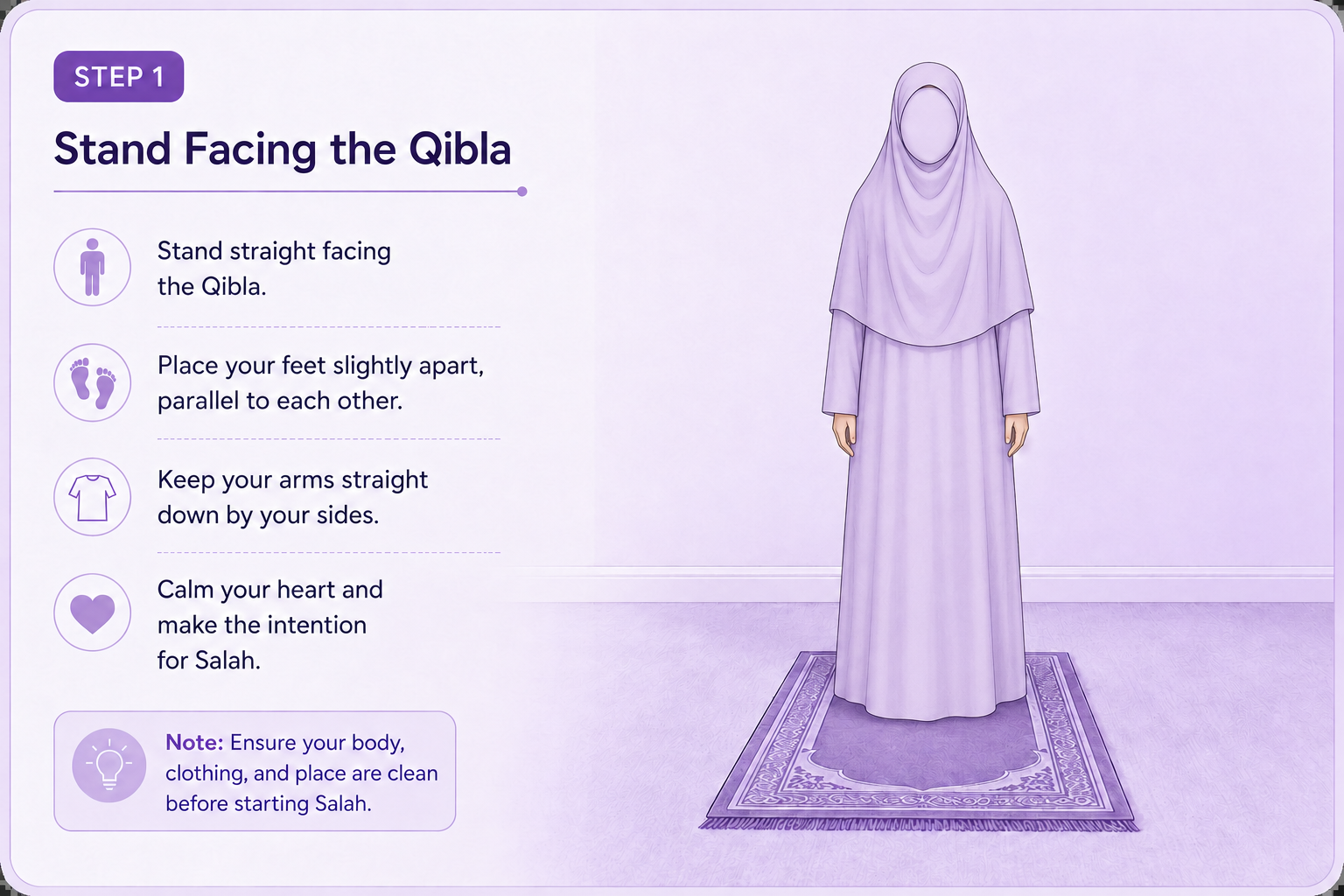
Step 1

Stand Facing the Qibla

What to do: Stand calmly, face the Qibla, keep the body still, and prepare to begin Salah with humility and modesty.
Meaning: Make the intention in your heart for the prayer you are about to perform. The intention does not need to be spoken aloud.
Before beginning, make sure you have Wudu, clean clothing, proper covering, a clean place, and you are facing the Qibla.
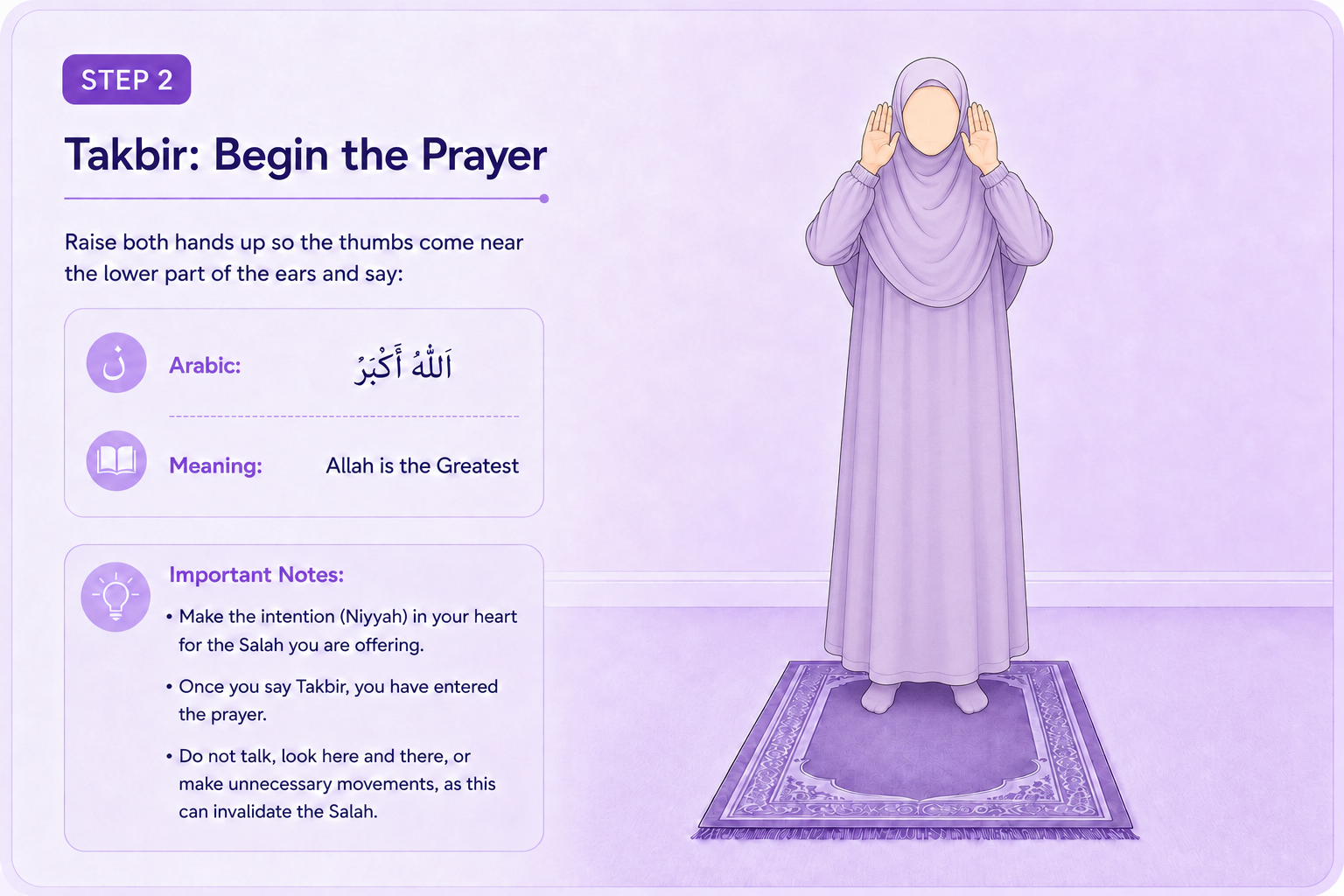
Step 2

Takbir: Begin the Prayer

What to do: Raise the hands near the shoulders and say the opening Takbir. This begins the Salah.
اللَّهُ أَكْبَرُ
Transliteration:
Allahu Akbar.
Meaning: Allah is the Greatest.
After this Takbir, the prayer has started, so avoid unnecessary movement and speech.
Step 3

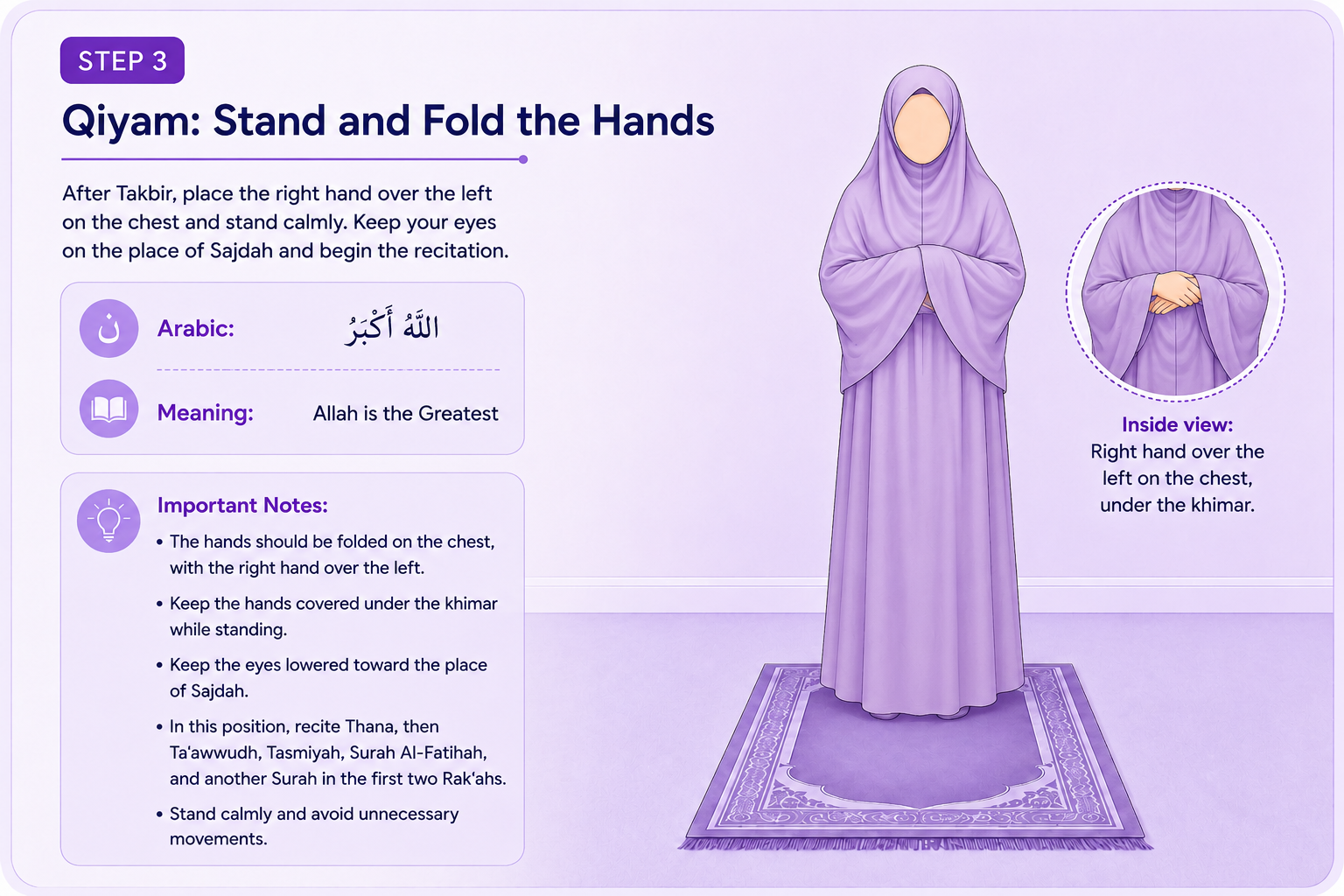
Qiyam: Stand and Fold the Hands

What to do: Stand upright and fold the hands on the chest in a modest standing position. Begin with the opening praise.
سُبْحَانَكَ اللَّهُمَّ وَبِحَمْدِكَ، وَتَبَارَكَ اسْمُكَ، وَتَعَالَى جَدُّكَ، وَلَا إِلَٰهَ غَيْرُكَ
Transliteration:
Subhanak Allahumma wa bihamdika, wa tabarakasmuka, wa ta‘ala jadduka, wa la ilaha ghayruk.
Meaning: Glory is to You, O Allah, and praise. Blessed is Your Name, exalted is Your Majesty, and there is no god besides You.
This opening praise is commonly known as Thana.
Step 4

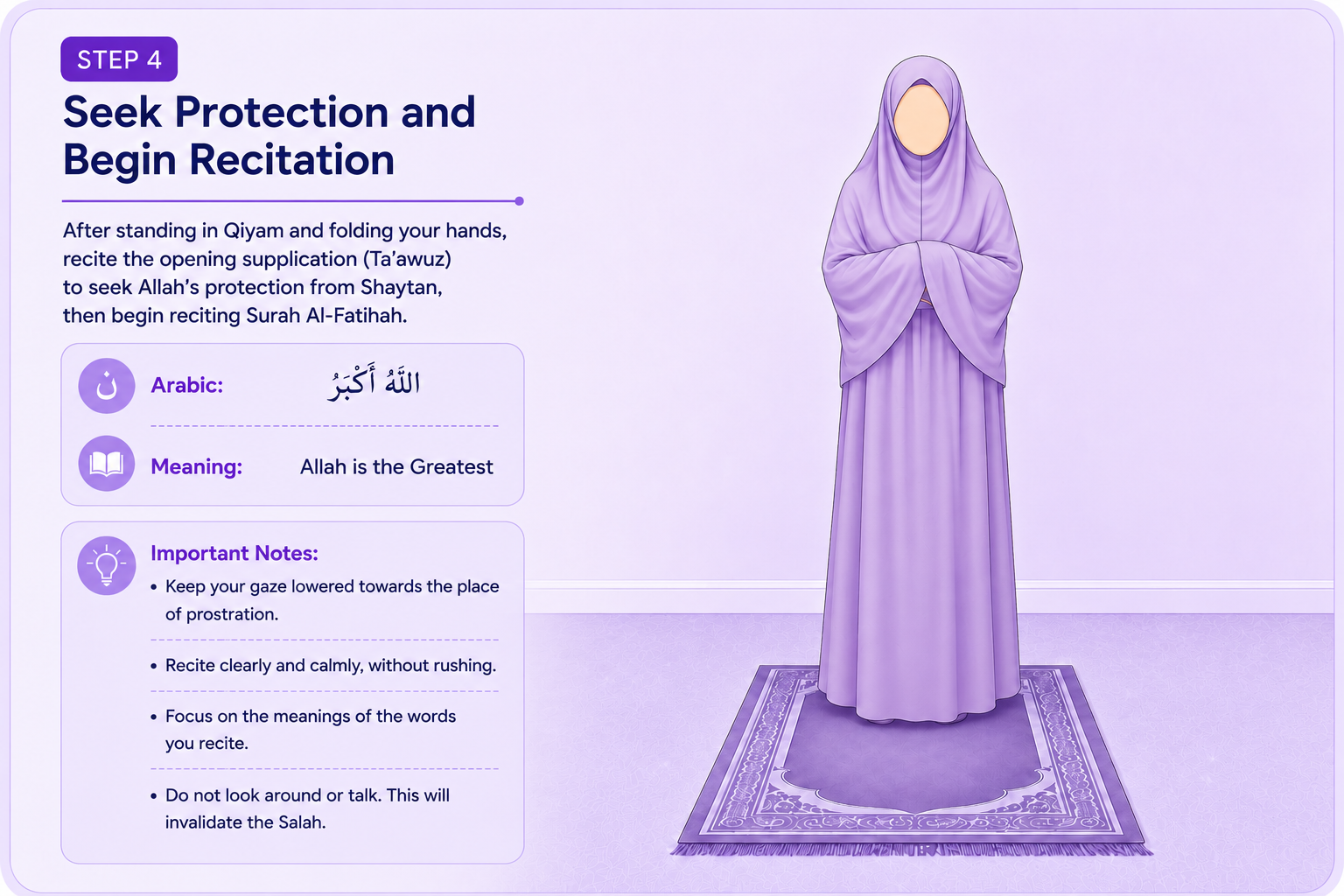
Seek Protection and Begin Recitation

What to do: Before reciting Qur’an, seek Allah’s protection from Shaytan and say Bismillah.
أَعُوذُ بِاللَّهِ مِنَ الشَّيْطَانِ الرَّجِيمِ
بِسْمِ اللَّهِ الرَّحْمَٰنِ الرَّحِيمِ
Transliteration:
A‘udhu billahi minash-shaytanir-rajim.
Bismillahir-Rahmanir-Rahim.
Meaning: I seek refuge in Allah from the rejected Shaytan.
In the Name of Allah, the Most Merciful, the Especially Merciful.
This is recited before Surah Al-Fatihah.
Step 5

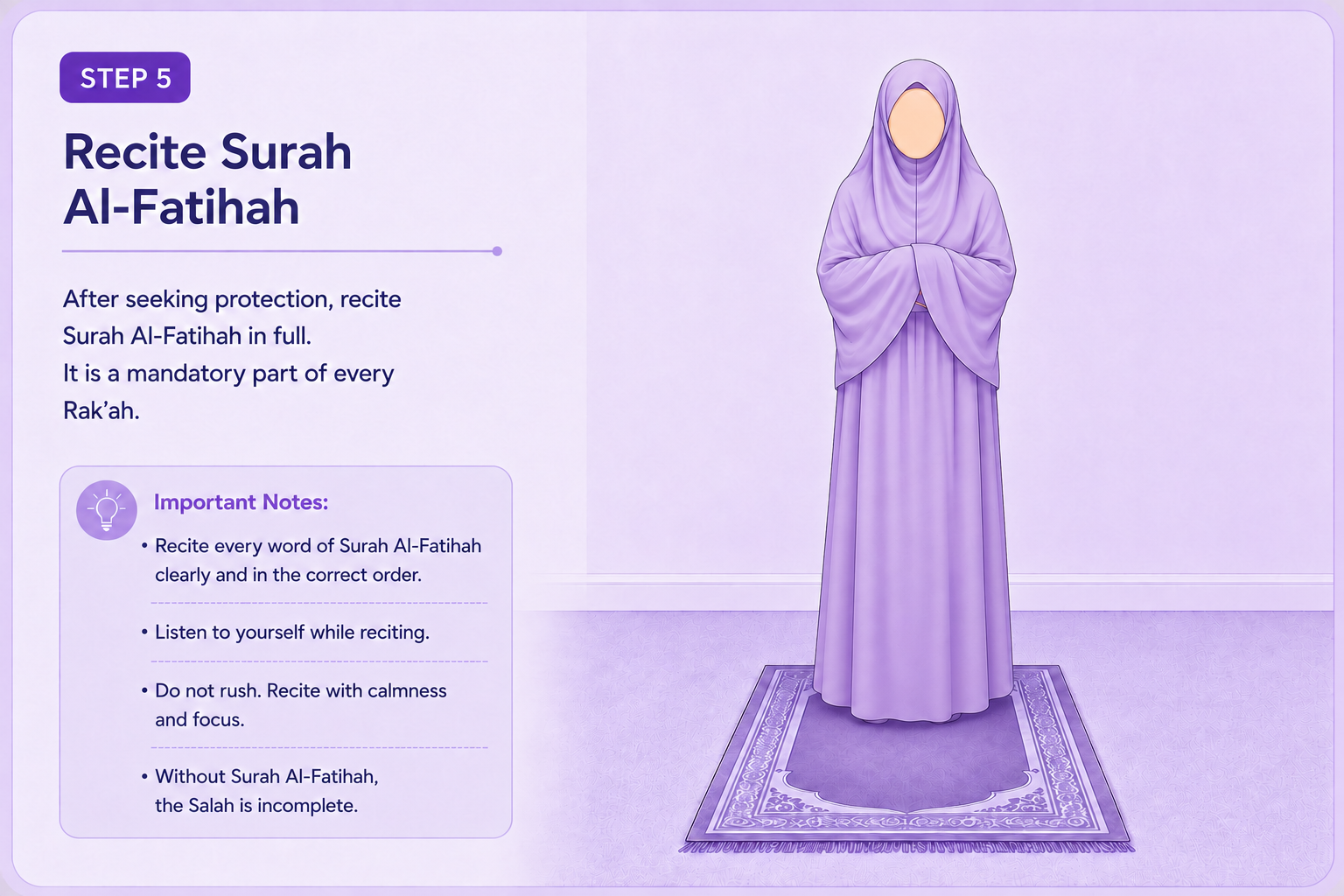
Recite Surah Al-Fatihah

What to do: Recite Surah Al-Fatihah in every rak‘ah. It is the opening chapter of the Qur’an and an essential part of Salah.
الْحَمْدُ لِلَّهِ رَبِّ الْعَالَمِينَ
الرَّحْمَٰنِ الرَّحِيمِ
مَالِكِ يَوْمِ الدِّينِ
إِيَّاكَ نَعْبُدُ وَإِيَّاكَ نَسْتَعِينُ
اهْدِنَا الصِّرَاطَ الْمُسْتَقِيمَ
صِرَاطَ الَّذِينَ أَنْعَمْتَ عَلَيْهِمْ
غَيْرِ الْمَغْضُوبِ عَلَيْهِمْ وَلَا الضَّالِّينَ
Transliteration:
Alhamdu lillahi Rabbil-‘alamin. Ar-Rahmanir-Rahim. Maliki yawmid-din. Iyyaka na‘budu wa iyyaka nasta‘in. Ihdinaṣ-ṣiratal-mustaqim. Ṣiratal-ladhina an‘amta ‘alayhim, ghayril-maghḍubi ‘alayhim wa laḍ-ḍallin.
Meaning: All praise is for Allah, Lord of all worlds, the Most Merciful, the Especially Merciful, Master of the Day of Judgment. You alone we worship and You alone we ask for help. Guide us to the straight path, the path of those You have blessed, not of those who earned anger, nor of those who went astray.
Qur’an: Surah Al-Fatihah, 1:1-7.
Step 6

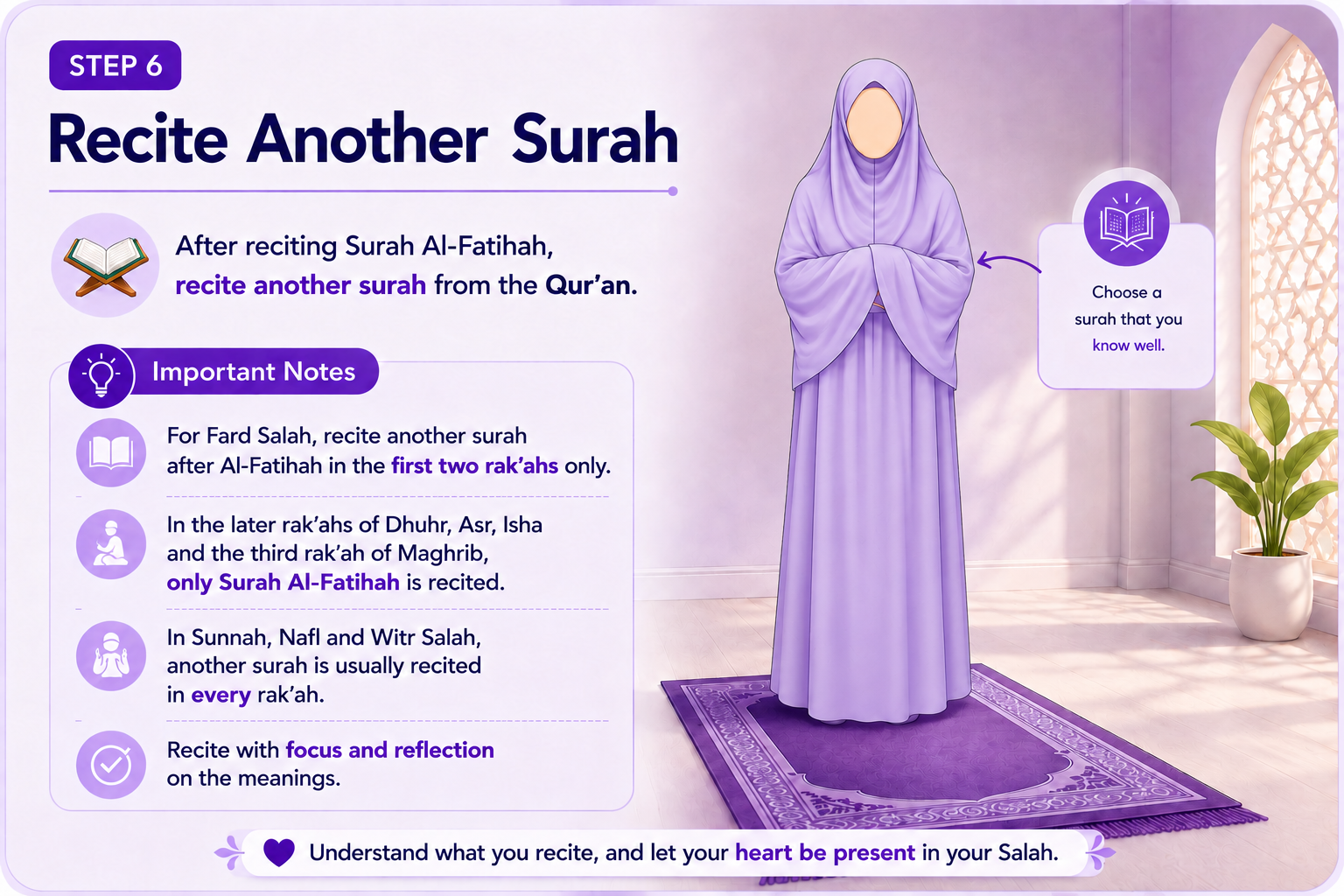
Recite Another Surah

What to do: After Al-Fatihah, recite another surah or a few verses in the first two rak‘ahs. A beginner may start with Surah Al-Ikhlas.
قُلْ هُوَ اللَّهُ أَحَدٌ
اللَّهُ الصَّمَدُ
لَمْ يَلِدْ وَلَمْ يُولَدْ
وَلَمْ يَكُنْ لَهُ كُفُوًا أَحَدٌ
Transliteration:
Qul huwallahu ahad. Allahuṣ-ṣamad. Lam yalid wa lam yulad. Wa lam yakun lahu kufuwan ahad.
Meaning: Say: He is Allah, One. Allah, the Self-Sufficient. He neither begets nor is born, and there is none comparable to Him.
Qur’an: Surah Al-Ikhlas, 112:1-4.
Step 7

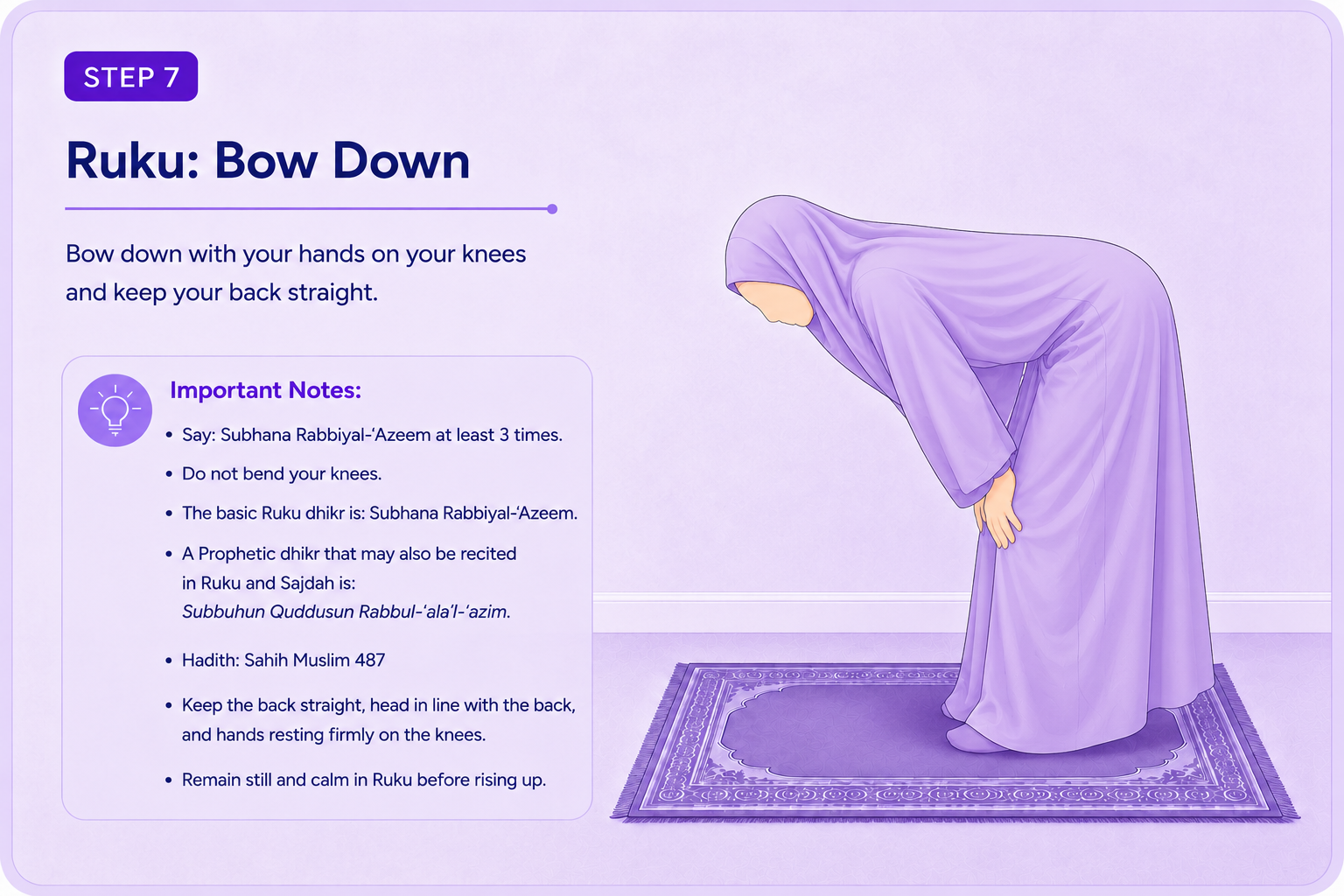
Ruku: Bow Down

What to do: Say Allahu Akbar and go into Ruku. Bow calmly, keep the body modestly gathered, place the hands on the knees, and recite the Ruku dhikr calmly.
سُبْحَانَ رَبِّيَ الْعَظِيمِ

سُبُّوحٌ قُدُّوسٌ رَبُّ الْمَلَائِكَةِ وَالرُّوحِ
Transliteration:
Subhana Rabbiyal-‘Azim.

Subbuhun Quddusun Rabbul-mala’ikati war-ruh.
Meaning: Glory be to my Lord, the Most Great.

Perfectly Pure, Most Holy, Lord of the angels and the Spirit.
The first dhikr is the basic Ruku dhikr. The second is a Prophetic dhikr recited in Ruku and Sajdah. Hadith: Sahih Muslim 487.
Step 8

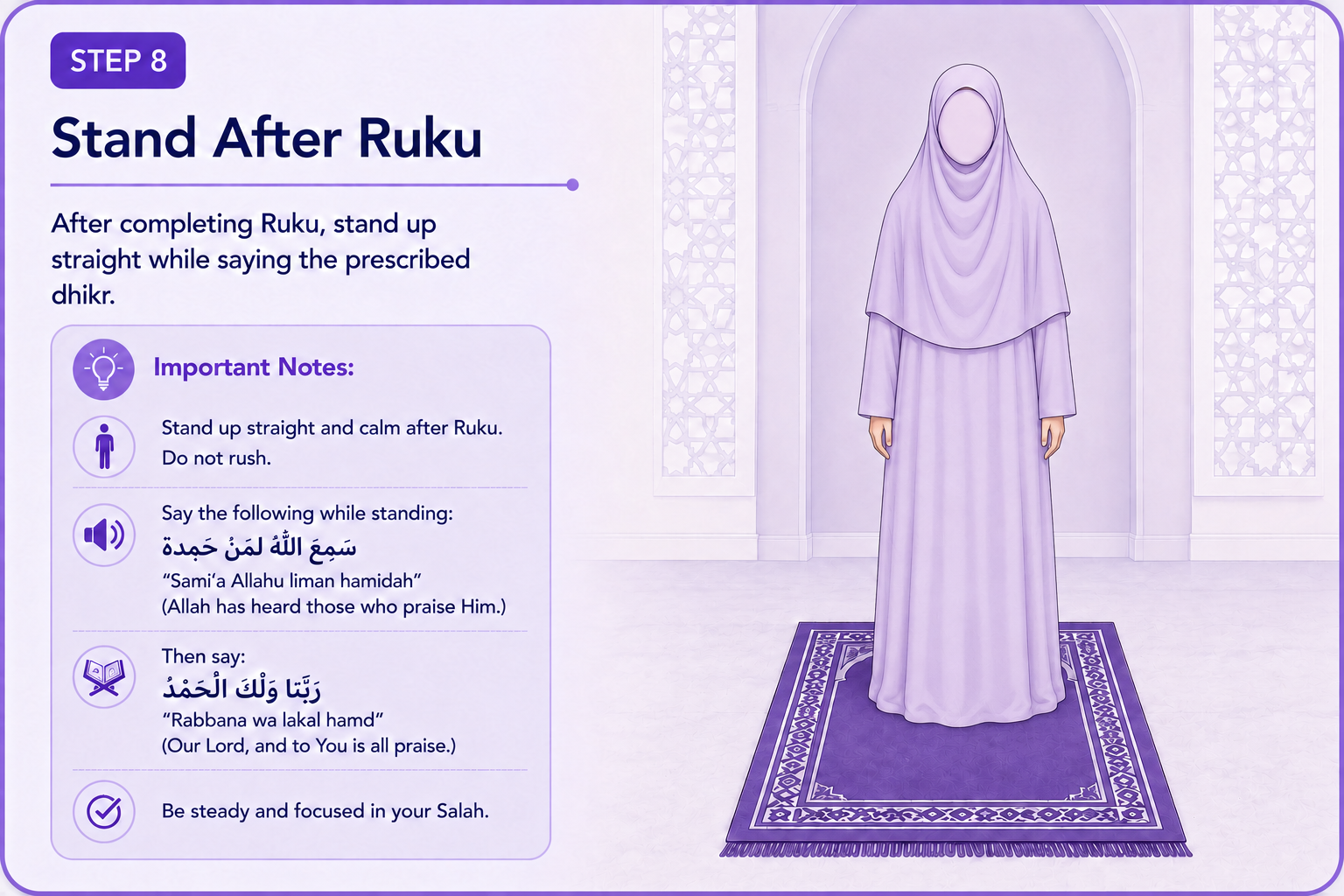
Stand After Ruku

What to do: Rise from Ruku and stand straight before going into Sajdah. Do not rush this position.
سَمِعَ اللَّهُ لِمَنْ حَمِدَهُ
رَبَّنَا لَكَ الْحَمْدُ
Transliteration:
Sami‘allahu liman hamidah.
Rabbana lakal-hamd.
Meaning: Allah hears the one who praises Him.
Our Lord, to You belongs all praise.
Stand properly and calmly before moving to Sajdah.
Step 9

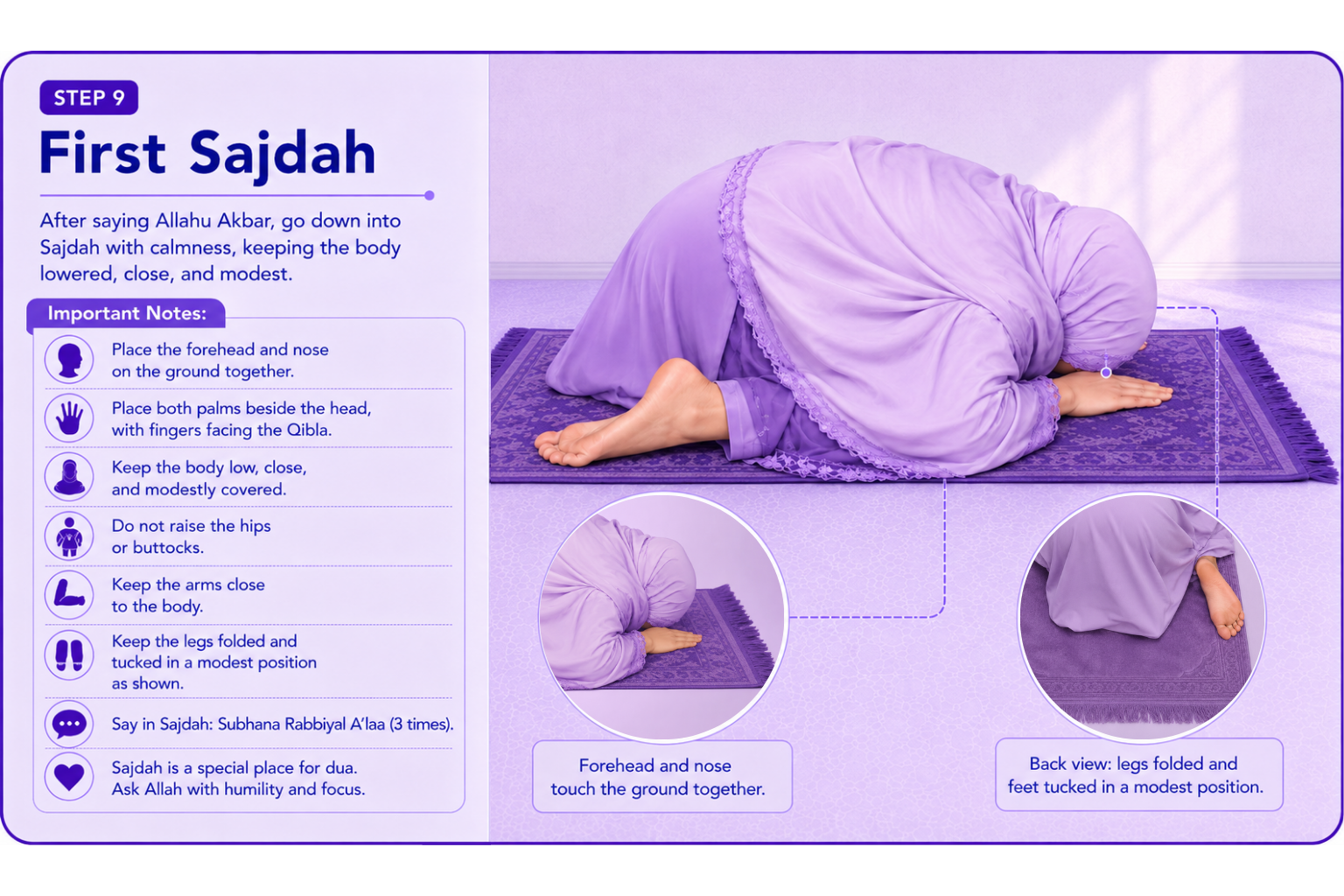
First Sajdah

What to do: Say Allahu Akbar and go into Sajdah. Place the forehead, nose, palms, knees, and toes on the ground while keeping the body modestly gathered.
سُبْحَانَ رَبِّيَ الْأَعْلَى

اللَّهُمَّ اغْفِرْ لِي ذَنْبِي كُلَّهُ، دِقَّهُ وَجِلَّهُ، وَأَوَّلَهُ وَآخِرَهُ، وَعَلَانِيَتَهُ وَسِرَّهُ
Transliteration:
Subhana Rabbiyal-A‘la.

Allahummaghfir li dhanbi kullahu, diqqahu wa jillahu, wa awwalahu wa akhirahu, wa ‘alaniyatahu wa sirrahu.
Meaning: Glory be to my Lord, the Most High.

O Allah, forgive all my sins: the small and the great, the first and the last, the open and the hidden.
Sajdah is one of the best places for dua. Hadith: Sahih Muslim 482; Sahih Muslim 483.
Step 10

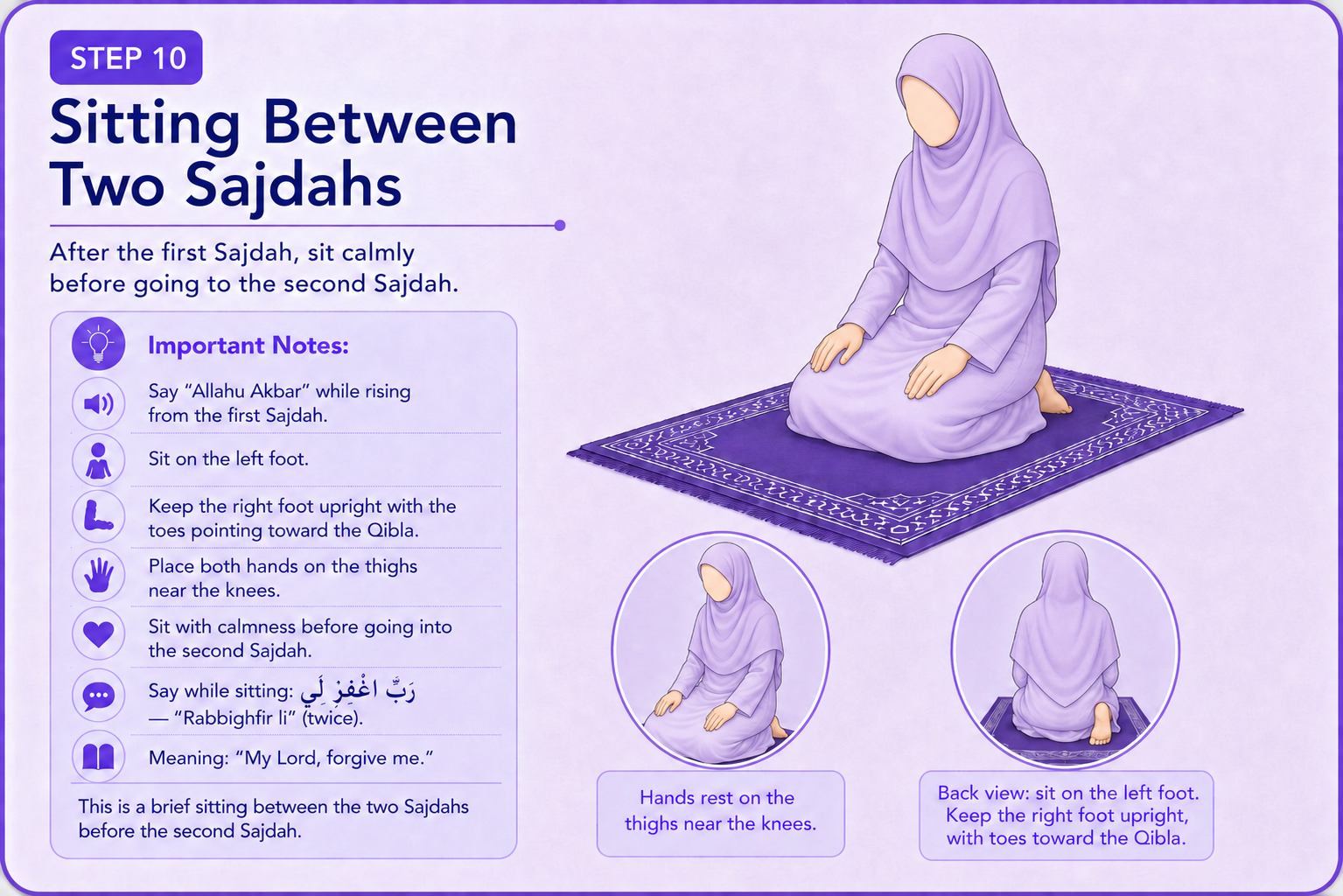
Sitting Between Two Sajdahs

What to do: Say Allahu Akbar and sit calmly between the two Sajdahs. Sit in a modest gathered posture and do not rush this sitting.
رَبِّ اغْفِرْ لِي، رَبِّ اغْفِرْ لِي
Transliteration:
Rabbighfir li, Rabbighfir li.
Meaning: My Lord, forgive me. My Lord, forgive me.
Hadith: Sunan Abi Dawud 874.
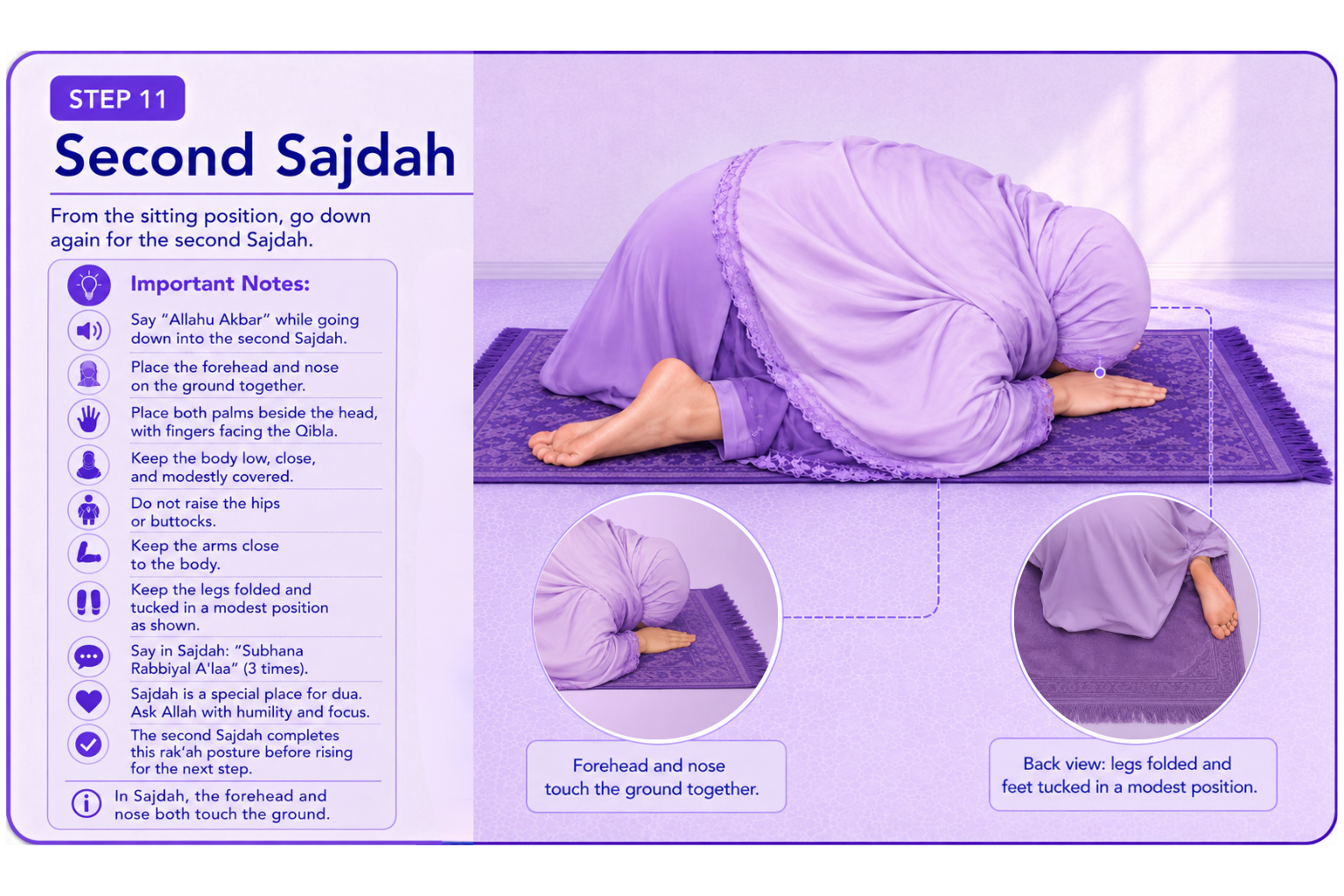
Step 11

Second Sajdah

What to do: Say Allahu Akbar and perform the second Sajdah in the same calm way as the first.
سُبْحَانَ رَبِّيَ الْأَعْلَى
Transliteration:
Subhana Rabbiyal-A‘la.
Meaning: Glory be to my Lord, the Most High.
After this, stand for the next rak‘ah or sit if it is the sitting point of the prayer.
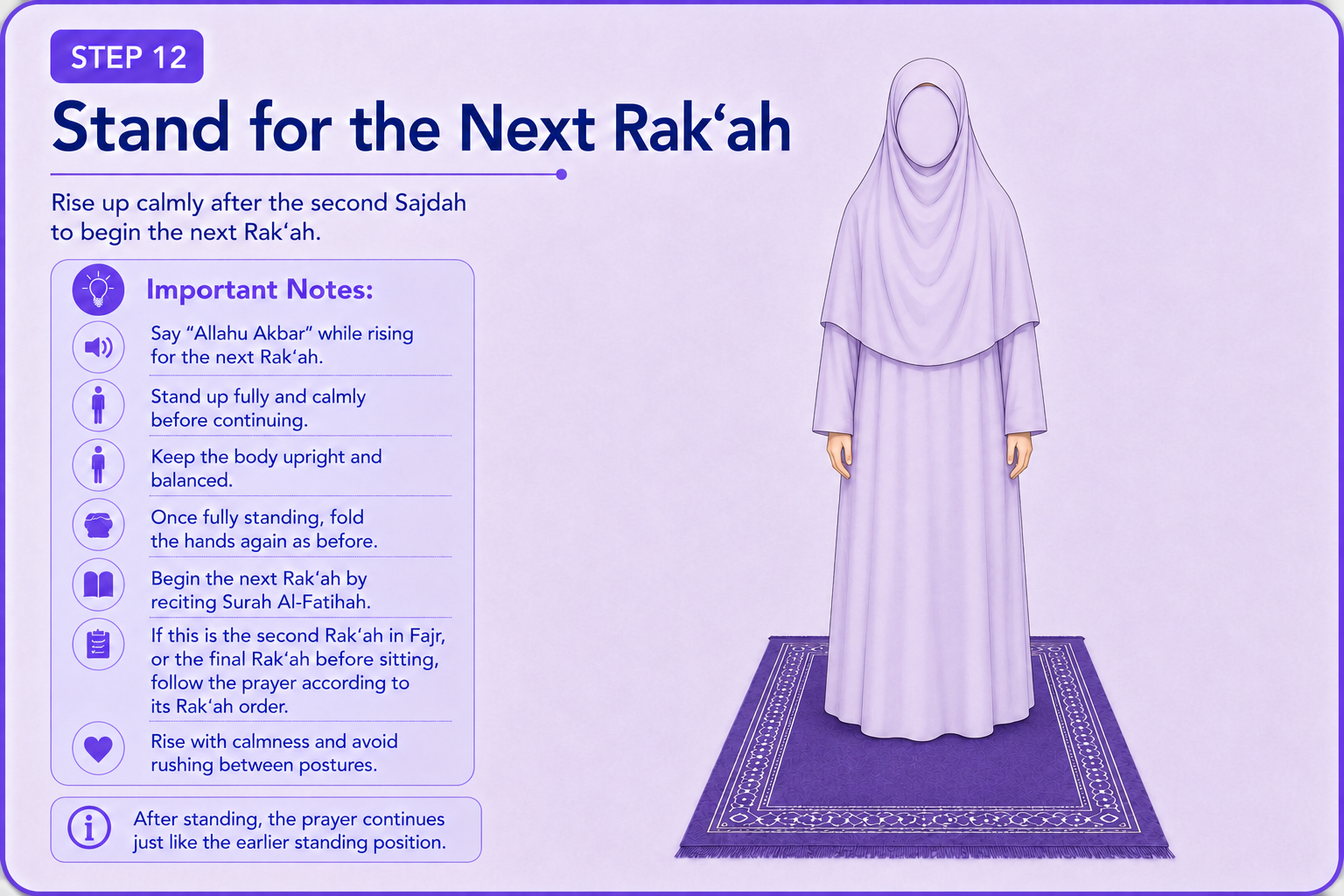
Step 12

Stand for the Next Rak‘ah

What to do: Say Allahu Akbar and stand for the next rak‘ah. Recite Al-Fatihah again. In the first two rak‘ahs, recite another surah after Al-Fatihah.
اللَّهُ أَكْبَرُ
Transliteration:
Allahu Akbar.
Meaning: Allah is the Greatest.
In Fard prayers, the third and fourth rak‘ahs are shorter. In Sunnah and Nafl prayers, recitation after Al-Fatihah continues in each rak‘ah.
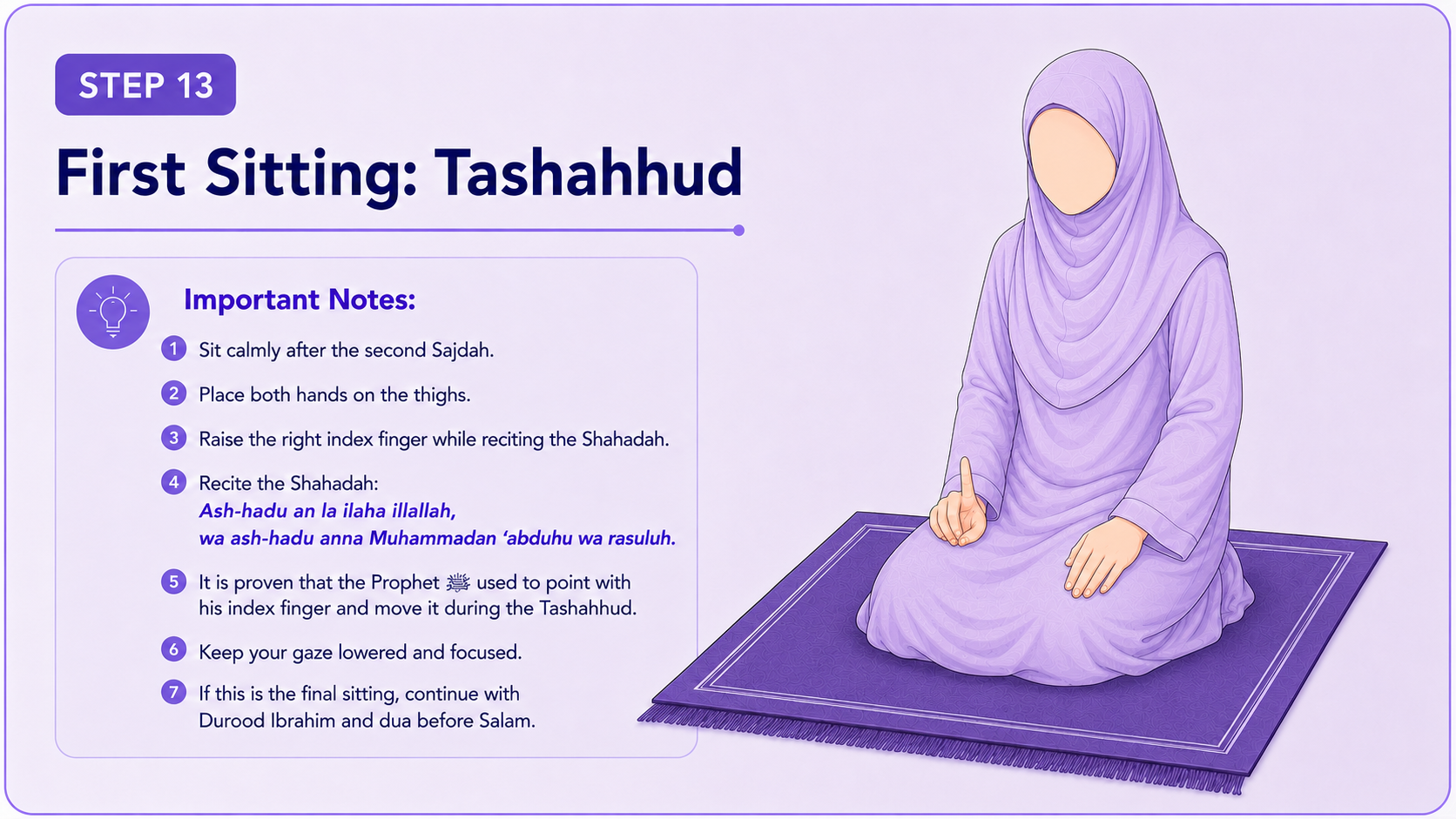
Step 13

First Sitting: Tashahhud

What to do: After two rak‘ahs, sit in the Tashahhud position and recite Tashahhud. If the prayer has more rak‘ahs, stand after Tashahhud. If it is the final sitting, continue with Durood and dua.
التَّحِيَّاتُ لِلَّهِ وَالصَّلَوَاتُ وَالطَّيِّبَاتُ، السَّلَامُ عَلَيْكَ أَيُّهَا النَّبِيُّ وَرَحْمَةُ اللَّهِ وَبَرَكَاتُهُ، السَّلَامُ عَلَيْنَا وَعَلَى عِبَادِ اللَّهِ الصَّالِحِينَ، أَشْهَدُ أَنْ لَا إِلَٰهَ إِلَّا اللَّهُ، وَأَشْهَدُ أَنَّ مُحَمَّدًا عَبْدُهُ وَرَسُولُهُ
Transliteration:
At-tahiyyatu lillahi waṣ-ṣalawatu waṭ-ṭayyibat. As-salamu ‘alayka ayyuhan-Nabiyyu wa rahmatullahi wa barakatuh. As-salamu ‘alayna wa ‘ala ‘ibadillahis-ṣalihin. Ash-hadu an la ilaha illallah, wa ash-hadu anna Muhammadan ‘abduhu wa rasuluh.
Meaning: All greetings, prayers, and pure words are for Allah. Peace be upon you, O Prophet, and the mercy of Allah and His blessings. Peace be upon us and upon the righteous servants of Allah. I testify that none has the right to be worshipped except Allah, and I testify that Muhammad is His servant and Messenger.
Hadith: Sahih al-Bukhari 831.
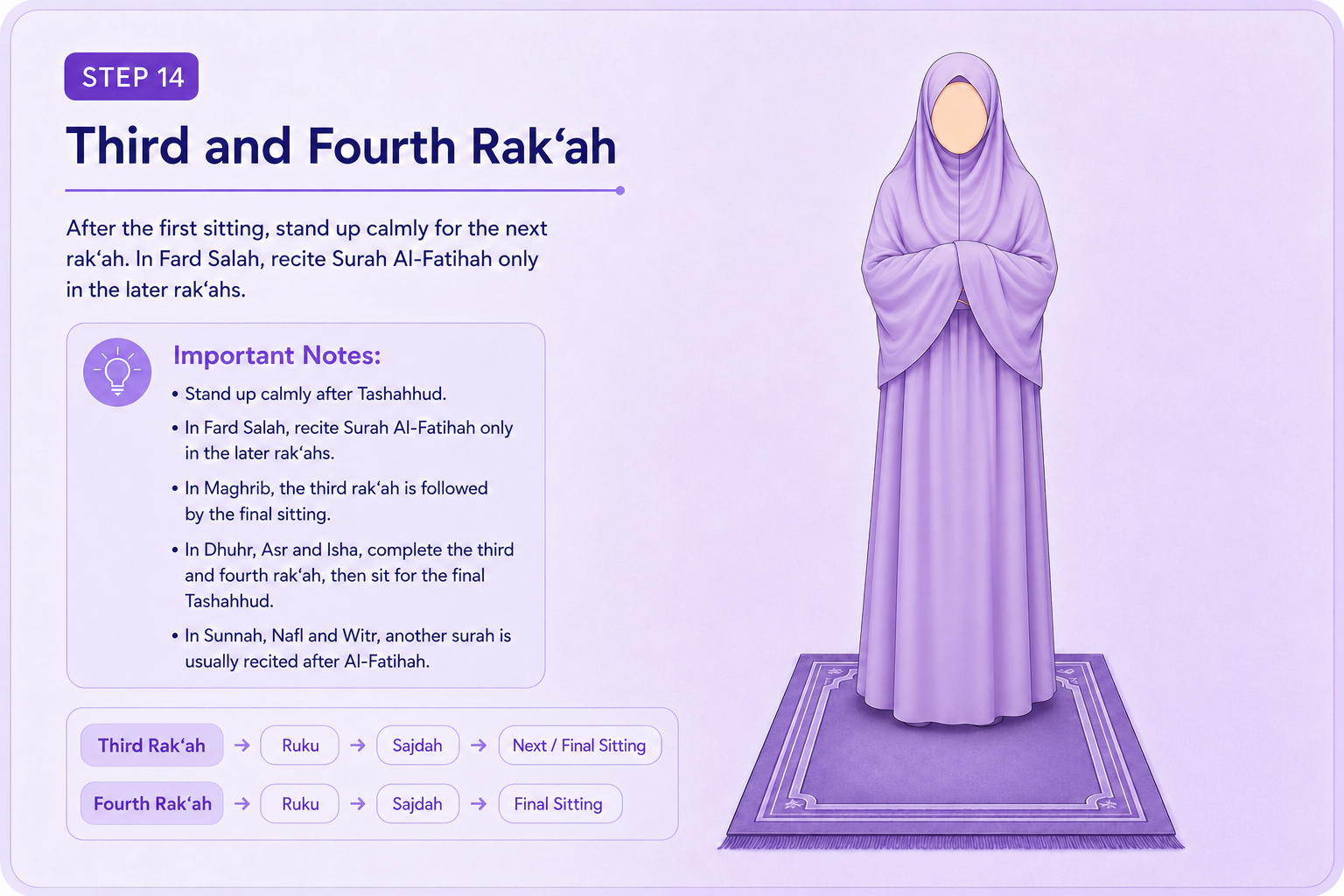
Step 14

Third and Fourth Rak‘ah

What to do: For 3 or 4 rak‘ah prayers, stand after the first sitting and continue the remaining rak‘ahs. Keep the order calm and do not lose count.
Meaning: In 3 rak‘ah prayer, sit finally after the third rak‘ah. In 4 rak‘ah prayer, complete the third and fourth rak‘ahs, then sit finally.
This is why learning how 2, 3, and 4 rak‘ah prayers work is important before practicing the full prayer.
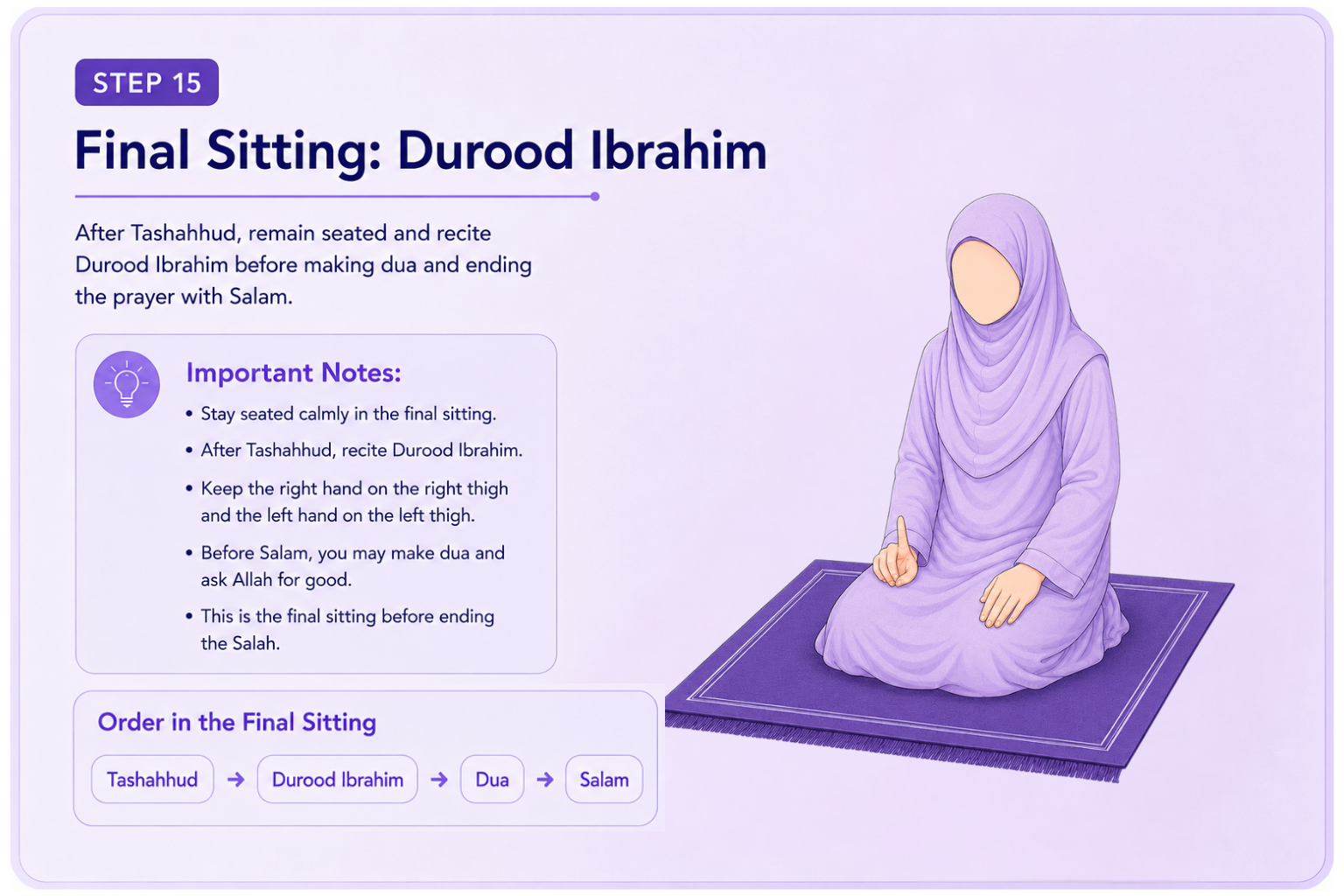
Step 15

Final Sitting: Durood Ibrahim

What to do: In the final sitting, recite Tashahhud, then send blessings upon the Prophet ﷺ with Durood Ibrahim.
اللَّهُمَّ صَلِّ عَلَى مُحَمَّدٍ وَعَلَى آلِ مُحَمَّدٍ، كَمَا صَلَّيْتَ عَلَى إِبْرَاهِيمَ وَعَلَى آلِ إِبْرَاهِيمَ، إِنَّكَ حَمِيدٌ مَجِيدٌ

اللَّهُمَّ بَارِكْ عَلَى مُحَمَّدٍ وَعَلَى آلِ مُحَمَّدٍ، كَمَا بَارَكْتَ عَلَى إِبْرَاهِيمَ وَعَلَى آلِ إِبْرَاهِيمَ، إِنَّكَ حَمِيدٌ مَجِيدٌ
Transliteration:
Allahumma ṣalli ‘ala Muhammad wa ‘ala ali Muhammad, kama ṣallayta ‘ala Ibrahim wa ‘ala ali Ibrahim, innaka Hamidun Majid.

Allahumma barik ‘ala Muhammad wa ‘ala ali Muhammad, kama barakta ‘ala Ibrahim wa ‘ala ali Ibrahim, innaka Hamidun Majid.
Meaning: O Allah, send Your mercy upon Muhammad and the family of Muhammad, as You sent mercy upon Ibrahim and the family of Ibrahim. Indeed, You are Praiseworthy, Glorious. O Allah, bless Muhammad and the family of Muhammad, as You blessed Ibrahim and the family of Ibrahim. Indeed, You are Praiseworthy, Glorious.
Hadith: Sahih al-Bukhari 3370.
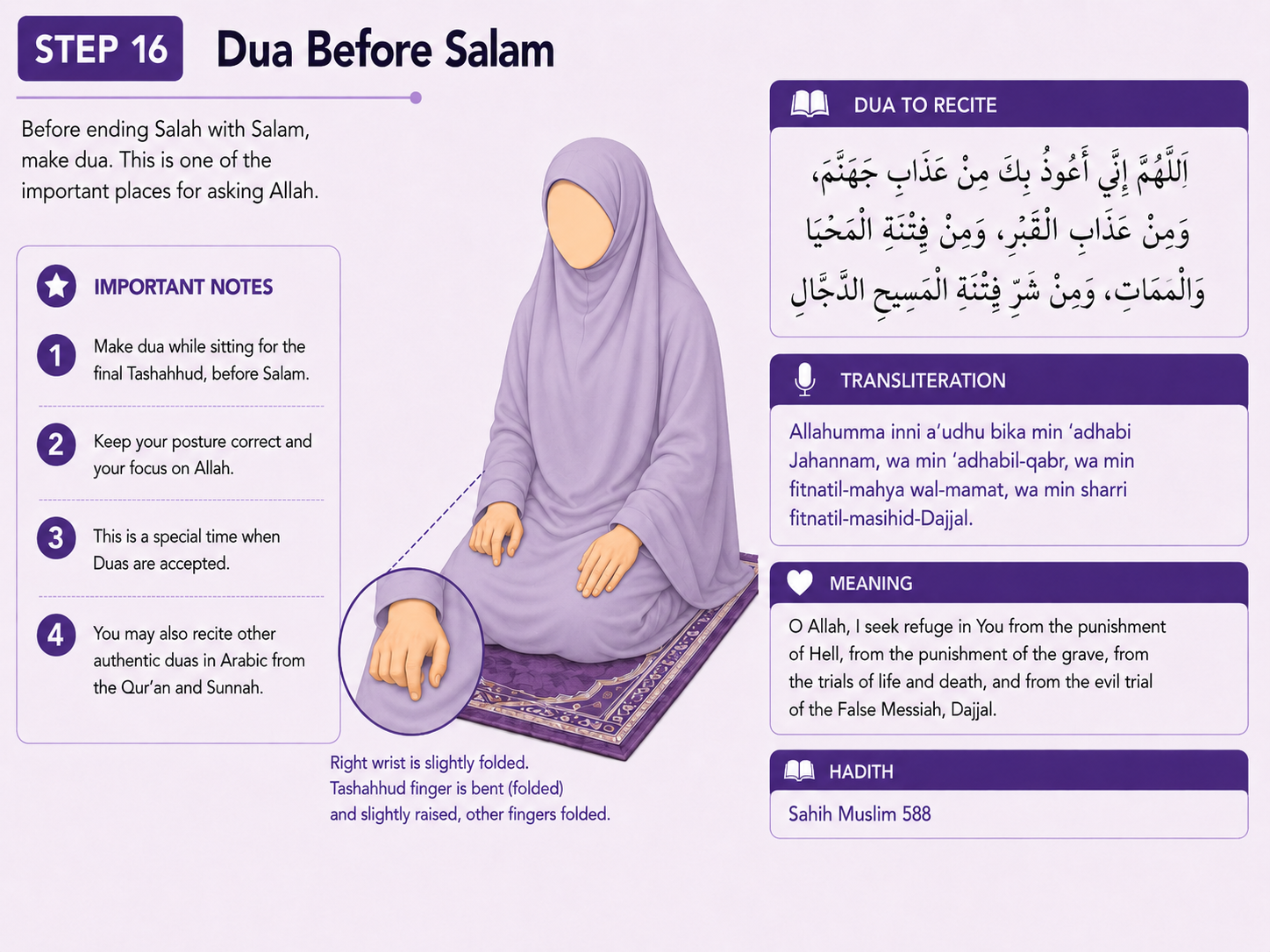
Step 16

Dua Before Salam

What to do: Before ending Salah with Salam, make dua. This is one of the important places for asking Allah.
اللَّهُمَّ إِنِّي أَعُوذُ بِكَ مِنْ عَذَابِ جَهَنَّمَ، وَمِنْ عَذَابِ الْقَبْرِ، وَمِنْ فِتْنَةِ الْمَحْيَا وَالْمَمَاتِ، وَمِنْ شَرِّ فِتْنَةِ الْمَسِيحِ الدَّجَّالِ
Transliteration:
Allahumma inni a‘udhu bika min ‘adhabi Jahannam, wa min ‘adhabil-qabr, wa min fitnatil-mahya wal-mamat, wa min sharri fitnatil-masihid-Dajjal.
Meaning: O Allah, I seek refuge in You from the punishment of Hell, from the punishment of the grave, from the trials of life and death, and from the evil trial of the False Messiah, Dajjal.
Hadith: Sahih Muslim 588. You may also make personal dua before Salam.
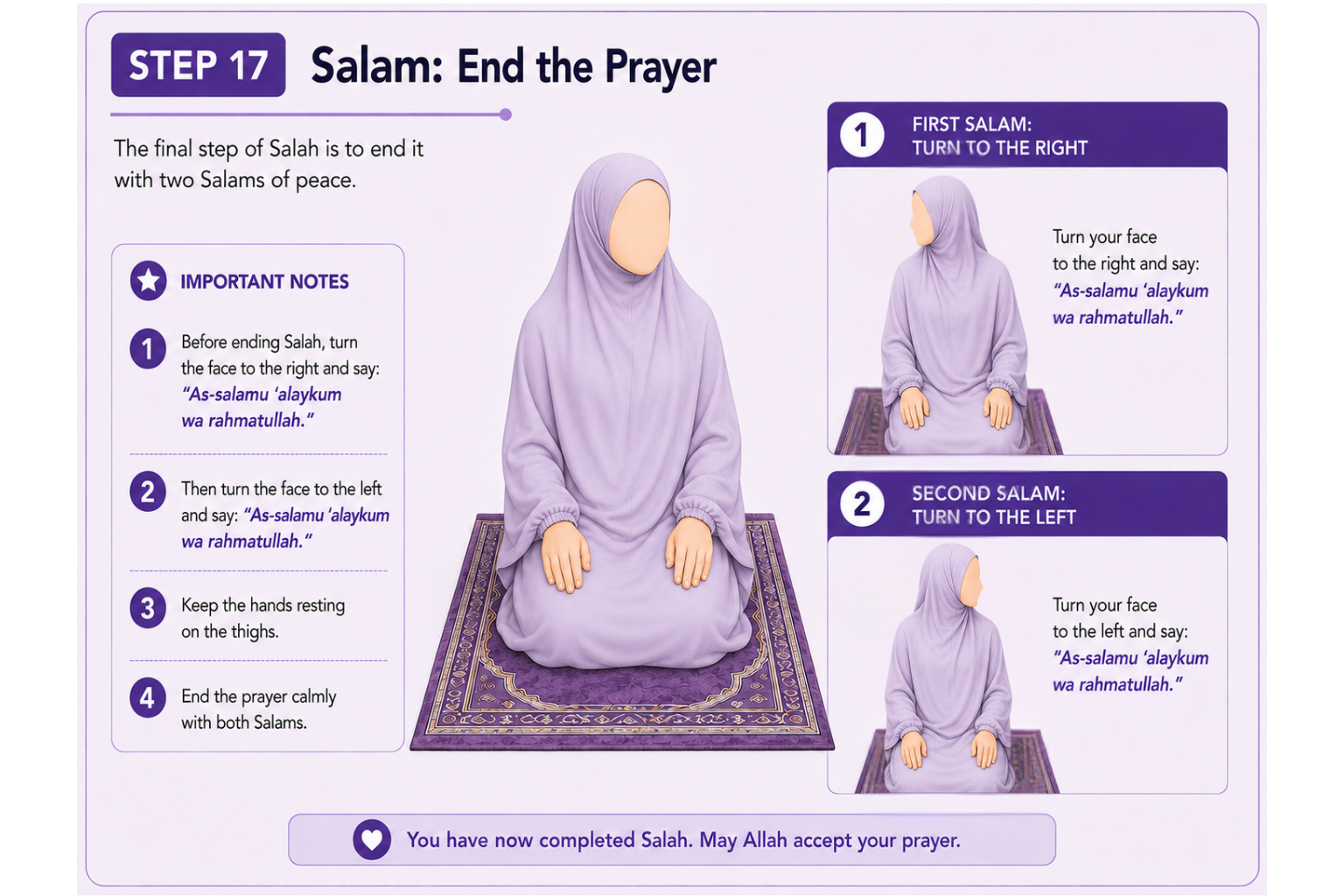
Step 17

Salam: End the Prayer

What to do: Turn the head to the right and say Salam, then turn to the left and say Salam.
السَّلَامُ عَلَيْكُمْ وَرَحْمَةُ اللَّهِ
Transliteration:
As-salamu ‘alaykum wa rahmatullah.
Meaning: Peace be upon you and the mercy of Allah.
This completes the Salah.

Best Places for Dua During Salah

Salah includes moments where a person can ask Allah with humility and hope.

In Sajdah

The Prophet ﷺ said that the closest a servant is to his Lord is while prostrating, so one should make plenty of dua in Sajdah.

Hadith: Sahih Muslim 482

Before Salam

After Tashahhud and Durood Ibrahim, before ending Salah with Salam, a person may make dua and ask Allah for good.

Hadith: Sahih al-Bukhari 835; Sahih Muslim 589

How 2, 3, and 4 Rak‘ah Salah Works

2 Rak‘ah Salah

Pray two full rak‘ahs. After the second rak‘ah, sit for Tashahhud, recite Durood Ibrahim and dua, then end with Salam.

3 Rak‘ah Salah

Pray two rak‘ahs and sit for Tashahhud. Then stand for the third rak‘ah. After the third rak‘ah, sit for the final sitting and end with Salam.

4 Rak‘ah Salah

Pray two rak‘ahs and sit for Tashahhud. Then stand and complete the third and fourth rak‘ahs. After the fourth rak‘ah, sit for the final sitting and end with Salam.

If You Lose Count

Pause calmly and act according to what you are more sure of. If unsure often, learn the rules of Sajdah Sahw separately from a reliable teacher.

Important Posture Notes for Women

  • Cover properly before Salah. Wear loose and opaque clothing that covers the body modestly. The prayer clothing should not be tight or transparent.
  • Stand calmly in Qiyam. Stand facing the Qibla with stillness and fold the hands on the chest in the common women’s prayer posture.
  • In Ruku, keep the posture modest and calm. Bow without rushing, keep the body gathered, and place the hands on the knees.
  • In Sajdah, keep the body gathered. Place the required parts on the ground while keeping the arms and body modestly close.
  • Sit calmly between the two Sajdahs and in Tashahhud. The sitting should be clear and calm, not rushed.
  • Move from one posture to another with calmness. Salah should not feel like a race. Each posture deserves stillness and humility.

Women’s Salah Guidance

  • Salah during menstruation and postnatal bleeding. Women do not pray Salah during menstruation or postnatal bleeding. These missed prayers are not made up later. After the bleeding ends, Ghusl is performed and Salah resumes.
  • Prayer clothes should remain modest during movement. Check that the clothing stays covering during Ruku, Sajdah, and sitting, not only while standing.
  • Hair should be covered. Make sure hair is properly covered before starting Salah and remains covered during the prayer.
  • If praying at home, choose a clean and calm place. A quiet corner helps focus and keeps the prayer steady.

Common Salah Mistakes

  • Rushing the prayer. Many mistakes happen because a person moves too fast through Ruku, Sajdah, and sitting.
  • Not standing straight after Ruku. Rise fully and pause before going into Sajdah.
  • Not sitting calmly between two Sajdahs. This sitting should be clear and calm.
  • Reciting without understanding. Learn the meanings slowly so the heart becomes more present.
  • Losing track of rak‘ahs. Learn the structure of 2, 3, and 4 rak‘ah prayers carefully.
  • Thinking mistakes mean you should stop learning. Keep practicing. Salah becomes easier with steady learning.

Qur’an and Hadith References

  • Salah has fixed times. Allah says prayer is prescribed for believers at fixed times. Qur’an: Surah An-Nisa 4:103
  • Guard the prayers. Allah commands believers to guard the prayers and stand before Him devoutly. Qur’an: Surah Al-Baqarah 2:238
  • Learn the prayer from the Prophet ﷺ. The Prophet ﷺ said, “Pray as you have seen me praying.” Hadith: Sahih al-Bukhari 631
  • Sajdah is a place of closeness. The closest a servant is to his Lord is while prostrating. Hadith: Sahih Muslim 482
  • Dua before Salam is taught in the Sunnah. Supplications were taught before ending Salah. Hadith: Sahih al-Bukhari 835; Sahih Muslim 589
  • Women do not make up missed prayers from menstruation. The Sunnah explains that women do not pray during menstruation and do not make up those prayers after purity returns. Hadith: Sahih al-Bukhari 321; Sahih Muslim 335

ٱلْحَمْدُ لِلَّٰهِ رَبِّ ٱلْعَٰلَمِينَ

All praise is for Allah, Lord of all worlds.