

Story of Dawud عليه السلام
The Prophet and king whom Allah gave strength, wisdom, the Zabur, beautiful recitation, softened iron, just judgment, victory over Jalut, and a heart that turned quickly to Allah in repentance.
The journey of Dawud عليه السلام
A clear path through Talut and Jalut, kingship, the Zabur, mountains and birds, softened iron, judgment, repentance, and worship.
Bani Israel ask for a king
After Musa عليه السلام, a group from Bani Israel ask their Prophet to appoint a king so they can fight in Allah’s path.
Talut is appointed
Allah chooses Talut, though some object because he is not wealthy.
The river tests the army
Many fail the test, while a smaller group remains firm.
Dawud عليه السلام kills Jalut
Allah grants victory through Dawud عليه السلام against the tyrant Jalut.
Allah gives him kingship and wisdom
Dawud عليه السلام becomes both Prophet and king by Allah’s gift.
Allah gives him the Zabur
The Zabur is revealed to Dawud عليه السلام.
Mountains and birds glorify Allah with him
Allah makes creation join Dawud عليه السلام in praise.
Iron is softened for him
Allah teaches him to make coats of mail with balance and skill.
He judges with truth
Allah strengthens his kingdom and teaches him wisdom and decisive speech.
He turns to Allah in repentance
When tested, Dawud عليه السلام seeks forgiveness, bows, and returns to Allah.
Approximate Timeline / Dates
Dates are kept safe and simple. Exact years are not claimed where revelation does not confirm them.
Exact dates are not confirmed
The Qur’an and authentic hadith do not give a confirmed birth year, death year, exact age, or full calendar timeline for Dawud عليه السلام.
He came after Musa عليه السلام in the history of Bani Israel. His story appears with Talut and Jalut, then his kingship, wisdom, and Prophethood.
Place connected to Bani Israel
Dawud عليه السلام was a Prophet and king among Bani Israel. Exact map details, palace locations, and grave claims should not be presented as Qur’an-confirmed facts.
Family Tree / Lineage
Personal Family Tree
This visual should show only the reliable close family details connected to Dawud عليه السلام.
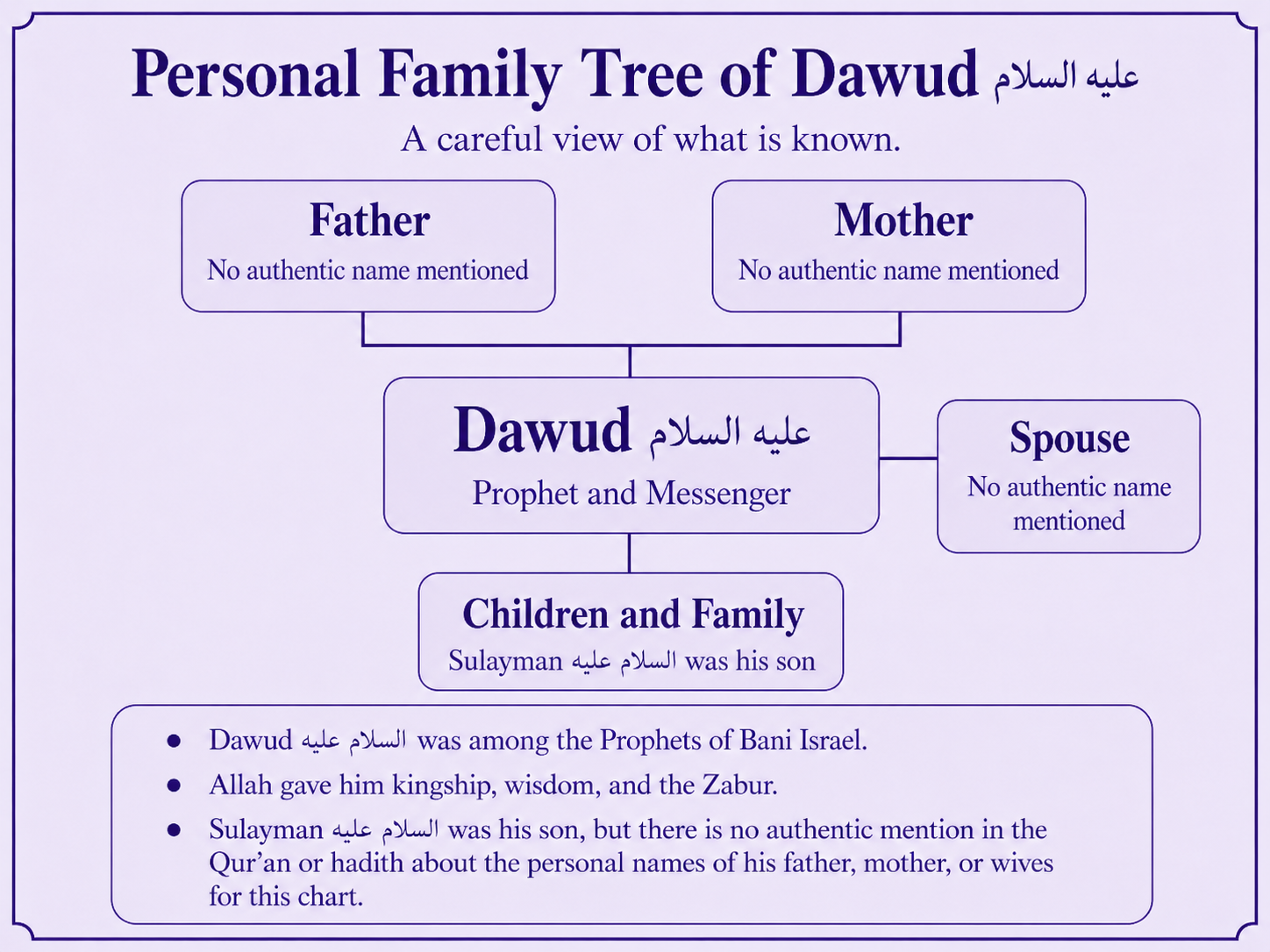
- Use for: Dawud عليه السلام → Sulayman عليه السلام.
- Confirmed: Sulayman عليه السلام was the son and inheritor of Dawud عليه السلام.
- Do not add: wife names, other children, palace details, or grave location as Qur’an-confirmed facts.
Prophetic Lineage
This visual should show the broader Prophetic lineage context without claiming every missing generation is known.

- Use for: Ibrahim عليه السلام → Ishaq عليه السلام → Ya'qub عليه السلام → Bani Israel → Dawud عليه السلام → Sulayman عليه السلام.
- Purpose: show Dawud عليه السلام as a Prophet and king among Bani Israel.
- Do not invent: exact intermediate generations not confirmed in the Qur’an or authentic hadith.
From battlefield courage to Prophetic kingship
Dawud عليه السلام first appears in the Qur’anic story through the battle against Jalut.
A group from Bani Israel asked their Prophet to appoint a king so they could fight in the path of Allah. Allah appointed Talut as king. Some objected because Talut was not wealthy, but their Prophet told them Allah had chosen him and increased him in knowledge and body.
In that army was Dawud عليه السلام. Allah gave victory through him when he killed Jalut. Then Allah gave Dawud عليه السلام kingship, wisdom, and taught him from what He willed.
Talut is appointed as king
Their Prophet told them Allah had appointed Talut as king over them, though some objected because of wealth. Source: Quran 2:246-247, meaning summarized.
The believers’ dua before battle
رَبَّنَا أَفْرِغْ عَلَيْنَا صَبْرًا وَثَبِّتْ أَقْدَامَنَا وَانصُرْنَا عَلَى الْقَوْمِ الْكَافِرِينَ
Rabbana afrigh 'alayna sabran wa thabbit aqdamana wansurna 'alal-qawmil-kafirin.
Our Lord, pour upon us patience, make firm our feet, and give us victory over the disbelieving people. Source: Quran 2:250.
Dawud عليه السلام kills Jalut
وَقَتَلَ دَاوُودُ جَالُوتَ
Wa qatala Dawudu Jalut.
And Dawud killed Jalut. Source: Quran 2:251, relevant part.
Kingship and wisdom
وَآتَاهُ اللَّهُ الْمُلْكَ وَالْحِكْمَةَ
Wa atahullahu al-mulka wal-hikmah.
And Allah gave him kingship and wisdom. Source: Quran 2:251, relevant part.
Allah gave Dawud عليه السلام the Zabur
Dawud عليه السلام was given scripture: the Zabur.
The Qur’an mentions the Zabur clearly. This was one of the great honours of Dawud عليه السلام. He was a Prophet with revelation, not merely a brave warrior or political ruler.
His worship and recitation were famous. Authentic hadith describe the beauty and speed of his recitation and the special nature of his prayer and fasting. He had strength, kingdom, skill, and scripture, but his greatness was rooted in turning to Allah.
We gave Dawud the Zabur
وَآتَيْنَا دَاوُودَ زَبُورًا
Wa atayna Dawuda Zabura.
And We gave Dawud the Zabur. Source: Quran 17:55 and Quran 4:163.
Beautiful worship
Authentic hadith mention the prayer and fasting of Dawud عليه السلام as especially beloved to Allah, and mention his recitation of the Zabur. Reported in Sahih al-Bukhari and Sahih Muslim, meaning summarized.
Power did not make Dawud عليه السلام distant from worship. His kingdom and devotion stood together.
Mountains and birds glorified Allah with him
Allah gave Dawud عليه السلام a unique honour: the mountains and birds glorified Allah with him. His worship was not isolated from creation. The mountains and birds joined in praise by Allah’s command.
This shows the beauty of his voice and remembrance, but more importantly it shows Allah’s power over creation. A king’s court may gather people, but Allah gathered mountains and birds around the praise of Dawud عليه السلام.
O mountains, repeat with him
يَا جِبَالُ أَوِّبِي مَعَهُ وَالطَّيْرَ
Ya jibalu awwibi ma'ahu wat-tayr.
O mountains, repeat with him, and the birds. Source: Quran 34:10, relevant meaning.
Mountains and birds gathered
Allah subjected the mountains to exalt Allah with Dawud عليه السلام in the evening and sunrise, and the birds were gathered, all turning with him. Source: Quran 38:18-19, meaning summarized.
Iron was softened for Dawud عليه السلام
Allah softened iron for Dawud عليه السلام and taught him to make coats of mail.
This was not merely a craft lesson. It was a gift tied to protection, skill, balance, and gratitude. Dawud عليه السلام was told to make full coats of mail and calculate the links properly.
The Qur’an connects this gift to righteous action. Technology, strength, and industry are blessings when they are used in obedience to Allah and for protection, not oppression.
We softened iron for him
وَأَلَنَّا لَهُ الْحَدِيدَ
Wa alanna lahul-hadid.
And We softened iron for him. Source: Quran 34:10, relevant part.
Make coats of mail and calculate the links
أَنِ اعْمَلْ سَابِغَاتٍ وَقَدِّرْ فِي السَّرْدِ
Ani'mal sabighatin wa qaddir fis-sard.
Make full coats of mail and calculate precisely in the links. Source: Quran 34:11, relevant meaning.
Wisdom, strong kingdom, and decisive speech
Allah strengthened the kingdom of Dawud عليه السلام and gave him wisdom and decisive speech. His kingship was not meant for pride. It was a trust requiring justice.
Allah told him that he had been made a khalifah on earth and commanded him to judge between people with truth and not follow desire. This is one of the most direct Qur’anic lessons about leadership: judgement must be tied to truth, not personal desire.
Strong kingdom and decisive speech
وَشَدَدْنَا مُلْكَهُ وَآتَيْنَاهُ الْحِكْمَةَ وَفَصْلَ الْخِطَابِ
Wa shadadna mulkahu wa ataynahul-hikmata wa faslal-khitab.
We strengthened his kingdom and gave him wisdom and decisive speech. Source: Quran 38:20.
Judge between people with truth
فَاحْكُم بَيْنَ النَّاسِ بِالْحَقِّ وَلَا تَتَّبِعِ الْهَوَىٰ
Fahkum baynan-nasi bil-haqqi wa la tattabi'il-hawa.
So judge between people with truth and do not follow desire. Source: Quran 38:26, relevant part.
The field damaged by sheep
The Qur’an mentions Dawud and Sulayman عليهما السلام judging a case about a field when the sheep of a people had pastured in it by night. Allah gave understanding of the case to Sulayman عليه السلام, while both Dawud and Sulayman عليهما السلام were given judgement and knowledge.
This story teaches that even when one ruling is more precise, both Prophets remain honoured by Allah. It also teaches that judges and leaders must seek the best understanding, and Allah gives insight to whom He wills.
Dawud and Sulayman judged the field
Dawud and Sulayman عليهما السلام judged concerning a field damaged by sheep at night, and Allah was witness to their judgement. Source: Quran 21:78, meaning summarized.
Allah gave understanding to Sulayman
Allah gave understanding of it to Sulayman عليه السلام, and to each He gave judgement and knowledge. Source: Quran 21:79, meaning summarized.
A correction or stronger judgement does not erase the honour of a Prophet. Allah praised both.
The two disputants and Dawud’s repentance
Surah Sad mentions a test involving two disputants who entered upon Dawud عليه السلام.
They came suddenly into his private place of worship, and he was alarmed. They told him not to fear and presented a dispute. One said his brother had ninety-nine ewes while he had one, and that the brother wanted to add his one ewe to his own.
Dawud عليه السلام judged that the one demanding the ewe had wronged the other. Then he realised he had been tested, sought forgiveness from his Lord, bowed down, and turned in repentance. Allah forgave him and said he had nearness and a good return.
Some books add detailed stories around this incident that are disrespectful to Dawud عليه السلام. They should not be taught as Qur’anic fact. The Qur’an gives the safe lesson: a Prophet was tested, he quickly returned to Allah, and Allah honoured him.
Ninety-nine ewes and one ewe
One disputant said his brother had ninety-nine ewes and he had one ewe, and the brother wanted to take it. Source: Quran 38:23, meaning summarized.
Dawud عليه السلام sought forgiveness
فَاسْتَغْفَرَ رَبَّهُ وَخَرَّ رَاكِعًا وَأَنَابَ
Fastaghfara rabbahu wa kharra raki'an wa anab.
He sought forgiveness from his Lord, fell bowing, and turned in repentance. Source: Quran 38:24, relevant part.
Allah forgave him
فَغَفَرْنَا لَهُ ذَٰلِكَ
Faghafarna lahu dhalik.
So We forgave him that. Source: Quran 38:25, relevant part.
Avoid disrespectful additions
The Qur’an does not give the scandal-style details found in some later reports. A public page should not repeat stories that harm the honour of a Prophet without clear authentic proof.
Dawud عليه السلام ate from his own work
Authentic hadith mention that Dawud عليه السلام used to eat from the work of his own hand. This fits beautifully with the Qur’anic mention of softened iron and making coats of mail.
He was a king, yet he was connected to work, skill, and earning. His story teaches that honourable work is not beneath a righteous person. A Prophet and king could still value earning through his own effort.
Eating from the work of his own hand
Authentic hadith mention that Dawud عليه السلام used to eat from the work of his own hand. Reported in Sahih al-Bukhari, meaning summarized.
Skill, labour, and halal earning are noble when joined with gratitude and obedience.
Duas and powerful words connected to Dawud عليه السلام
رَبَّنَا أَفْرِغْ عَلَيْنَا صَبْرًا وَثَبِّتْ أَقْدَامَنَا وَانصُرْنَا عَلَى الْقَوْمِ الْكَافِرِينَ
Rabbana afrigh 'alayna sabran wa thabbit aqdamana wansurna 'alal-qawmil-kafirin.
Our Lord, pour upon us patience, make firm our feet, and give us victory over the disbelieving people. Source: Quran 2:250.
فَاسْتَغْفَرَ رَبَّهُ وَخَرَّ رَاكِعًا وَأَنَابَ
Fastaghfara rabbahu wa kharra raki'an wa anab.
He sought forgiveness from his Lord, fell bowing, and turned in repentance. Source: Quran 38:24. The Qur’an describes his repentance but does not quote a separate spoken dua from him in this verse.
فَاحْكُم بَيْنَ النَّاسِ بِالْحَقِّ وَلَا تَتَّبِعِ الْهَوَىٰ
Fahkum baynan-nasi bil-haqqi wa la tattabi'il-hawa.
Judge between people with truth and do not follow desire. Source: Quran 38:26, relevant part.
نِعْمَ الْعَبْدُ ۖ إِنَّهُ أَوَّابٌ
Ni'mal-'abd. Innahu awwab.
What an excellent servant. Indeed, he constantly turned back to Allah. Source: Quran 38:30 uses this praise for Sulayman عليه السلام, while Quran 38:17 describes Dawud عليه السلام as one who constantly turned back to Allah.
Common questions about Dawud عليه السلام
These points are often mixed with stories from outside the Qur’an, so they need careful wording.
Was Dawud عليه السلام given a scripture?
Yes. The Qur’an clearly says Allah gave Dawud عليه السلام the Zabur.
Was he both Prophet and king?
Yes. Allah gave him kingship and wisdom. His rule was a trust connected to truth, worship, and justice.
Is Jalut the same as Goliath?
Jalut is commonly identified with Goliath in English discussions. On an Islamic page, it is best to use the Qur’anic name Jalut and mention the common English identification only if needed.
Should the scandal-style stories about the disputants be included?
No. The Qur’an gives the safe and honoured wording. Disrespectful extra details from later reports should not be taught as fact about a Prophet.
Do we have a direct dua quote from Dawud عليه السلام?
The Qur’an describes Dawud عليه السلام seeking forgiveness and turning in repentance, but it does not quote a separate spoken dua from him in that verse. The page includes the Qur’anic wording of his repentance and the believers’ dua before Jalut.
Do we know his grave?
There are historical and local claims about the grave of Dawud عليه السلام, but no exact grave location is established from the Qur’an as required belief. Such claims should be handled cautiously.
Allah gives victory through whom He wills
Dawud عليه السلام killed Jalut by Allah’s permission, and a small faithful group overcame a larger enemy.
Power needs wisdom
Allah gave Dawud عليه السلام kingship with wisdom and decisive speech.
Worship can beautify leadership
Dawud عليه السلام had kingdom, but he was known for recitation, prayer, fasting, and turning to Allah.
Skill is a gift from Allah
Softened iron and coats of mail show that craft and technology can serve righteousness.
Judge with truth, not desire
Allah commanded Dawud عليه السلام to judge between people with truth and not follow desire.
Return quickly after a test
Dawud عليه السلام sought forgiveness, bowed, and turned back to Allah.
Common mistakes about this story
- Reducing Dawud عليه السلام to a warrior: he was a Prophet, king, worshipper, judge, and recipient of scripture.
- Adding disrespectful scandal stories: do not narrate unsupported details about the disputants as fact.
- Forgetting the Zabur: the Qur’an clearly mentions that Allah gave him the Zabur.
- Separating power from justice: his rule was tied to judging with truth.
- Ignoring halal work: authentic hadith mention that he ate from the work of his own hand.
- Claiming exact dates and graves: these are not established as clear Qur’an facts.
The whole story in eight lines
- Bani Israel asked for a king, and Allah appointed Talut.
- A small faithful group faced Jalut and his army.
- Dawud عليه السلام killed Jalut by Allah’s permission.
- Allah gave Dawud عليه السلام kingship, wisdom, and the Zabur.
- Mountains and birds glorified Allah with him.
- Allah softened iron for him and taught him coats of mail.
- Allah gave him judgement, knowledge, and decisive speech.
- When tested, he sought forgiveness and turned back to Allah.
Main references used
- Qur’an: Talut, the battle, the believers’ dua, Dawud killing Jalut, kingship and wisdom: Quran 2:246-251.
- Qur’an: Dawud عليه السلام given the Zabur: Quran 4:163 and Quran 17:55.
- Qur’an: Mountains, birds, softened iron, and coats of mail: Quran 34:10-11, Quran 38:18-19.
- Qur’an: Dawud and Sulayman عليهما السلام judging the field: Quran 21:78-79.
- Qur’an: Strong kingdom, wisdom, decisive speech, disputants, repentance, and judging with truth: Quran 38:17-26.
- Qur’an: Dawud عليه السلام among guided Prophets: Quran 6:84.
- Hadith: Authentic hadith mention the prayer and fasting of Dawud عليه السلام, his recitation of the Zabur, and that he ate from the work of his own hand. Reported in Sahih al-Bukhari and Sahih Muslim, meaning summarized.
- Extra details: Exact dates, grave location, and disrespectful expanded stories around the disputants are not established as clear Qur’an facts and should not be taught as certainty.
Dawud عليه السلام teaches power that bows
His story gathers strength and softness in one place: victory over Jalut, a strong kingdom, wisdom in judgement, iron softened in his hands, mountains and birds joining his praise, and a heart that quickly turned back to Allah. Dawud عليه السلام teaches that the strongest leader is not the one who never bows. It is the one whose power, work, voice, and judgement all bow before Allah.