

Story of Harun عليه السلام
The brother of Musa عليه السلام, gifted as a Prophet by Allah’s mercy, chosen as a helper in the mission to Pharaoh, known for clear speech, patience with Bani Israel, warning against the calf, and standing firm while trying to protect unity and faith.
The journey of Harun عليه السلام
A clear path through his Prophethood, support for Musa عليه السلام, mission to Pharaoh, leadership during the forty nights, the calf trial, and his defence before Musa عليه السلام.
Musa عليه السلام asks for Harun
Musa عليه السلام asks Allah to appoint his brother as a helper and strengthen him through him.
Allah grants Harun عليه السلام as mercy
Allah makes Harun عليه السلام a Prophet and support for Musa عليه السلام.
They are sent to Pharaoh
Allah commands both brothers to speak gently to Pharaoh and call him to Allah.
They face denial and arrogance
Pharaoh rejects the signs, challenges them with magicians, and continues oppression.
Allah saves them through the sea
Musa, Harun, and Bani Israel are saved while Pharaoh and his army are drowned.
Musa عليه السلام leaves Harun in charge
During the forty nights, Musa عليه السلام appoints Harun عليه السلام over his people and tells him to reform.
The Samiri misleads Bani Israel
They take the calf, and Harun عليه السلام warns them that they are being tested.
Harun عليه السلام is overpowered
He explains that the people weakened him and almost killed him.
Musa عليه السلام makes dua for them both
Musa عليه السلام asks Allah to forgive him and his brother and admit them into His mercy.
Approximate Timeline / Dates
Dates are kept safe and simple. Exact years are not claimed where revelation does not confirm them.
Exact dates are not confirmed
The Qur’an and authentic hadith do not give a confirmed birth year, death year, exact age, or full calendar timeline for Harun عليه السلام.
Harun عليه السلام lived in the time of Musa عليه السلام. He was sent with Musa عليه السلام to Pharaoh and to Bani Israel.
Connected to Musa عليه السلام and Bani Israel
His mission is connected with Egypt, Pharaoh, the Exodus, and Bani Israel. Exact grave location and many later place claims should not be stated as Qur’an-confirmed facts.
Family Tree / Lineage
Personal Family Tree
This visual should show only the reliable close family details connected to Harun عليه السلام.
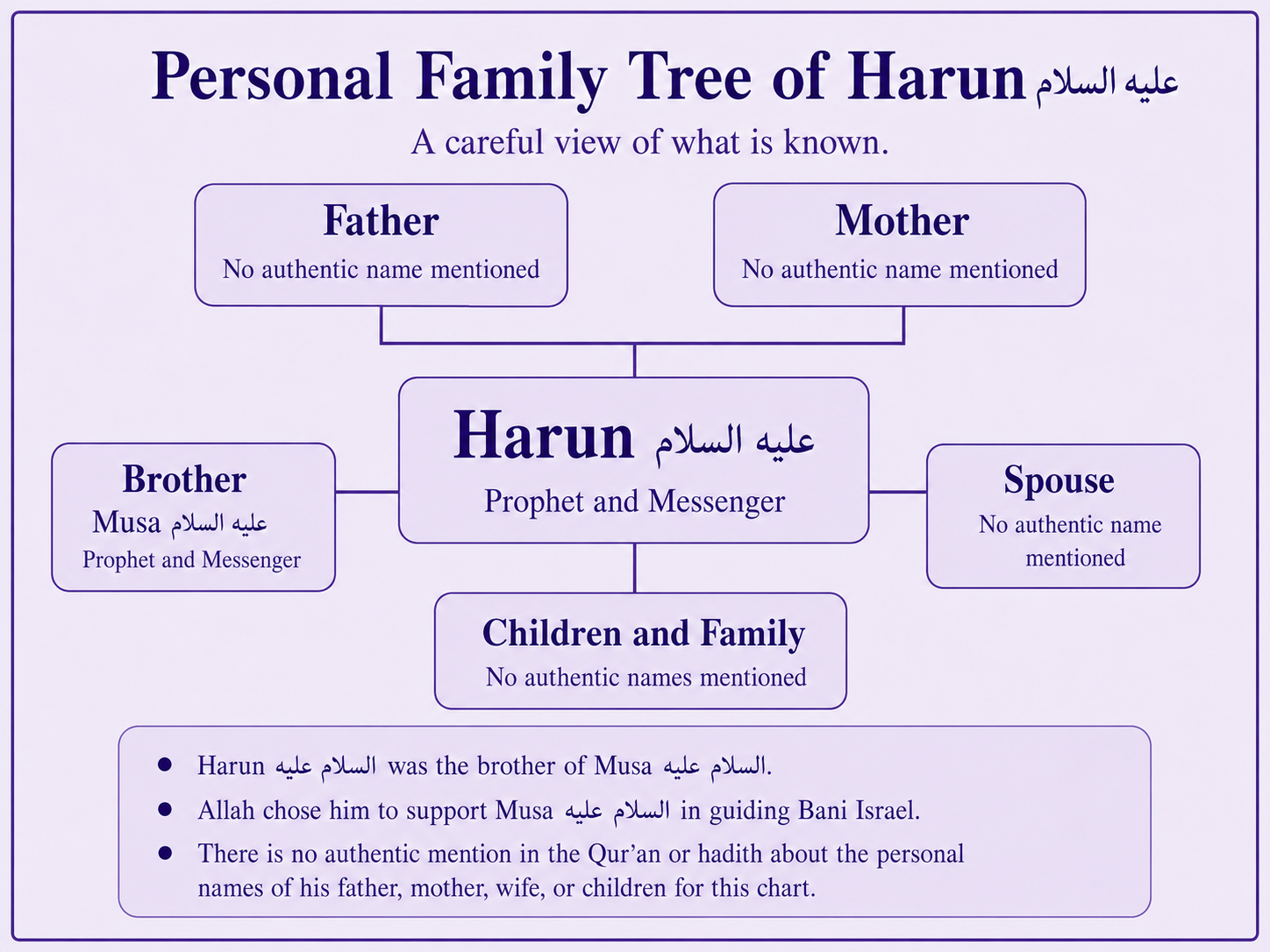
- Use for: Musa عليه السلام and Harun عليه السلام as brothers.
- Confirmed: the Qur’an clearly mentions Harun عليه السلام as the brother of Musa عليه السلام.
- Do not add: parents’ names, wife, children, exact birth order, or grave location as Qur’an-confirmed facts.
Prophetic Lineage
This visual should show the broader Prophetic lineage context without claiming every missing generation is known.
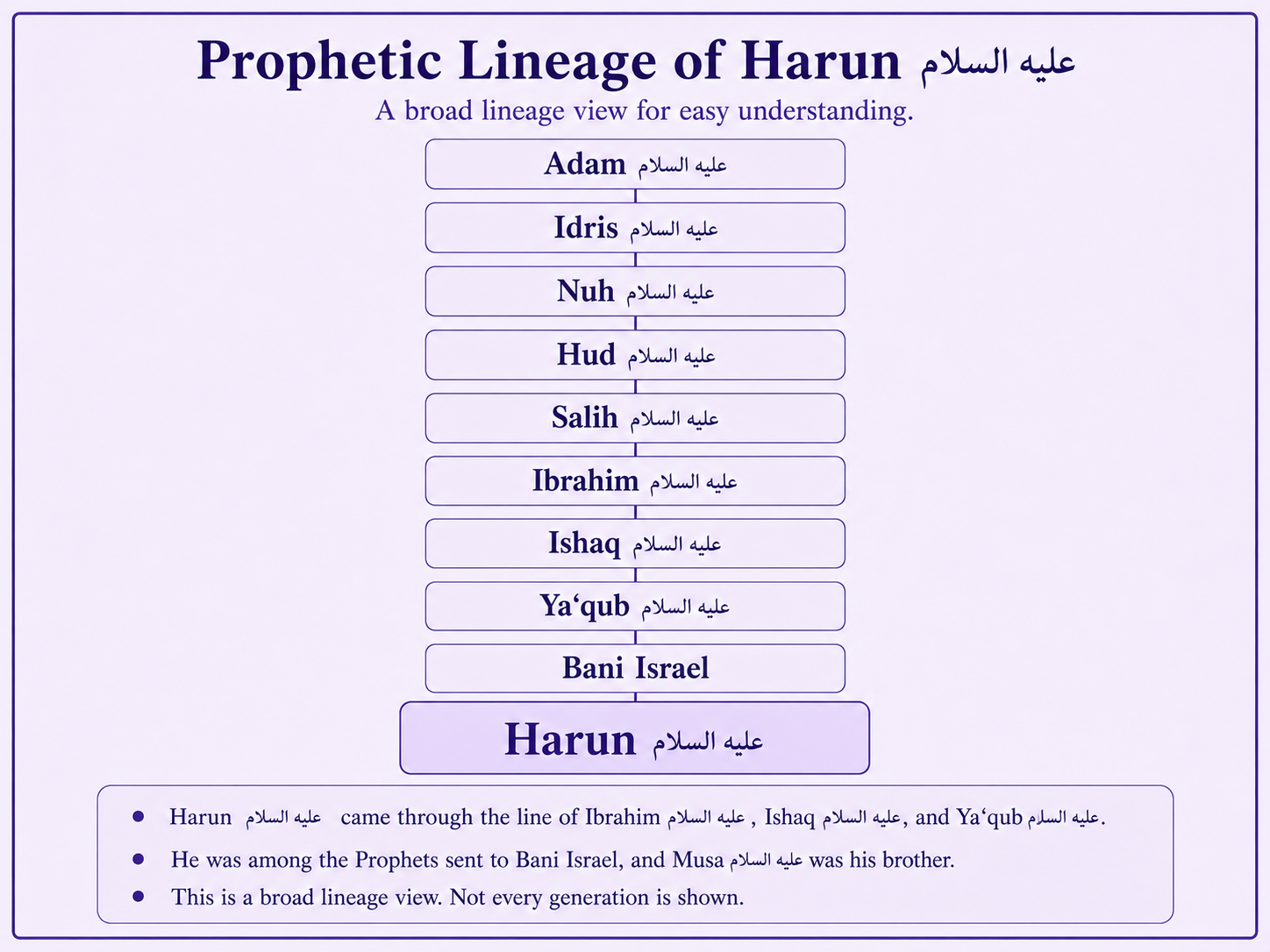
- Use for: Ibrahim عليه السلام → Ishaq عليه السلام → Ya'qub عليه السلام → Bani Israel → Musa and Harun عليهما السلام.
- Purpose: show Harun عليه السلام as a Prophet from Bani Israel and helper of Musa عليه السلام.
- Do not invent: exact intermediate generations not confirmed in the Qur’an or authentic hadith.
A brother requested for a Prophetic mission
Harun عليه السلام enters the Qur’anic story through one of the most beautiful requests of Musa عليه السلام.
When Allah sent Musa عليه السلام back to Pharaoh, Musa عليه السلام knew the mission was enormous. Pharaoh was a tyrant. Bani Israel were oppressed. The message would be rejected, mocked, and fought. Musa عليه السلام asked Allah to expand his chest, ease his task, loosen his tongue, and appoint Harun عليه السلام as a helper from his family.
This request shows love, humility, and wisdom. Musa عليه السلام did not see his brother as a rival. He saw him as support in obedience to Allah. Harun عليه السلام was granted as mercy, and both brothers became a model of Prophetic teamwork.
Appoint for me a helper from my family
وَاجْعَل لِّي وَزِيرًا مِّنْ أَهْلِي هَارُونَ أَخِي
Waj'al li waziram-min ahli. Haruna akhi.
And appoint for me a helper from my family, Harun, my brother. Source: Quran 20:29-30.
Strengthen me through him
اشْدُدْ بِهِ أَزْرِي وَأَشْرِكْهُ فِي أَمْرِي
Ushdud bihi azri. Wa ashrikhu fi amri.
Strengthen through him my back, and let him share my task. Source: Quran 20:31-32.
He is more fluent than me in speech
هُوَ أَفْصَحُ مِنِّي لِسَانًا
Huwa afsahu minni lisana.
He is more fluent than me in speech. Source: Quran 28:34, relevant part.
Granted as a Prophet
وَوَهَبْنَا لَهُ مِن رَّحْمَتِنَا أَخَاهُ هَارُونَ نَبِيًّا
Wa wahabna lahu mir-rahmatina akhahu Haruna nabiyya.
And We granted him, from Our mercy, his brother Harun as a Prophet. Source: Quran 19:53.
Sent together to Pharaoh
Allah sent Musa and Harun عليهما السلام to Pharaoh, who had transgressed. They were commanded to speak to him with gentle words, so perhaps he would remember or fear Allah.
They feared that Pharaoh might hasten against them or become more oppressive. Allah reassured both brothers: “Do not fear. Indeed, I am with you both, hearing and seeing.”
Harun عليه السلام therefore stood beside Musa عليه السلام in one of the most dangerous missions in history: calling a tyrant away from arrogance and oppression and demanding the freedom of Bani Israel.
Go, you and your brother, with My signs
اذْهَبْ أَنتَ وَأَخُوكَ بِآيَاتِي
Idhhab anta wa akhuka bi ayati.
Go, you and your brother, with My signs. Source: Quran 20:42, relevant part.
Speak gently to Pharaoh
فَقُولَا لَهُ قَوْلًا لَّيِّنًا
Fa qula lahu qawlal-layyina.
So speak to him with gentle speech. Source: Quran 20:44, relevant part.
I am with you both
لَا تَخَافَا ۖ إِنَّنِي مَعَكُمَا أَسْمَعُ وَأَرَىٰ
La takhafa. Innani ma'akuma asma'u wa ara.
Do not fear. Indeed, I am with you both, hearing and seeing. Source: Quran 20:46.
Send Bani Israel with us
Musa and Harun عليهما السلام were told to say to Pharaoh that they were Messengers of his Lord and to send Bani Israel with them and not punish them. Source: Quran 20:47, meaning summarized.
Standing beside Musa عليه السلام against false power
Pharaoh mocked, argued, accused, and gathered magicians. The mission of Musa and Harun عليهما السلام continued through signs, public challenge, and Pharaoh’s stubborn refusal.
When the magicians saw the truth, they fell in prostration and declared belief in the Lord of Harun and Musa. Pharaoh threatened them, but truth had already entered their hearts.
Harun عليه السلام is sometimes mentioned less in the story because Musa عليه السلام is the main Messenger sent to Pharaoh, but the Qur’an repeatedly places Harun beside him as a Prophet, brother, supporter, and partner in the mission.
Lord of Harun and Musa
آمَنَّا بِرَبِّ هَارُونَ وَمُوسَىٰ
Amanna birabbi Haruna wa Musa.
We believe in the Lord of Harun and Musa. Source: Quran 20:70, relevant part.
Musa and Harun were called liars
Pharaoh’s people denied Musa and Harun عليهما السلام, so they were among those destroyed. Source: Quran 23:45-48, meaning summarized.
Rejecting Allah’s Messengers after clear signs is not a small matter. Pharaoh’s power could not protect him from Allah.
Musa عليه السلام leaves Harun عليه السلام in charge
When Allah appointed Musa عليه السلام for forty nights, Musa عليه السلام told Harun عليه السلام to take his place among the people, to reform, and not follow the way of those who spread corruption.
This shows Harun’s responsibility among Bani Israel. He was not passive. He was entrusted with leadership while Musa عليه السلام went to receive revelation.
But Bani Israel were quickly tested. The Samiri misled them, and they took a calf as an object of worship. The people who had just been saved from Pharaoh fell into a terrible act of shirk.
Take my place among my people
اخْلُفْنِي فِي قَوْمِي وَأَصْلِحْ وَلَا تَتَّبِعْ سَبِيلَ الْمُفْسِدِينَ
Ukhlufni fi qawmi wa aslih wa la tattabi' sabilal-mufsidin.
Take my place among my people, reform, and do not follow the way of the corrupters. Source: Quran 7:142, relevant part.
The Samiri misled them
Allah informed Musa عليه السلام that his people had been tested after he left, and the Samiri had misled them. Source: Quran 20:85, meaning summarized.
Harun عليه السلام warns them about the calf
Harun عليه السلام warned Bani Israel before Musa عليه السلام returned. He told them they were being tested by the calf, that their Lord is the Most Merciful, and that they should follow him and obey his command.
The people refused. They said they would continue devoted to the calf until Musa عليه السلام returned. This shows that Harun عليه السلام did not approve of the calf and did not stay silent about shirk. He warned them clearly.
His situation was difficult: he had to oppose false worship while facing a people who were already slipping into rebellion and could split apart or even turn violent.
You are only being tested by it
يَا قَوْمِ إِنَّمَا فُتِنتُم بِهِ
Ya qawmi innama futintum bih.
O my people, you are only being tested by it. Source: Quran 20:90, relevant part.
Your Lord is the Most Merciful
وَإِنَّ رَبَّكُمُ الرَّحْمَٰنُ فَاتَّبِعُونِي وَأَطِيعُوا أَمْرِي
Wa inna rabbakumur-Rahmanu fattabi'uni wa ati'u amri.
And indeed your Lord is the Most Merciful, so follow me and obey my command. Source: Quran 20:90, relevant part.
Musa عليه السلام returns angry and grieved
When Musa عليه السلام returned and saw the calf worship, he was angry and grieved for Allah’s sake. He took hold of his brother’s head and beard, demanding why Harun عليه السلام had not followed him and whether he had disobeyed his command.
Harun عليه السلام answered with humility and pain. He said the people had deemed him weak and almost killed him. He also said he feared Musa عليه السلام would say he had caused division among Bani Israel and had not observed his word.
This does not show weakness in faith. It shows the pressure of leadership during a severe community collapse. Harun عليه السلام warned them, but they resisted, and he tried to avoid a greater split until Musa عليه السلام returned.
O son of my mother, do not seize my beard or head
يَا ابْنَ أُمَّ لَا تَأْخُذْ بِلِحْيَتِي وَلَا بِرَأْسِي
Yabna umma la ta'khudh bilihyati wa la bira'si.
O son of my mother, do not seize me by my beard or by my head. Source: Quran 20:94, relevant meaning.
I feared you would say I caused division
إِنِّي خَشِيتُ أَن تَقُولَ فَرَّقْتَ بَيْنَ بَنِي إِسْرَائِيلَ
Inni khashitu an taqula farraqta bayna Bani Isra'il.
Indeed, I feared that you would say: You caused division among Bani Israel. Source: Quran 20:94, relevant part.
The people deemed me weak
إِنَّ الْقَوْمَ اسْتَضْعَفُونِي وَكَادُوا يَقْتُلُونَنِي
Innal-qawma istad'afuni wa kadu yaqtulunani.
Indeed, the people deemed me weak and almost killed me. Source: Quran 7:150, relevant part.
Do not place me among the wrongdoers
فَلَا تُشْمِتْ بِيَ الْأَعْدَاءَ وَلَا تَجْعَلْنِي مَعَ الْقَوْمِ الظَّالِمِينَ
Fa la tushmit biyal-a'da'a wa la taj'alni ma'al-qawmiz-zalimin.
So do not let the enemies rejoice over me and do not place me with the wrongdoing people. Source: Quran 7:150, relevant meaning.
Musa عليه السلام asks forgiveness for himself and Harun عليه السلام
After Harun عليه السلام explained his situation, Musa عليه السلام made dua for himself and his brother. He asked Allah to forgive them and admit them into His mercy.
This dua is important because it shows the brotherhood of the Prophets after a painful moment. Musa عليه السلام was angry for Allah’s religion, Harun عليه السلام had warned the people and been overpowered, and the matter returned to Allah’s forgiveness and mercy.
Forgive me and my brother
رَبِّ اغْفِرْ لِي وَلِأَخِي وَأَدْخِلْنَا فِي رَحْمَتِكَ
Rabbighfir li wa li akhi wa adkhilna fi rahmatik.
My Lord, forgive me and my brother and admit us into Your mercy. Source: Quran 7:151, relevant part.
Even after a painful family and community crisis, the hearts of the Prophets returned to forgiveness and Allah’s mercy.
Harun عليه السلام among the chosen Prophets
The Qur’an mentions Harun عليه السلام among the Prophets guided by Allah. He is also mentioned in the line of those upon whom Allah bestowed favour.
His story is often hidden behind the larger story of Musa عليه السلام, but the Qur’an does not hide his rank. He was a Prophet, a supporter of a Messenger, a caller to tawheed, a guardian of his people during a dangerous trial, and a servant whom Allah honoured.
Among the guided
Allah mentions Harun عليه السلام among the Prophets He guided. Source: Quran 6:84-87, meaning summarized.
Peace upon Musa and Harun
سَلَامٌ عَلَىٰ مُوسَىٰ وَهَارُونَ
Salamun 'ala Musa wa Harun.
Peace upon Musa and Harun. Source: Quran 37:120.
Duas and powerful words connected to Harun عليه السلام
وَاجْعَل لِّي وَزِيرًا مِّنْ أَهْلِي هَارُونَ أَخِي
Waj'al li waziram-min ahli. Haruna akhi.
And appoint for me a helper from my family, Harun, my brother. Source: Quran 20:29-30.
يَا قَوْمِ إِنَّمَا فُتِنتُم بِهِ وَإِنَّ رَبَّكُمُ الرَّحْمَٰنُ
Ya qawmi innama futintum bih wa inna rabbakumur-Rahman.
O my people, you are only being tested by it, and indeed your Lord is the Most Merciful. Source: Quran 20:90, relevant part.
فَاتَّبِعُونِي وَأَطِيعُوا أَمْرِي
Fattabi'uni wa ati'u amri.
So follow me and obey my command. Source: Quran 20:90, relevant part.
إِنَّ الْقَوْمَ اسْتَضْعَفُونِي وَكَادُوا يَقْتُلُونَنِي
Innal-qawma istad'afuni wa kadu yaqtulunani.
The people deemed me weak and almost killed me. Source: Quran 7:150, relevant part.
رَبِّ اغْفِرْ لِي وَلِأَخِي وَأَدْخِلْنَا فِي رَحْمَتِكَ
Rabbighfir li wa li akhi wa adkhilna fi rahmatik.
My Lord, forgive me and my brother and admit us into Your mercy. Source: Quran 7:151, relevant part.
Common questions about Harun عليه السلام
These points are often confused because Harun’s story is closely tied to Musa عليه السلام.
Was Harun عليه السلام a Prophet?
Yes. The Qur’an clearly says Allah granted Musa عليه السلام his brother Harun as a Prophet from His mercy. Harun عليه السلام was not only a helper. He was a Prophet.
Did Harun عليه السلام allow calf worship?
No. The Qur’an quotes Harun عليه السلام warning them that they were being tested, that their Lord is the Most Merciful, and that they should follow him and obey his command.
Why did he not fight them immediately?
Harun عليه السلام explained that the people had deemed him weak and almost killed him. He also feared Musa عليه السلام would say he had caused division among Bani Israel. The Qur’an presents this as a difficult leadership trial, not approval of shirk.
Why did Musa عليه السلام ask for Harun?
Musa عليه السلام said Harun عليه السلام was more fluent in speech and asked Allah to send him as support. This teaches teamwork, humility, and asking Allah for the right helper.
Is “sister of Harun” about this same Harun?
Maryam عليها السلام being called “sister of Harun” in Quran 19:28 does not mean she was the literal sister of Prophet Harun عليه السلام who lived long before her. It is understood as a naming or lineage expression, not a same-generation sibling claim.
Do we know his grave?
There are local claims about the grave of Harun عليه السلام, but no exact grave location is established from the Qur’an or authentic hadith. It should not be taught as required belief.
Good missions need good support
Musa عليه السلام asked for Harun عليه السلام as a helper in obedience to Allah.
Fluent speech is a blessing
Harun عليه السلام used his clarity to support truth, not ego.
Leadership can be painful
Harun عليه السلام warned the people but was overpowered during the calf trial.
Unity cannot approve shirk
Harun عليه السلام tried to prevent division, but he still clearly rejected calf worship.
Truth needs patience with people
Bani Israel were saved from Pharaoh but still fell into severe tests.
Return conflict to Allah’s mercy
After the painful moment, Musa عليه السلام made dua for himself and Harun عليه السلام.
Common mistakes about this story
- Calling Harun عليه السلام only a helper: he was a Prophet by Allah’s mercy.
- Thinking he accepted the calf: he warned Bani Israel and told them to follow him.
- Ignoring his difficult position: the people weakened him and almost killed him.
- Forgetting his speech gift: Musa عليه السلام asked for him because he was more fluent.
- Confusing Maryam’s “sister of Harun” phrase: it does not mean she was the literal sister of this Prophet Harun عليه السلام.
- Claiming exact dates and grave location: these are not established from Qur’an or authentic hadith.
The whole story in seven lines
- Harun عليه السلام was the brother of Musa عليه السلام.
- Musa عليه السلام asked Allah to appoint Harun عليه السلام as his helper.
- Allah granted Harun عليه السلام as a Prophet from His mercy.
- Both brothers were sent to Pharaoh with signs and gentle speech.
- Harun عليه السلام stood with Musa عليه السلام through the mission and the rescue of Bani Israel.
- When Musa عليه السلام went for forty nights, Harun عليه السلام was left in charge.
- He warned Bani Israel against the calf, was overpowered, and Musa عليه السلام made dua for him.
Main references used
- Qur’an: Musa عليه السلام asking for Harun عليه السلام as helper: Quran 20:29-35, Quran 28:34.
- Qur’an: Harun عليه السلام granted as a Prophet by Allah’s mercy: Quran 19:53.
- Qur’an: Musa and Harun عليهما السلام sent to Pharaoh: Quran 20:42-48, Quran 23:45-48, Quran 26:10-17.
- Qur’an: Magicians believing in the Lord of Harun and Musa: Quran 20:70.
- Qur’an: Musa عليه السلام leaving Harun عليه السلام in charge: Quran 7:142.
- Qur’an: Harun عليه السلام warning Bani Israel during the calf trial: Quran 20:90-94.
- Qur’an: Harun عليه السلام explaining that the people weakened him and almost killed him: Quran 7:150.
- Qur’an: Musa عليه السلام making dua for himself and Harun عليه السلام: Quran 7:151.
- Qur’an: Harun عليه السلام among the guided Prophets and peace upon Musa and Harun: Quran 6:84-87, Quran 37:120.
- Extra details: Exact birth date, death date, age, grave location, and many expanded biography details are not established as clear Qur’an or authentic hadith facts.
Harun عليه السلام teaches faithful support
His story is the story of a brother who became a Prophet, a helper who carried truth, a speaker whose clarity served revelation, and a leader tested by a people who turned quickly to the calf. He teaches that supporting a righteous mission is itself honour, that unity must never approve shirk, and that even painful leadership moments must be returned to Allah’s forgiveness and mercy.