

Story of Ya'qub عليه السلام
The son of Ishaq عليه السلام, grandson of Ibrahim عليه السلام, father of Yusuf عليه السلام, and Prophet of patient grief. His story teaches beautiful patience, trust in Allah during family pain, wise parenting, hope after loss, and the final advice of tawheed at the time of death.
The journey of Ya'qub عليه السلام
A clear path through his Prophetic family, Yusuf’s dream, the brothers’ jealousy, years of grief, hope in Allah, reunion, and his final advice.
Allah gives him to Ishaq عليه السلام
Ya'qub عليه السلام is given as part of the blessed family line of Ibrahim عليه السلام.
He becomes a Prophet and father
His household carries both blessing and difficult tests.
Yusuf عليه السلام sees a dream
Ya'qub عليه السلام understands the dream has meaning and tells Yusuf not to share it with his brothers.
The brothers become jealous
They plot against Yusuf عليه السلام and return with a false story and a shirt marked with false blood.
Ya'qub عليه السلام chooses beautiful patience
He knows their story is not right, but he turns to Allah for help.
Binyamin is later taken
Another son is lost from the family, and the pain of Ya'qub عليه السلام increases.
He complains only to Allah
His grief is deep, but his complaint is worshipfully directed to Allah, not rebellion against Allah.
He sends his sons back with hope
He tells them not to despair of relief from Allah.
The family is reunited in Egypt
Yusuf عليه السلام raises his parents, and the dream is fulfilled by Allah’s permission.
His final advice is tawheed
At death, Ya'qub عليه السلام asks his children what they will worship after him.
Approximate Timeline / Dates
Dates are kept safe and simple. Exact years are not claimed where revelation does not confirm them.
Exact dates are not confirmed
The Qur’an and authentic hadith do not give a confirmed birth year, death year, exact age, or full calendar timeline for Ya'qub عليه السلام.
Ya'qub عليه السلام came after Ishaq عليه السلام and before Yusuf عليه السلام. He is also known as Israel, and Bani Israel are connected to his descendants.
Family story connected to Yusuf عليه السلام
His story is deeply connected to the family test around Yusuf عليه السلام, grief, patience, and reunion. Exact grave details and later location claims should not be stated as Qur’an-confirmed facts.
Family Tree / Lineage
Personal Family Tree
This visual should show the reliable close family details connected to Ya'qub عليه السلام.
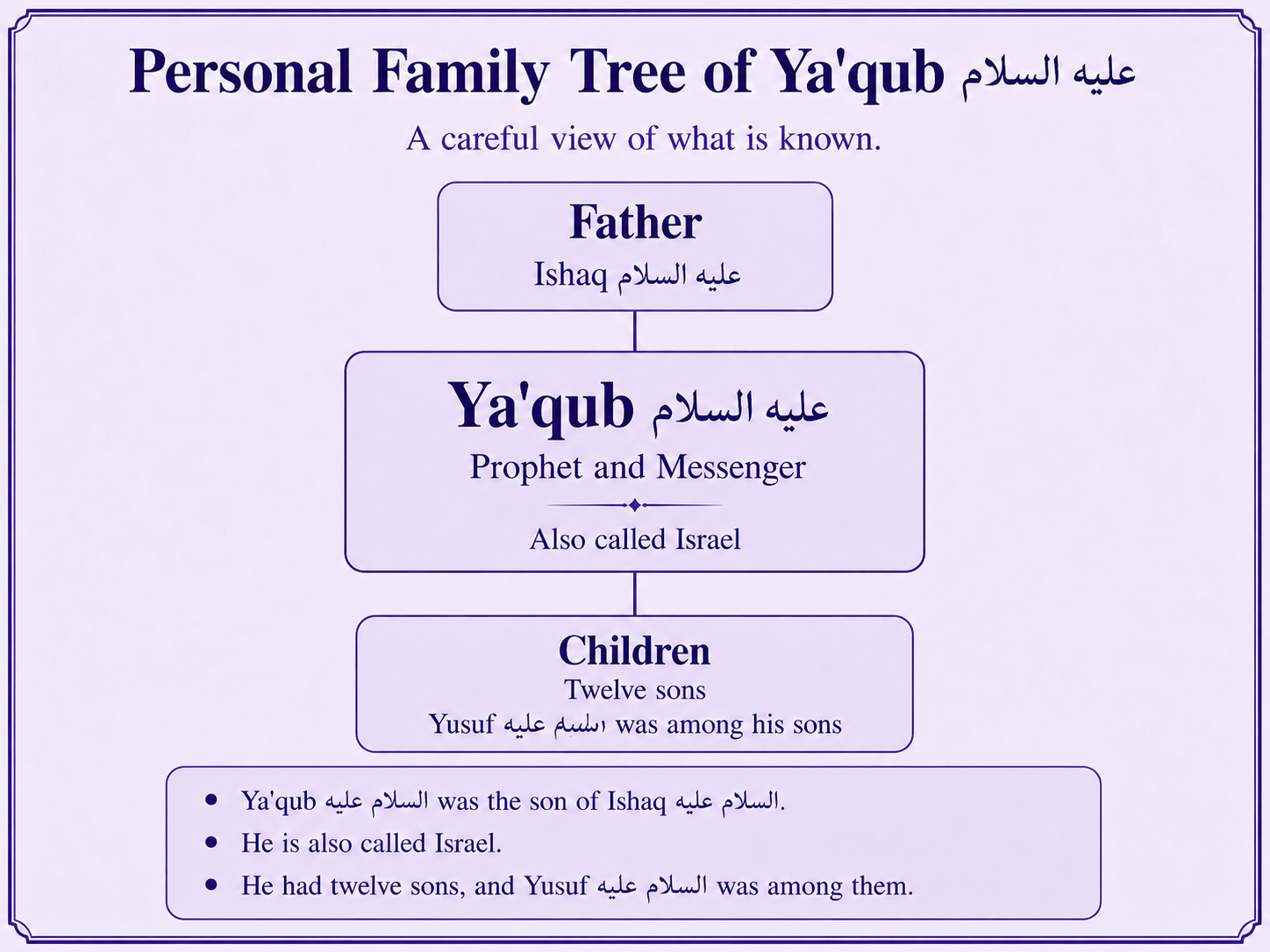
- Use for: Ishaq عليه السلام → Ya'qub عليه السلام → Yusuf عليه السلام and his brothers.
- Confirmed: Ya'qub عليه السلام was connected to Ishaq عليه السلام and was the father of Yusuf عليه السلام and his brothers.
- Keep careful: do not add wife names, exact number details beyond the story, ages, or grave details as Qur’an-confirmed facts.
Prophetic Lineage
This visual should show the broader Prophetic lineage context without claiming every missing generation is known.
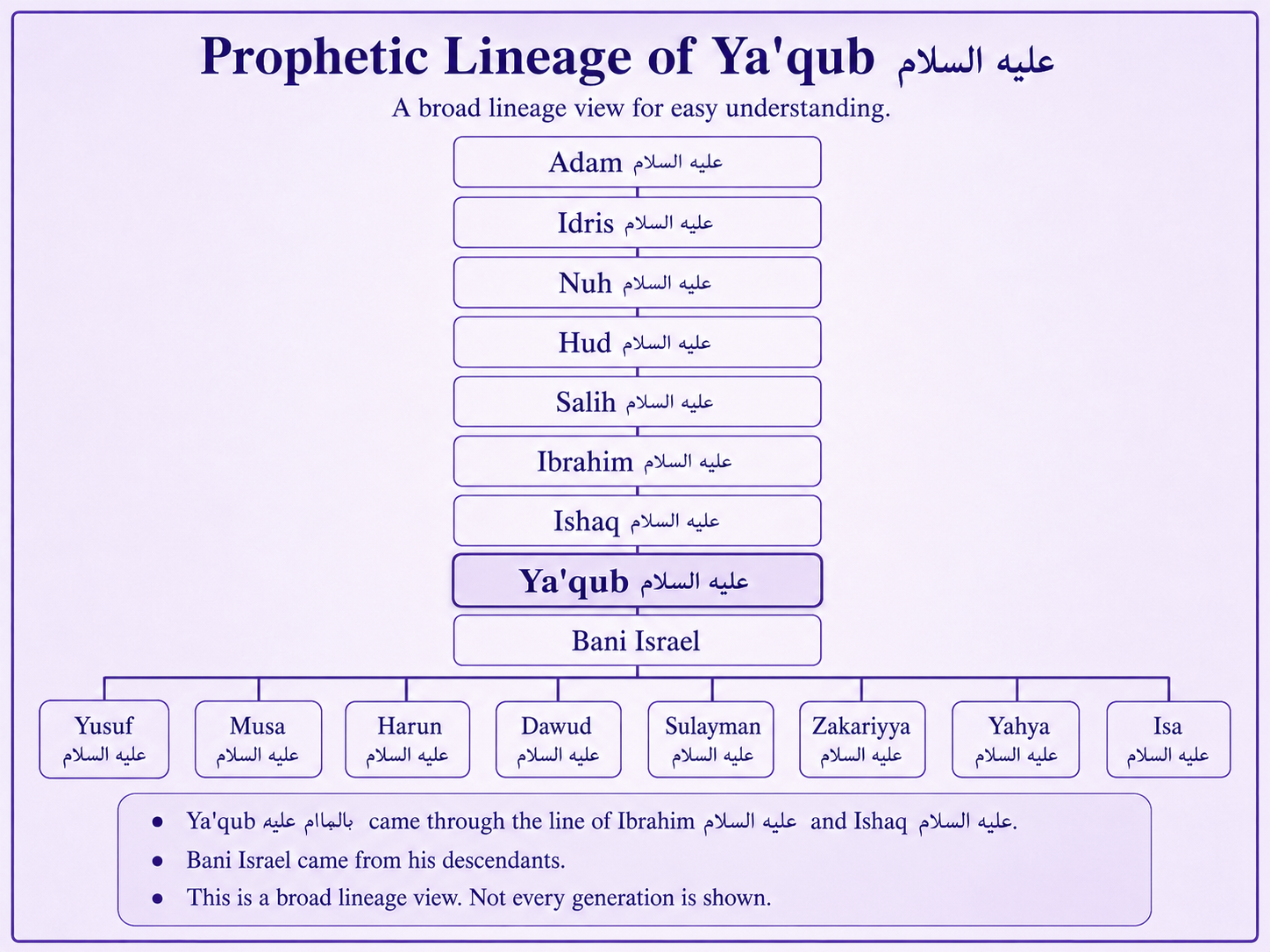
- Use for: Ibrahim عليه السلام → Ishaq عليه السلام → Ya'qub عليه السلام → Bani Israel Prophets.
- Purpose: show Ya'qub عليه السلام as Israel, the father of the Bani Israel line.
- Do not invent: exact intermediate generations beyond what is confirmed in Qur’an and authentic reports.
A Prophet in a blessed family
Ya'qub عليه السلام was born into the house of Prophethood. His grandfather was Ibrahim عليه السلام, his father was Ishaq عليه السلام, and his son Yusuf عليه السلام would also be a Prophet.
Allah made him part of a family line that carried guidance, prayer, worship, and revelation. But being from a blessed family did not mean a life without pain. His story in the Qur’an is full of family trial: jealousy between sons, a missing child, another son taken later, years of grief, and the long wait for Allah’s plan to unfold.
Ya'qub عليه السلام teaches that Prophets are not stone-hearted. They feel grief deeply, but their grief does not cut them off from Allah. His tears, patience, and hope turn pain into worship.
Allah gave Ishaq and Ya'qub عليهما السلام
وَوَهَبْنَا لَهُ إِسْحَاقَ وَيَعْقُوبَ نَافِلَةً
Wa wahabna lahu Ishaqa wa Ya'quba nafilah.
And We gave him Ishaq and Ya'qub in addition. Source: Quran 21:72, relevant meaning.
Guided and chosen
Allah mentions Ya'qub عليه السلام among Prophets He guided, along with Ibrahim, Ishaq, and other Prophets. Source: Quran 6:84-87, meaning summarized.
Ya'qub عليه السلام is not only a father in Yusuf’s story. He is a guided Prophet chosen by Allah.
Yusuf عليه السلام tells his father the dream
The story of Ya'qub عليه السلام becomes most detailed through the story of his son Yusuf عليه السلام.
Yusuf عليه السلام told his father that he saw eleven stars, the sun, and the moon prostrating to him. Ya'qub عليه السلام understood that this dream was not ordinary. He saw signs of Allah’s future favour upon Yusuf عليه السلام.
But he also understood the danger of jealousy. He told Yusuf عليه السلام not to tell the dream to his brothers, because Shaytan could use envy to push them toward a harmful plan.
This is one of the great parenting lessons in the Qur’an: not every blessing should be spoken about in every gathering. Wisdom protects a blessing until Allah opens its time.
Eleven stars, the sun, and the moon
إِنِّي رَأَيْتُ أَحَدَ عَشَرَ كَوْكَبًا وَالشَّمْسَ وَالْقَمَرَ رَأَيْتُهُمْ لِي سَاجِدِينَ
Inni ra'aytu ahada 'ashara kawkaban wash-shamsa wal-qamara ra'aytuhum li sajidin.
I saw eleven stars, the sun, and the moon. I saw them prostrating to me. Source: Quran 12:4, meaning.
Do not tell your brothers
يَا بُنَيَّ لَا تَقْصُصْ رُؤْيَاكَ عَلَىٰ إِخْوَتِكَ
Ya bunayya la taqsus ru'yaka 'ala ikhwatik.
O my son, do not relate your vision to your brothers. Source: Quran 12:5, relevant part.
Wisdom sometimes means hiding a blessing from those who may not carry it safely.
Allah would complete His favour
Ya'qub عليه السلام told Yusuf عليه السلام that Allah would choose him, teach him interpretation of events, and complete His favour upon him and the family of Ya'qub. Source: Quran 12:6, meaning summarized.
He saw the danger before the children saw it
Ya'qub عليه السلام did not accuse without wisdom. He understood that jealousy can grow quietly, and he advised Yusuf عليه السلام before harm reached him.
The brothers return with a false story
Yusuf’s brothers asked Ya'qub عليه السلام to send Yusuf with them. Ya'qub عليه السلام feared that a wolf might eat him while they were careless. They insisted they would protect him.
They took Yusuf عليه السلام and threw him into the well. Then they came back at night crying, claiming that a wolf had eaten him while they were racing. They brought his shirt with false blood.
Ya'qub عليه السلام did not accept the story at face value. The shirt was present, the tears were present, but the truth was not. He said their souls had made something seem attractive to them, then chose beautiful patience. He turned to Allah for help over what they described.
I fear that a wolf may eat him
Ya'qub عليه السلام said it saddened him that they should take Yusuf, and he feared a wolf might eat him while they were unaware. Source: Quran 12:13, meaning summarized.
False blood on the shirt
They came with false blood on Yusuf’s shirt. Ya'qub عليه السلام said their souls had made something seem attractive to them. Source: Quran 12:18, meaning summarized.
Beautiful patience
فَصَبْرٌ جَمِيلٌ ۖ وَاللَّهُ الْمُسْتَعَانُ عَلَىٰ مَا تَصِفُونَ
Fa sabrun jamil. Wallahul-musta'anu 'ala ma tasifun.
So beautiful patience. And Allah is the One sought for help against what you describe. Source: Quran 12:18.
Beautiful patience is not pretending pain does not exist. It is carrying pain without rebelling against Allah.
Tears do not always prove truth
The brothers came crying, but Ya'qub عليه السلام looked beyond the performance. A believer needs compassion, but also wisdom.
Years later, he sends his sons to Egypt
Years passed, and Yusuf عليه السلام rose by Allah’s plan in Egypt. A famine brought the brothers to Egypt seeking food, though they did not recognise Yusuf عليه السلام.
When they later needed to take Binyamin with them, Ya'qub عليه السلام remembered what had happened with Yusuf عليه السلام. He did not trust blindly. He asked for a pledge by Allah that they would bring Binyamin back unless they were completely surrounded.
He also advised them not to enter from one gate, but from different gates. This was wisdom in taking means, while knowing that no precaution can prevent Allah’s decree. He taught them to act wisely and trust Allah at the same time.
He asked for a pledge by Allah
Ya'qub عليه السلام said he would not send Binyamin until they gave him a pledge by Allah that they would bring him back, unless they were surrounded. Source: Quran 12:66, meaning summarized.
Enter by different gates
يَا بَنِيَّ لَا تَدْخُلُوا مِن بَابٍ وَاحِدٍ وَادْخُلُوا مِنْ أَبْوَابٍ مُّتَفَرِّقَةٍ
Ya baniyya la tadkhulu min babin wahidin wadkhulu min abwabin mutafarriqah.
O my sons, do not enter from one gate, but enter from different gates. Source: Quran 12:67, relevant part.
Judgment belongs only to Allah
إِنِ الْحُكْمُ إِلَّا لِلَّهِ ۖ عَلَيْهِ تَوَكَّلْتُ
Inil-hukmu illa lillah. 'Alayhi tawakkaltu.
Judgment belongs only to Allah. Upon Him I have relied. Source: Quran 12:67, relevant part.
Take means, then trust Allah
Ya'qub عليه السلام gave a practical safety instruction, then made it clear that Allah’s decree cannot be stopped by strategy. This is real tawakkul: effort without arrogance.
Another son is gone, and the old wound opens
When Binyamin was kept in Egypt, the brothers returned again with painful news. Ya'qub عليه السلام again saw that the matter was not simple. He repeated beautiful patience and hoped that Allah might bring all of them back to him.
His grief for Yusuf عليه السلام returned with force. He turned away from them and said, “O my sorrow over Yusuf.” His eyes became white from grief, and he held back his pain.
The sons told him he would not stop remembering Yusuf until he ruined himself or died. But Ya'qub عليه السلام was not complaining against Allah. He answered with one of the deepest statements of grief in the Qur’an: “I only complain of my suffering and my grief to Allah.”
Beautiful patience again
فَصَبْرٌ جَمِيلٌ ۖ عَسَى اللَّهُ أَن يَأْتِيَنِي بِهِمْ جَمِيعًا
Fa sabrun jamil. 'Asallahu an ya'tiyani bihim jami'a.
So beautiful patience. Perhaps Allah will bring them all to me. Source: Quran 12:83, relevant part.
His eyes became white from grief
Ya'qub عليه السلام said, “O my sorrow over Yusuf,” and his eyes became white from grief while he suppressed his sorrow. Source: Quran 12:84, meaning summarized.
Prophets felt real human pain. Patience does not mean the heart never hurts.
I only complain to Allah
إِنَّمَا أَشْكُو بَثِّي وَحُزْنِي إِلَى اللَّهِ
Innama ashku baththi wa huzni ilallah.
I only complain of my suffering and my grief to Allah. Source: Quran 12:86, relevant part.
Pour grief before Allah without accusing Allah. That is the difference between worshipful complaint and rebellious complaint.
I know from Allah what you do not know
وَأَعْلَمُ مِنَ اللَّهِ مَا لَا تَعْلَمُونَ
Wa a'lamu minallahi ma la ta'lamun.
And I know from Allah what you do not know. Source: Quran 12:86, relevant part.
Do not despair of relief from Allah
Ya'qub عليه السلام had every worldly reason to collapse into hopelessness, but his heart still knew Allah.
He sent his sons back to search for Yusuf and his brother. He told them not to despair of relief from Allah, because no one despairs of relief from Allah except the disbelieving people.
This is not shallow optimism. Ya'qub عليه السلام had suffered for years. He had lost Yusuf, then Binyamin, and his body carried the marks of grief. Yet he still taught hope. In his darkest family moment, he became a teacher of not giving up on Allah.
Do not despair of Allah’s relief
وَلَا تَيْأَسُوا مِن رَّوْحِ اللَّهِ ۖ إِنَّهُ لَا يَيْأَسُ مِن رَّوْحِ اللَّهِ إِلَّا الْقَوْمُ الْكَافِرُونَ
Wa la tay'asu mir-rawhillah. Innahu la yay'asu mir-rawhillahi illal-qawmul-kafirun.
Do not despair of relief from Allah. Indeed, none despairs of relief from Allah except the disbelieving people. Source: Quran 12:87, relevant meaning.
Hope in Allah is not childish. It is a mark of faith, especially when the visible road looks closed.
The shirt returns, and sight returns
When Yusuf عليه السلام revealed himself to his brothers, he sent his shirt back with them and told them to place it over his father’s face. Before the caravan even arrived, Ya'qub عليه السلام said he could smell the scent of Yusuf.
Those around him thought he was still lost in old emotion, but the shirt came, was placed over his face, and his sight returned by Allah’s permission. The same object used years earlier in a lie now returned as a sign of truth.
The brothers finally admitted their sin and asked their father to seek forgiveness for them. Ya'qub عليه السلام promised to seek forgiveness from his Lord.
I smell the scent of Yusuf
إِنِّي لَأَجِدُ رِيحَ يُوسُفَ
Inni la ajidu riha Yusuf.
Indeed, I find the scent of Yusuf. Source: Quran 12:94, relevant part.
His sight returned
When the bearer of good news came, he placed the shirt over Ya'qub’s face, and he returned seeing. Source: Quran 12:96, meaning summarized.
I will ask forgiveness for you
سَوْفَ أَسْتَغْفِرُ لَكُمْ رَبِّي
Sawfa astaghfiru lakum rabbi.
I will ask forgiveness for you from my Lord. Source: Quran 12:98, relevant part.
A wounded parent can still choose forgiveness and dua when repentance appears.
The shirt appears twice
First, the shirt was used with false blood to support a lie. Later, the shirt returned as a sign of truth and healing. Allah can turn the object of pain into an opening of relief.
The family enters upon Yusuf عليه السلام
Ya'qub عليه السلام and his family came to Egypt. Yusuf عليه السلام received his parents and raised them upon the throne. The family fell in prostration before Yusuf عليه السلام, and Yusuf said this was the interpretation of his old dream.
This prostration was not worship of Yusuf عليه السلام. It was a form of honour permitted in earlier law, not allowed as worship. In Islam, prostration is for Allah alone.
For Ya'qub عليه السلام, the reunion was not only emotional relief. It was the unveiling of Allah’s plan after years of pain. The dream he had heard from young Yusuf عليه السلام had come true.
Enter Egypt, if Allah wills, safe
ادْخُلُوا مِصْرَ إِن شَاءَ اللَّهُ آمِنِينَ
Udkhulu Misra in sha Allahu aminin.
Enter Egypt, if Allah wills, safe. Source: Quran 12:99, relevant meaning.
The dream fulfilled
Yusuf عليه السلام raised his parents upon the throne, and they fell in prostration before him. Yusuf said this was the interpretation of his earlier dream. Source: Quran 12:100, meaning summarized.
Allah’s plan may take years, but not one piece is lost.
What will you worship after me?
The Qur’an gives a powerful scene from the end of Ya'qub’s life. His concern was not money, land, or family reputation. His concern was tawheed.
When death approached, he asked his children what they would worship after him. They answered that they would worship his God, the God of his fathers Ibrahim, Isma'il, and Ishaq عليهم السلام, one God, and to Him they would submit.
This is the final portrait of Ya'qub عليه السلام: a father whose last concern was the faith of his children. He had suffered because of family, but he never stopped guiding family.
The deathbed question of tawheed
مَا تَعْبُدُونَ مِن بَعْدِي
Ma ta'buduna mim ba'di?
What will you worship after me? Source: Quran 2:133, relevant part.
They said they would worship his God and the God of his fathers Ibrahim, Isma'il, and Ishaq, one God, and to Him they would submit. Source: Quran 2:133, meaning summarized.
The greatest inheritance a parent worries about is not property. It is tawheed.
Words and duas of Ya'qub عليه السلام
فَصَبْرٌ جَمِيلٌ ۖ وَاللَّهُ الْمُسْتَعَانُ عَلَىٰ مَا تَصِفُونَ
Fa sabrun jamil. Wallahul-musta'anu 'ala ma tasifun.
So beautiful patience. And Allah is the One sought for help against what you describe. Source: Quran 12:18.
فَصَبْرٌ جَمِيلٌ ۖ عَسَى اللَّهُ أَن يَأْتِيَنِي بِهِمْ جَمِيعًا
Fa sabrun jamil. 'Asallahu an ya'tiyani bihim jami'a.
So beautiful patience. Perhaps Allah will bring them all to me. Source: Quran 12:83, relevant part.
إِنَّمَا أَشْكُو بَثِّي وَحُزْنِي إِلَى اللَّهِ
Innama ashku baththi wa huzni ilallah.
I only complain of my suffering and my grief to Allah. Source: Quran 12:86.
وَلَا تَيْأَسُوا مِن رَّوْحِ اللَّهِ
Wa la tay'asu mir-rawhillah.
Do not despair of relief from Allah. Source: Quran 12:87, relevant part.
سَوْفَ أَسْتَغْفِرُ لَكُمْ رَبِّي
Sawfa astaghfiru lakum rabbi.
I will ask forgiveness for you from my Lord. Source: Quran 12:98, relevant part.
Common questions about Ya'qub عليه السلام
These details are often mixed with the story of Yusuf عليه السلام, so they need clean wording.
Is Ya'qub عليه السلام also called Israel?
Many scholars identify Israel as Ya'qub عليه السلام, and the Qur’an speaks of Bani Israel. The page can mention this in simple wording without turning it into a long technical debate.
Do we know all names of his sons from the Qur’an?
The Qur’an names Yusuf عليه السلام and mentions his brothers, but it does not list all the brothers by name in Surah Yusuf. Names of the tribes and sons are discussed in history and tafsir, but should not be presented as Qur’anic wording if not named there.
Did Ya'qub عليه السلام lose his eyesight?
The Qur’an says his eyes became white from grief, and later his sight returned when Yusuf’s shirt was placed on his face. So the page can mention loss of sight through grief, using the Qur’anic wording.
Does beautiful patience mean not crying?
No. Ya'qub عليه السلام grieved deeply. Beautiful patience means not rebelling against Allah, not accusing Allah, and taking grief to Allah with faith.
Did the family worship Yusuf عليه السلام?
No. Their prostration was not worship. It was an honouring gesture permitted in earlier law. Worshipful prostration is for Allah alone.
Do we know his grave?
There are historical claims about the burial place of Ya'qub عليه السلام, but exact grave location is not established from the Qur’an or authentic hadith. It should not be taught as required belief.
Protect blessings with wisdom
Ya'qub عليه السلام told Yusuf عليه السلام not to share his dream with brothers who might envy him.
Beautiful patience still feels pain
His eyes became white from grief, yet his heart remained attached to Allah.
Complain to Allah, not against Allah
Ya'qub عليه السلام complained of his suffering and grief to Allah, while keeping faith.
Never despair of Allah’s relief
He taught hope after years of loss, because Allah’s plan was still moving.
Take means with tawakkul
He told his sons to enter from different gates, then declared reliance upon Allah.
Leave tawheed as your family’s inheritance
At death, his concern was what his children would worship after him.
Common mistakes about this story
- Thinking patience means no tears: Ya'qub عليه السلام grieved deeply, but did not rebel against Allah.
- Exposing every blessing: he taught Yusuf عليه السلام not to share the dream with jealous hearts.
- Calling the brothers’ names Qur’anic: the Qur’an does not list all their names in Surah Yusuf.
- Misreading the prostration: it was not worship of Yusuf عليه السلام.
- Claiming exact dates and graves: these are not established from Qur’an or authentic hadith.
- Forgetting his final advice: Ya'qub عليه السلام ended with concern for tawheed.
The whole story in seven lines
- Ya'qub عليه السلام was the son of Ishaq and grandson of Ibrahim عليهما السلام.
- He was a guided Prophet and father of Yusuf عليه السلام.
- He advised Yusuf عليه السلام not to share his dream with jealous brothers.
- When Yusuf عليه السلام was taken, he chose beautiful patience and sought Allah’s help.
- When Binyamin was also taken, he complained of grief only to Allah and kept hope.
- Allah reunited him with Yusuf عليه السلام and restored his sight.
- At death, he advised his children to worship the One God.
Main references used
- Qur’an: Ya'qub عليه السلام given to Ibrahim عليه السلام through Ishaq عليه السلام: Quran 11:71, 21:72, 29:27.
- Qur’an: Ya'qub عليه السلام among those guided by Allah: Quran 6:84-87.
- Qur’an: Yusuf’s dream and Ya'qub’s advice: Quran 12:4-6.
- Qur’an: Yusuf taken, false blood, and beautiful patience: Quran 12:13-18.
- Qur’an: Binyamin, entering by different gates, grief, and hope: Quran 12:66-87.
- Qur’an: Shirt, restored sight, forgiveness, and reunion: Quran 12:94-100.
- Qur’an: Ya'qub’s deathbed advice of tawheed: Quran 2:133.
- Extra details: Exact birth date, death date, age, grave location, and full list of sons by name are not established as clear Qur’an or authentic hadith facts.
Ya'qub عليه السلام teaches beautiful patience
His story is not the story of a father who did not feel pain. It is the story of a Prophet who felt pain and carried it to Allah. He lost Yusuf عليه السلام, then Binyamin, then his sight weakened through grief, yet hope stayed alive in his heart. He teaches that grief can be deep, tears can be real, and faith can still stand. The final treasure he left his children was tawheed.