

Story of Isma'il عليه السلام
The forbearing son of Ibrahim عليه السلام, the child of Hajar عليها السلام, the baby left in Makkah by Allah’s command, the one connected to Zamzam and Safa-Marwah, the patient son in the sacrifice test, the Prophet who kept his promise, commanded prayer and zakah, and raised the Ka'bah with his father.
The journey of Isma'il عليه السلام
A clear path through his birth, Makkah, Zamzam, sacrifice, family, prophethood, and the Ka'bah.
Allah gives glad tidings of a forbearing boy
Ibrahim عليه السلام is given the good news of a son described as forbearing.
Hajar and Isma'il are taken to Makkah
Ibrahim عليه السلام leaves them in a barren valley by Allah’s command.
Hajar searches between Safa and Marwah
She runs seeking help for her child, and Allah brings relief.
Zamzam appears
Water opens in the empty valley, and Makkah begins to grow.
Jurhum settles near them
Isma'il عليه السلام grows among them, learns Arabic, and later marries from them.
Ibrahim عليه السلام visits his son
The visits include the lesson of the doorstep and the household’s gratitude.
The sacrifice test comes
The son answers with patience and surrender when Ibrahim عليه السلام tells him the dream.
Father and son raise the Ka'bah
They build while asking Allah to accept from them.
Isma'il عليه السلام becomes a Prophet
The Qur’an describes him as true to his promise, a Messenger and Prophet, and one who commanded prayer and zakah.
Approximate Timeline / Dates
Dates are kept safe and simple. Exact years are not claimed where revelation does not confirm them.
Exact dates are not confirmed
The Qur’an and authentic hadith do not give a confirmed birth year, death year, exact age, or full calendar timeline for Isma'il عليه السلام.
Isma'il عليه السلام was the son of Ibrahim عليه السلام and Hajar. His story is closely connected with Makkah, Zamzam, the Ka'bah, and the family line leading to Prophet Muhammad ﷺ.
Connected to Makkah
Isma'il عليه السلام was settled with his mother Hajar in the barren valley of Makkah by Allah’s command, and later helped Ibrahim عليه السلام raise the foundations of the Ka'bah.
Family Tree / Lineage
Personal Family Tree
This visual should show the reliable close family details connected to Isma'il عليه السلام.
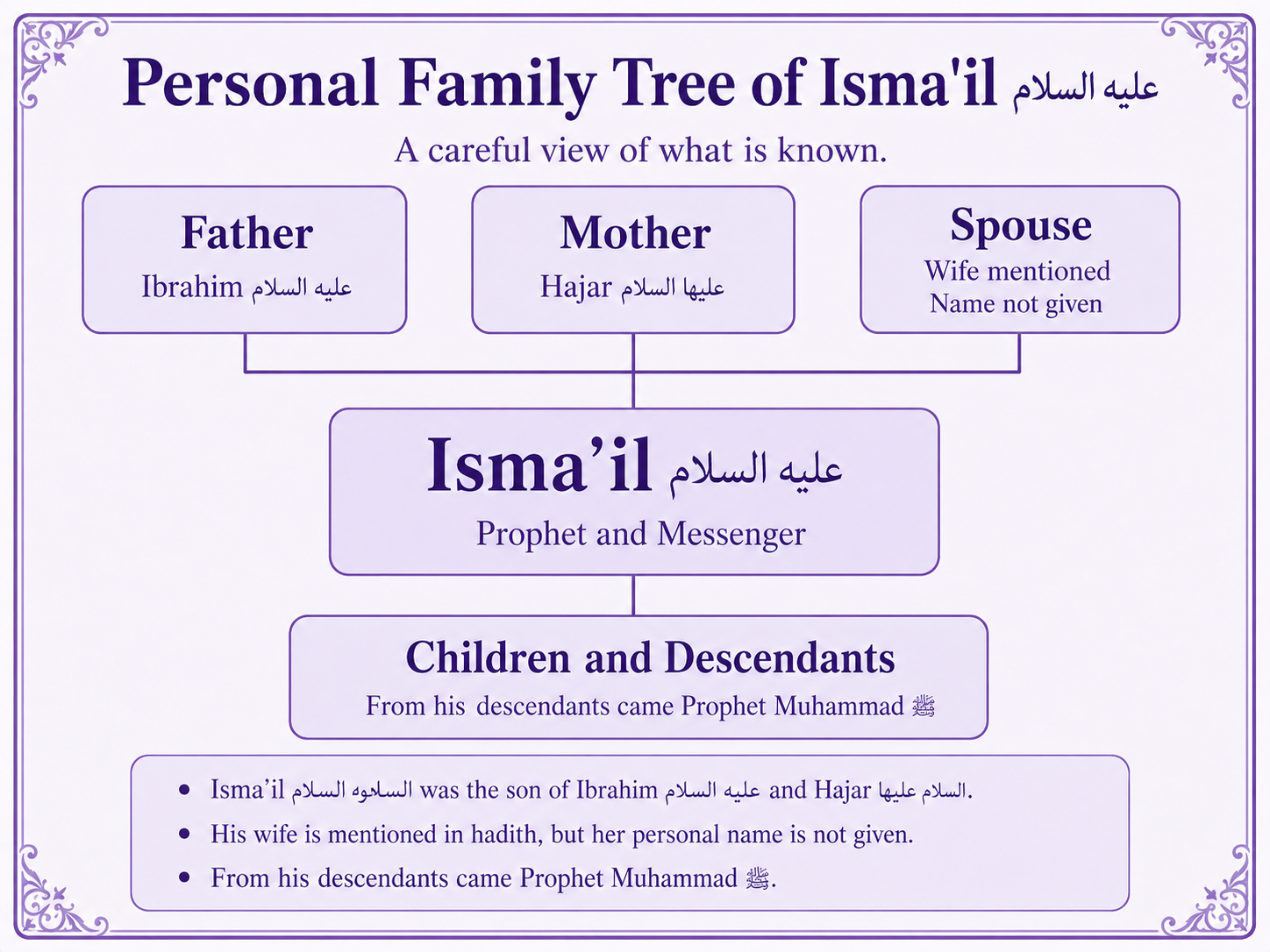
- Use for: Ibrahim عليه السلام and Hajar → Isma'il عليه السلام.
- Confirmed: Isma'il عليه السلام was the son of Ibrahim عليه السلام, and Hajar is known from authentic hadith connected to Makkah and Zamzam.
- Keep careful: do not add unsupported wife names, children’s names, exact ages, or grave details as Qur’an-confirmed facts.
Prophetic Lineage
This visual should show the broader Prophetic lineage context without claiming every missing generation is known.
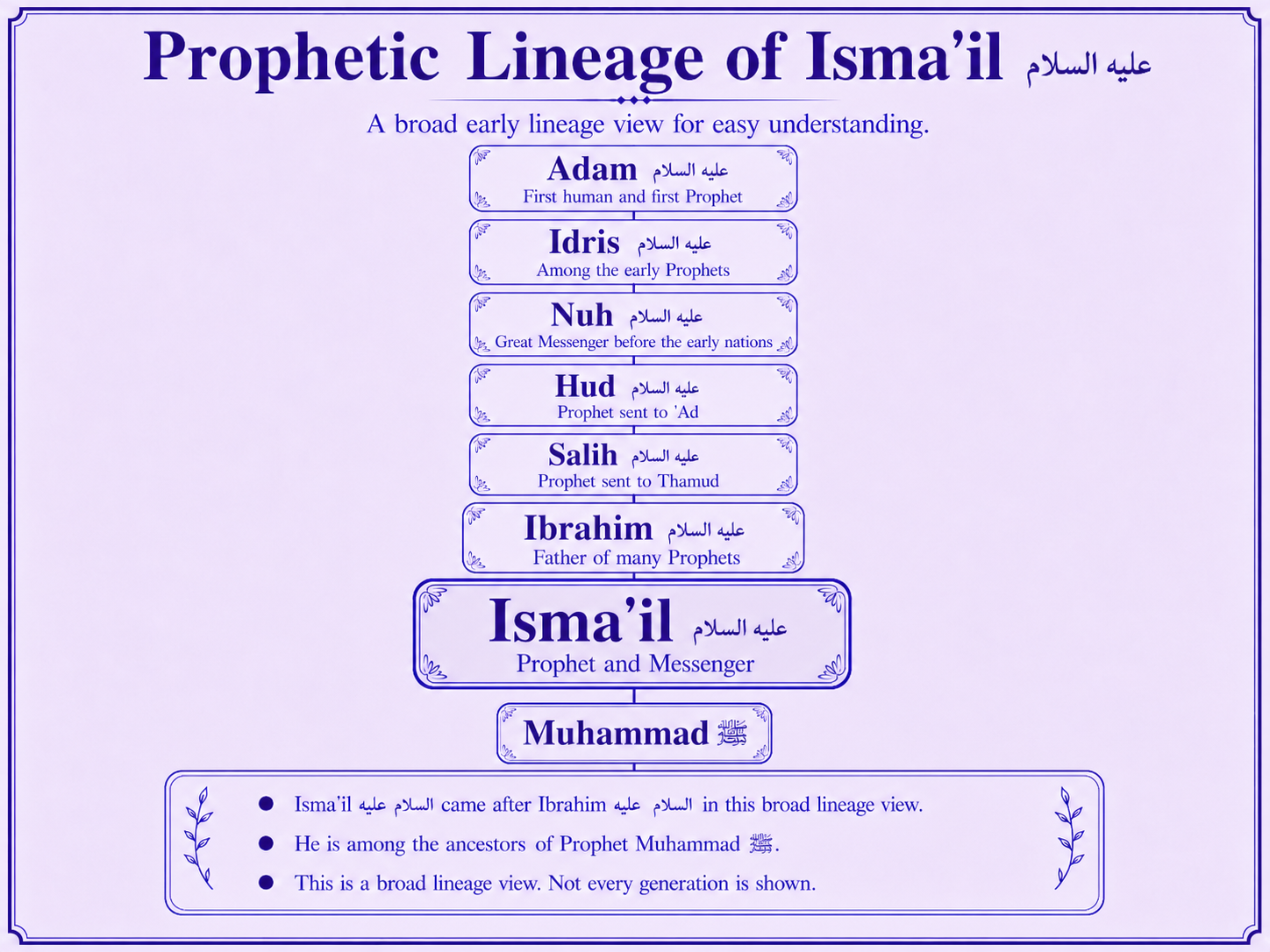
- Use for: Ibrahim عليه السلام → Isma'il عليه السلام → later Arab line → Quraysh → Prophet Muhammad ﷺ.
- Purpose: show Isma'il عليه السلام as the Prophetic branch connected to Makkah and Prophet Muhammad ﷺ.
- Do not invent: exact intermediate generations beyond what is reliable and needed for the page.
The forbearing boy
Ibrahim عليه السلام had waited long for a child. Allah gave him glad tidings of a forbearing boy.
The Qur’an describes this son as halim, forbearing. That word becomes visible in the sacrifice test. Isma'il عليه السلام was not only a child in a story. He was a servant trained upon patience, surrender, and trust.
His life begins inside the larger journey of Ibrahim عليه السلام, but he is not a side character. Allah named him among the Prophets, praised his promise, and connected him to prayer, zakah, Makkah, Hajj, and the lineage of Prophet Muhammad ﷺ.
Glad tidings of a forbearing boy
فَبَشَّرْنَاهُ بِغُلَامٍ حَلِيمٍ
Fabashsharnahu bighulamin halim.
So We gave him glad tidings of a forbearing boy. Source: Quran 37:101.
Allah described him with patience before the sacrifice test appeared in the story.
Hajar عليها السلام and the baby in the valley
Ibrahim عليه السلام brought Hajar عليها السلام and baby Isma'il عليه السلام to the valley of Makkah. At that time, it was a place without crops, crowds, or visible support.
When Ibrahim عليه السلام began to leave, Hajar عليها السلام followed and asked why he was leaving them in such a place. He did not answer until she asked the question that reveals her faith: had Allah commanded him to do this? When she understood it was by Allah’s command, she accepted with trust. Allah would not abandon them.
This was not neglect. It was obedience to Allah. The valley looked empty to human eyes, but Allah was placing the roots of a future that would include Zamzam, Safa-Marwah, Hajj, the Ka'bah, and the final Prophet ﷺ.
A valley without crops
رَبَّنَا إِنِّي أَسْكَنتُ مِن ذُرِّيَّتِي بِوَادٍ غَيْرِ ذِي زَرْعٍ
Rabbana inni askantu min dhurriyyati biwadin ghayri dhi zar'in.
Our Lord, I have settled some of my descendants in a valley without cultivation. Source: Quran 14:37, relevant part.
Allah will not abandon us
In the authentic hadith, Hajar عليها السلام understood that Ibrahim عليه السلام was leaving by Allah’s command. She said that Allah would not abandon them. Her tawakkul became part of the story of Makkah itself.
Reported in Sahih al-Bukhari in the story of Hajar, Isma'il, Zamzam, and Makkah, meaning summarized.
Safa, Marwah, and the water Allah brought out
When the water and provisions ran out, Hajar عليها السلام began searching for help. She went between Safa and Marwah, looking and listening while her baby was in the valley. Her running was not panic without faith. It was effort tied to trust.
Then Allah brought out Zamzam. The water appeared by Allah’s mercy, and Hajar عليها السلام gathered it. That water changed the valley. Birds came. Travellers noticed. The tribe of Jurhum later settled near them with permission.
Every time pilgrims walk between Safa and Marwah, the story of a mother’s effort and trust returns. A woman searching for water became part of worship for the Ummah.
Safa and Marwah are from Allah’s symbols
إِنَّ الصَّفَا وَالْمَرْوَةَ مِن شَعَائِرِ اللَّهِ
Innas-Safa wal-Marwata min sha'a'irillah.
Indeed, Safa and Marwah are among the symbols of Allah. Source: Quran 2:158, relevant part.
The origin of the running
The hadith explains Hajar عليها السلام running between Safa and Marwah and the appearance of Zamzam. This is why the Sa'i between Safa and Marwah carries the memory of her search.
Reported in Sahih al-Bukhari, meaning summarized.
The valley begins to grow
After Zamzam appeared, the tribe of Jurhum came near the valley. They saw birds circling and understood that water was there. They asked permission from Hajar عليها السلام to settle nearby, and she allowed them while keeping the right to the water.
Isma'il عليه السلام grew among them. The hadith mentions that he learned Arabic from them, and they loved him. When he grew older, he married from them. Makkah was no longer an empty valley. Allah had placed life there.
This part of the story shows how Allah can build a community from what looks like abandonment. The water came first, then people, language, marriage, family, and later the House of Allah being raised.
Jurhum settled near Zamzam
The hadith mentions Jurhum settling near Hajar عليها السلام and Isma'il عليه السلام after Zamzam appeared. It also mentions Isma'il عليه السلام learning Arabic from them and later marrying from among them.
Reported in Sahih al-Bukhari, meaning summarized.
Arabic and Isma'il عليه السلام
Authentic hadith mentions that Isma'il عليه السلام learned Arabic from Jurhum. Details beyond that, such as exact dialect development or dramatic language claims, should not be overstated.
Ibrahim عليه السلام visits the house of Isma'il عليه السلام
After Hajar عليها السلام passed away and Isma'il عليه السلام had married, Ibrahim عليه السلام came to visit him but did not find him at home.
He asked Isma'il’s wife about their life. She complained about hardship and spoke with dissatisfaction. Ibrahim عليه السلام left a message for Isma'il عليه السلام: change the doorstep of his door. Isma'il عليه السلام understood the meaning and separated from that wife.
Later Ibrahim عليه السلام visited again. Isma'il عليه السلام was absent, and Ibrahim عليه السلام asked the new wife about their life. She praised Allah and spoke with gratitude. Ibrahim عليه السلام left a message: keep the doorstep of his door. Isma'il عليه السلام understood and kept her.
This story is not about insulting women. It is about the difference between a household of constant ingratitude and a household that remembers Allah even during simple living. A home is not only built with walls. It is built with shukr.
Change the doorstep
The first wife complained about their condition, so Ibrahim عليه السلام left the message to change the doorstep. Isma'il عليه السلام understood the advice.
Reported in Sahih al-Bukhari, meaning summarized.
Keep the doorstep
The later wife praised Allah and showed contentment. Ibrahim عليه السلام left the message to keep the doorstep, and Isma'il عليه السلام understood.
Reported in Sahih al-Bukhari, meaning summarized.
The son who said, “Do as you are commanded”
When the son became old enough to walk and work with Ibrahim عليه السلام, Ibrahim عليه السلام saw in a dream that he was sacrificing him. Dreams of Prophets are revelation. Ibrahim عليه السلام told his son what he had seen.
The answer of the son is one of the greatest answers in the Qur’an: “O my father, do as you are commanded. You will find me, if Allah wills, among the patient.” This was not the voice of rebellion. It was the voice of surrender.
When they both submitted, Allah called Ibrahim عليه السلام. The test had been fulfilled. Allah ransomed the son with a great sacrifice.
The Qur’an does not name the son in the sacrifice passage. The well-known Muslim understanding is that he was Isma'il عليه السلام, and this page follows that understanding while keeping the Qur’anic wording precise.
O my son, I see in a dream
يَا بُنَيَّ إِنِّي أَرَىٰ فِي الْمَنَامِ أَنِّي أَذْبَحُكَ
Ya bunayya inni ara fil-manami anni adhbahuk.
O my son, indeed I see in a dream that I am sacrificing you. Source: Quran 37:102, relevant part.
You will find me patient
يَا أَبَتِ افْعَلْ مَا تُؤْمَرُ ۖ سَتَجِدُنِي إِن شَاءَ اللَّهُ مِنَ الصَّابِرِينَ
Ya abatif'al ma tu'mar. Satajiduni in sha Allahu minas-sabirin.
O my father, do as you are commanded. You will find me, if Allah wills, among the patient. Source: Quran 37:102, relevant part.
They both submitted
فَلَمَّا أَسْلَمَا وَتَلَّهُ لِلْجَبِينِ
Falamma aslama wa tallahu lil-jabin.
So when they had both submitted, and he put him down upon his forehead. Source: Quran 37:103, meaning.
Ransomed with a great sacrifice
وَفَدَيْنَاهُ بِذِبْحٍ عَظِيمٍ
Wa fadaynahu bidhibhin 'azim.
And We ransomed him with a great sacrifice. Source: Quran 37:107.
Raising the foundations of the House
Ibrahim عليه السلام later came to Isma'il عليه السلام and told him that Allah had commanded him to build a House. Isma'il عليه السلام obeyed and helped his father.
Father and son raised the foundations of the Ka'bah. Isma'il عليه السلام brought stones, and Ibrahim عليه السلام built. They were doing one of the greatest acts in human history, yet their dua was full of humility: “Our Lord, accept from us.”
The Ka'bah was raised for tawheed, prayer, purification, and pilgrimage. The child once left in a valley now stood with his father raising the House that hearts would turn toward across the world.
Our Lord, accept from us
رَبَّنَا تَقَبَّلْ مِنَّا ۖ إِنَّكَ أَنتَ السَّمِيعُ الْعَلِيمُ
Rabbana taqabbal minna innaka antas-sami'ul-'alim.
Our Lord, accept from us. Indeed, You are the Hearing, the Knowing. Source: Quran 2:127.
Even Prophets building the Ka'bah asked Allah for acceptance. No good deed is safe from needing sincerity.
Make us submissive to You
رَبَّنَا وَاجْعَلْنَا مُسْلِمَيْنِ لَكَ وَمِن ذُرِّيَّتِنَا أُمَّةً مُّسْلِمَةً لَّكَ
Rabbana waj'alna muslimayni laka wa min dhurriyyatina ummatam-muslimatal-lak.
Our Lord, make us submissive to You, and from our descendants a nation submissive to You. Source: Quran 2:128, relevant part.
Send among them a Messenger
رَبَّنَا وَابْعَثْ فِيهِمْ رَسُولًا مِّنْهُمْ
Rabbana wab'ath fihim rasulam-minhum.
Our Lord, send among them a Messenger from themselves. Source: Quran 2:129, relevant part.
This dua is connected to the coming of Prophet Muhammad ﷺ from the descendants of Isma'il عليه السلام.
How the building happened
The hadith mentions Ibrahim عليه السلام coming to Isma'il عليه السلام, telling him that Allah commanded him to build a House, and Isma'il عليه السلام helping him by bringing stones while Ibrahim عليه السلام built.
Reported in Sahih al-Bukhari, meaning summarized.
A Messenger and Prophet, true to his promise
The Qur’an does not leave Isma'il عليه السلام only as a child in the valley or the son in the sacrifice test. Allah tells Prophet Muhammad ﷺ to mention Isma'il عليه السلام in the Book. He was true to his promise, and he was a Messenger and a Prophet.
He commanded his family or people to prayer and zakah, and he was pleasing to his Lord. This means his life after the famous childhood events had its own Prophetic mission: worship, truthfulness, family guidance, prayer, charity, and Allah’s pleasure.
He is also mentioned among the patient and among the righteous. The Qur’an places him in the line of noble Prophets, not merely as an ancestor or historical figure.
True to his promise
إِنَّهُ كَانَ صَادِقَ الْوَعْدِ وَكَانَ رَسُولًا نَّبِيًّا
Innahu kana sadiqal-wa'di wa kana rasulan nabiyya.
Indeed, he was true to his promise, and he was a Messenger and a Prophet. Source: Quran 19:54.
Prayer and zakah
وَكَانَ يَأْمُرُ أَهْلَهُ بِالصَّلَاةِ وَالزَّكَاةِ
Wa kana ya'muru ahlahu bis-salati waz-zakah.
And he used to command his family to prayer and zakah. Source: Quran 19:55, relevant part.
A righteous home is not only fed and sheltered. It is called to salah, zakah, and obedience to Allah.
Among the patient
Allah mentions Isma'il عليه السلام with Idris and Dhu al-Kifl among the patient, and says He admitted them into His mercy. Source: Quran 21:85-86, meaning summarized.
Among the best
Allah mentions Isma'il عليه السلام with al-Yasa' and Dhu al-Kifl, saying each was among the best. Source: Quran 38:48, meaning summarized.
From his line came Prophet Muhammad ﷺ
Allah placed great blessing in the descendants of Ibrahim عليه السلام. From the line of Isma'il عليه السلام came Prophet Muhammad ﷺ. This connects the story of the baby in Makkah to the final Messenger sent to all people.
Ibrahim and Isma'il عليهما السلام made dua for a Messenger to be sent among their descendants. Centuries later, Allah sent Muhammad ﷺ, reciting Allah’s verses, teaching the Book and wisdom, and purifying people.
This is one of the most beautiful openings in Islamic history: Hajar’s trust, Isma'il’s patience, Ibrahim’s dua, and the final Prophet ﷺ from that blessed line.
The Prophet ﷺ mentioned that Allah chose Kinana from the descendants of Isma'il, and chose Quraysh from Kinana. Reported in Sahih Muslim, meaning summarized.
Powerful words from the story
رَبَّنَا إِنِّي أَسْكَنتُ مِن ذُرِّيَّتِي بِوَادٍ غَيْرِ ذِي زَرْعٍ
Rabbana inni askantu min dhurriyyati biwadin ghayri dhi zar'in.
Our Lord, I have settled some of my descendants in a valley without cultivation. Source: Quran 14:37, relevant part.
يَا أَبَتِ افْعَلْ مَا تُؤْمَرُ
Ya abatif'al ma tu'mar.
O my father, do as you are commanded. Source: Quran 37:102, relevant part.
رَبَّنَا تَقَبَّلْ مِنَّا
Rabbana taqabbal minna.
Our Lord, accept from us. Source: Quran 2:127, relevant part.
Common questions about Isma'il عليه السلام
These details are often mixed with popular stories, so the wording should stay accurate.
Was the sacrifice son Isma'il عليه السلام?
The Qur’an does not name the son in the sacrifice passage. The well-known Muslim understanding is that he was Isma'il عليه السلام, and this view fits the flow of Surah as-Saffat where glad tidings of Ishaq عليه السلام are mentioned after the sacrifice story.
Is Isma'il عليه السلام buried in Hijr Isma'il?
There are popular claims about Isma'il عليه السلام being buried near the Ka'bah or in the area called Hijr Isma'il. The exact grave location is not proven from the Qur’an or authentic hadith, so it should not be taught as confirmed fact.
Do we know his age?
Exact age and death year are not established from Qur’an or authentic hadith. Some numbers appear in earlier historical reports, but they should not be presented as certain Islamic proof.
Why is Hajar عليها السلام central to this story?
Because Allah made her trust and effort part of the story of Makkah. The running between Safa and Marwah preserves the memory of a mother seeking help while relying on Allah.
What does the doorstep story teach?
It teaches the importance of gratitude and righteousness in the home. It should not be used as a shallow insult against women or marriage. The lesson is shukr, character, and household faith.
Did Isma'il عليه السلام speak Arabic?
Authentic hadith mentions that he learned Arabic from Jurhum. This is enough to say clearly. Extra claims about exact language history should be kept separate from revealed proof.
Allah does not abandon His servants
Hajar عليها السلام and baby Isma'il عليه السلام were in an empty valley, but Allah opened Zamzam.
Trust still takes steps
Hajar عليها السلام trusted Allah and still ran between Safa and Marwah seeking help.
Patience can be young
Isma'il عليه السلام answered the sacrifice test with surrender while still a son walking with his father.
Great deeds need acceptance
Father and son raised the Ka'bah and still asked Allah: “Our Lord, accept from us.”
Promise is part of faith
Allah praised Isma'il عليه السلام as true to his promise. Truthfulness is not small in Islam.
Guide your family to worship
Isma'il عليه السلام commanded his family to salah and zakah, showing that home guidance is part of Prophetic character.
Common mistakes about this story
- Forgetting Hajar عليها السلام: her trust and effort are central to the Makkah story.
- Calling the valley abandonment: Ibrahim عليه السلام acted by Allah’s command, not neglect.
- Teaching the sacrifice son without precision: the well-known Muslim understanding is Isma'il عليه السلام, while the passage itself does not name him.
- Claiming a confirmed grave: exact grave location is not proven from Qur’an or authentic hadith.
- Reducing him to lineage only: he was a Messenger and Prophet, true to his promise, and commanded prayer and zakah.
- Misusing the doorstep story: it teaches gratitude and household faith, not mockery.
The whole story in seven lines
- Allah gave Ibrahim عليه السلام glad tidings of a forbearing son.
- Hajar عليها السلام and baby Isma'il عليه السلام were left in Makkah by Allah’s command.
- Hajar ran between Safa and Marwah, and Allah opened Zamzam.
- Jurhum settled near them, and Isma'il عليه السلام grew, learned Arabic, and married.
- He showed patience in the sacrifice test and was ransomed by Allah.
- He raised the Ka'bah with Ibrahim عليه السلام and made dua for acceptance.
- Allah made him a Messenger and Prophet, true to his promise and devoted to prayer and zakah.
Main references used
- Qur’an: Glad tidings of a forbearing boy and the sacrifice test: Quran 37:101-107.
- Qur’an: Ibrahim’s dua for Makkah and his descendants: Quran 14:35-41.
- Qur’an: Safa and Marwah as symbols of Allah: Quran 2:158.
- Qur’an: Building the Ka'bah with Ibrahim عليه السلام: Quran 2:125-129.
- Qur’an: Isma'il عليه السلام as true to his promise, Messenger, Prophet, and one who commanded prayer and zakah: Quran 19:54-55.
- Qur’an: Isma'il عليه السلام among the patient and righteous: Quran 21:85-86, Quran 38:48.
- Hadith: Hajar, Isma'il, Zamzam, Jurhum, the doorstep visits, and building the Ka'bah are reported in Sahih al-Bukhari, meaning summarized.
- Hadith: Prophet Muhammad ﷺ being from the descendants of Isma'il عليه السلام is supported by the report in Sahih Muslim about Allah choosing Kinana from the descendants of Isma'il, meaning summarized.
- Extra details: Exact birth date, death date, age, grave location, and some expanded story details are not established as clear Qur’an or authentic hadith facts.
Isma'il عليه السلام teaches surrender with a quiet heart
He was carried as a baby into an empty valley, raised beside Zamzam, tested with sacrifice, honoured with prophethood, and chosen to raise the Ka'bah with his father. His story is water in the desert, patience under command, promise kept, prayer protected, and a life tied to the House of Allah. Through him, the valley of Makkah became a centre for the world.