

Story of Lut عليه السلام
The Prophet sent to a people who crossed limits, mocked purity, threatened the Messenger, and turned public sin into their culture. Lut عليه السلام called them to fear Allah, protect honour, and leave corruption, until the angels came and the towns were overturned by Allah’s command.
The journey of Lut عليه السلام
A clear path through his belief with Ibrahim عليه السلام, his mission, his people’s crimes, the angels, the rescue, and the punishment.
Lut عليه السلام believes with Ibrahim عليه السلام
The Qur’an mentions Lut عليه السلام believing in Ibrahim عليه السلام and being delivered with him to the blessed land.
Allah sends Lut عليه السلام to his people
He calls them to fear Allah, obey the Messenger, and leave their shameful corruption.
The people commit open sin
The Qur’an mentions sexual immorality, cutting off the road, and evil in their gatherings.
They mock purity
They threaten to expel Lut عليه السلام and his family because they wished to remain pure.
Angels first visit Ibrahim عليه السلام
They bring glad tidings, then reveal that they are sent to the people of Lut عليه السلام.
Ibrahim عليه السلام pleads
Out of compassion, Ibrahim عليه السلام speaks about the people, but Allah’s command has already come.
The angels enter Lut’s home
Lut عليه السلام becomes distressed for his guests, while his people rush toward evil.
Lut عليه السلام and the believers leave by night
The angels command him to leave with his family except his wife, who remains among those punished.
The towns are overturned
A terrible cry comes, the towns are turned upside down, and stones rain by Allah’s command.
Approximate Timeline / Dates
Dates are kept safe and simple. Exact years are not claimed where revelation does not confirm them.
Exact dates are not confirmed
The Qur’an and authentic hadith do not give a confirmed birth year, death year, exact age, or full calendar timeline for Lut عليه السلام.
Lut عليه السلام lived in the time of Ibrahim عليه السلام. He believed with Ibrahim عليه السلام and was sent to his own people.
Connected to the people of Lut
The Qur’an mentions the towns of his people and the punishment that came upon them, but exact modern map claims and grave locations should not be presented as Qur’an-confirmed facts.
Family Tree / Lineage
Personal Family Tree
This visual should show only the reliable close family details connected to Lut عليه السلام.
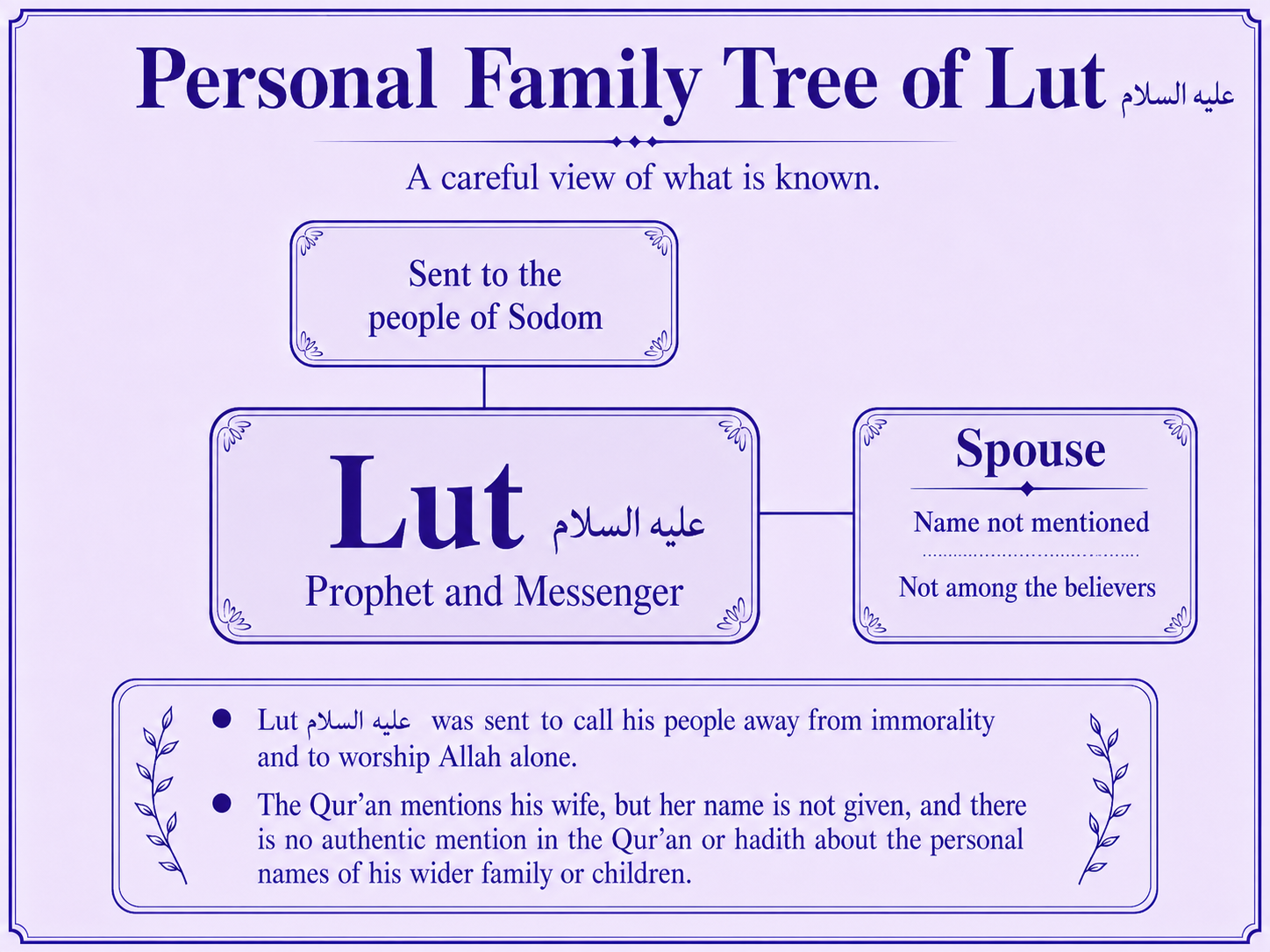
- Use for: Lut عليه السلام, his wife, and his daughters if shown in the story context.
- Confirmed: the Qur’an mentions his wife and daughters, and that his wife was not saved because she was with the wrongdoers.
- Keep careful: do not add wife’s name, daughters’ names, exact number of daughters, parents, or grave details as Qur’an-confirmed facts.
Prophetic Lineage
This visual should show the broader Prophetic lineage context without claiming every missing generation is known.
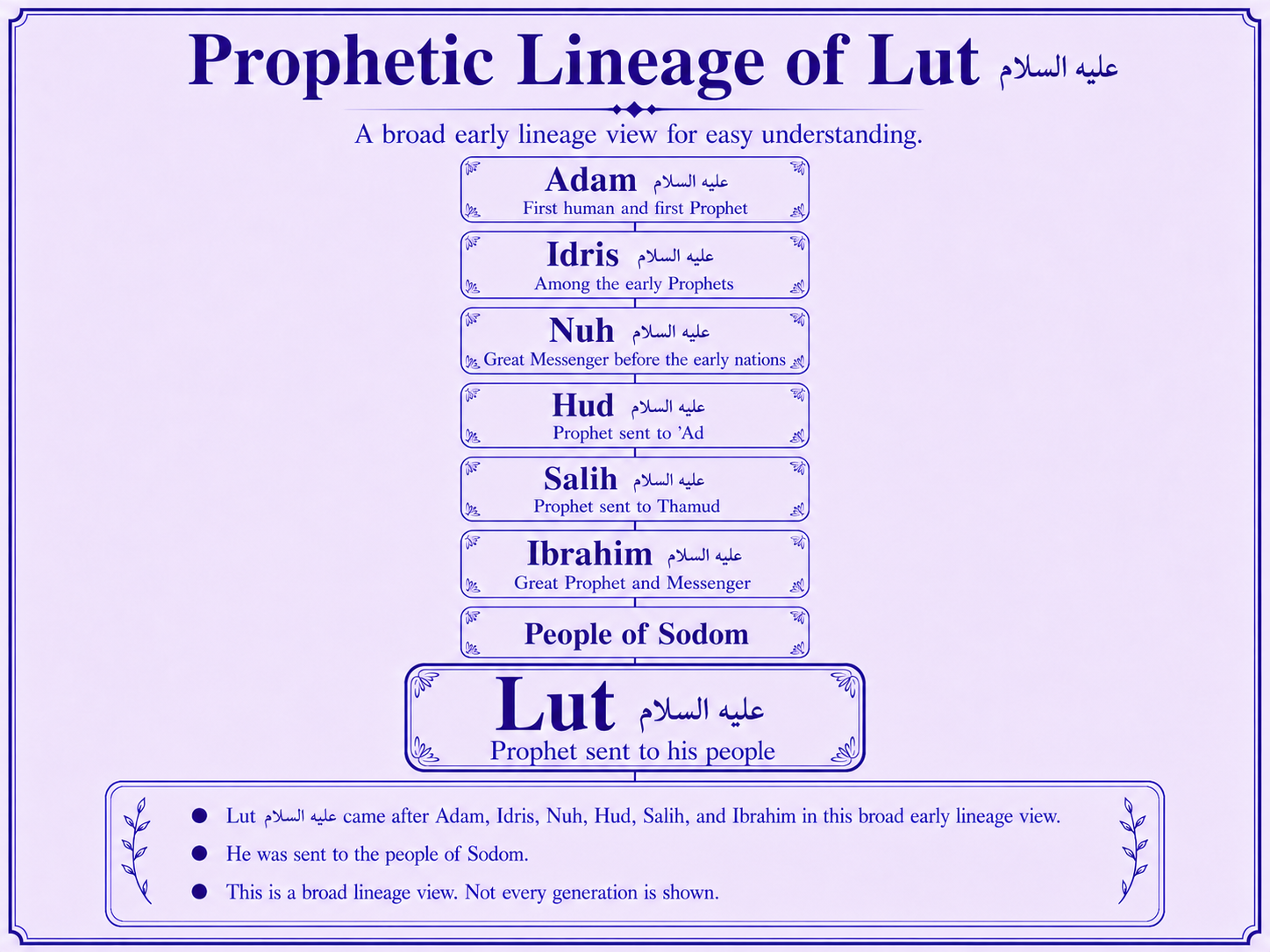
- Use for: broad context showing Lut عليه السلام living in the time of Ibrahim عليه السلام and believing with him.
- Purpose: show his Prophetic placement near Ibrahim عليه السلام without turning uncertain family reports into confirmed lineage.
- Do not invent: exact ancestry chain, parents, or intermediate generations not confirmed in the Qur’an or authentic hadith.
A Prophet among a people who crossed the limits
Lut عليه السلام believed in Ibrahim عليه السلام and was part of the great movement of tawheed in that age. Then Allah sent him to a people whose corruption had become public, aggressive, and shameless.
His people did not only make private mistakes. Their society became known for crossing the boundaries of Allah openly. They approached men with desire instead of women, cut off the road, and committed evil in their gatherings. Sin was not hidden in shame. It had become a public identity.
Lut عليه السلام called them back to purity, fear of Allah, and obedience to the Messenger. He did not hate guidance for them. He wanted them rescued from a road that was leading to punishment.
Lut عليه السلام believed with Ibrahim عليه السلام
فَآمَنَ لَهُ لُوطٌ
Fa amana lahu Lut.
So Lut believed in him. Source: Quran 29:26, relevant part.
He was among the Messengers
وَإِنَّ لُوطًا لَّمِنَ الْمُرْسَلِينَ
Wa inna Lutan laminal-mursalin.
And indeed, Lut was among the Messengers. Source: Quran 37:133.
Lut عليه السلام calls them to fear Allah
Lut عليه السلام addressed his people as a Messenger. He called them to fear Allah and obey him as a Messenger. Like the other Prophets, he did not ask them for payment. His reward was with Allah.
He questioned their behaviour directly. They were approaching men with desire instead of women. They were committing a shameful act that no nation before them had done in that way. He also condemned their road-cutting and evil gatherings.
The story should not be reduced to one sentence only. The Qur’an shows a whole social collapse: desire without restraint, public shamelessness, intimidation of guests, threat against a Prophet, mockery of purity, and rejection of Allah’s Messenger.
Fear Allah and obey me
فَاتَّقُوا اللَّهَ وَأَطِيعُونِ
Fattaqullaha wa ati'un.
So fear Allah and obey me. Source: Quran 26:163.
He asked for no payment
وَمَا أَسْأَلُكُمْ عَلَيْهِ مِنْ أَجْرٍ
Wa ma as'alukum 'alayhi min ajr.
And I do not ask you for any reward for it. Source: Quran 26:164, relevant part.
The major sin of his people
Lut عليه السلام asked his people whether they approached men with desire instead of women. Source: Quran 7:80-81, Quran 26:165-166, meaning summarized.
Allah created desire with boundaries. When a society celebrates crossing those boundaries, it is not freedom. It is rebellion against the Creator.
Road-cutting and evil gatherings
Lut عليه السلام also condemned them for approaching men, cutting off the road, and committing evil in their gatherings. Source: Quran 29:29, meaning summarized.
Their corruption was not only private immorality. It had become a public culture of intimidation and shamelessness.
They mocked purity
When a society becomes proud of sin, purity starts looking strange to them.
The people of Lut عليه السلام did not answer his warning with repentance. They threatened to drive him and his family out. Why? Because they were people who wanted to remain pure. In their upside-down world, purity became the crime.
They also told him to bring Allah’s punishment if he was truthful. This is the language of people who mistake Allah’s patience for weakness. They were not asking for proof with humility. They were mocking the warning.
Expel them, they are people who purify themselves
أَخْرِجُوهُم مِّن قَرْيَتِكُمْ ۖ إِنَّهُمْ أُنَاسٌ يَتَطَهَّرُونَ
Akhrijuhum min qaryatikum innahum unasun yatatahharun.
Expel them from your town. Indeed, they are people who purify themselves. Source: Quran 7:82, meaning.
They challenged the warning
Their answer was to tell Lut عليه السلام to bring the punishment of Allah if he was truthful. Source: Quran 29:29, meaning summarized.
Mocking punishment does not delay it when Allah’s command arrives.
The angels visit Ibrahim عليه السلام first
Before the angels came to Lut عليه السلام, they visited Ibrahim عليه السلام. They brought glad tidings, and then fear left Ibrahim عليه السلام when he understood they were messengers from Allah.
They revealed that they were sent to the people of Lut عليه السلام. Ibrahim عليه السلام, who was compassionate and tender-hearted, spoke about the people. He did not love destruction. He hoped for mercy and was concerned about Lut عليه السلام.
But the angels made it clear: Allah’s command had come, and the punishment could not be turned back from a people who had persisted in crime after warning.
Sent to the people of Lut عليه السلام
The messengers told Ibrahim عليه السلام they had been sent to a criminal people, the people of Lut. Source: Quran 11:70, Quran 29:31, Quran 51:32, meaning summarized.
Ibrahim عليه السلام pleaded
When fear left Ibrahim عليه السلام and glad tidings came, he began to plead with Allah’s messengers concerning the people of Lut. Source: Quran 11:74, meaning summarized.
A Prophet’s heart loves guidance for people and does not rush to see them destroyed.
The command had already come
Ibrahim عليه السلام was told to leave this matter, because the command of his Lord had come and punishment would reach them. Source: Quran 11:76, meaning summarized.
Compassion does not cancel justice
Ibrahim عليه السلام was compassionate, but Allah’s judgment was just. The people had been warned by a Messenger and had chosen rebellion again and again.
The angels enter Lut’s home
The angels came to Lut عليه السلام in human form. Lut عليه السلام did not yet know who they were, and he became distressed.
He knew his people. He knew they had no shame toward guests. He felt the pressure of protecting visitors in a town where corruption had become bold. His words show his pain: this was a difficult day.
The people came rushing. Lut عليه السلام reminded them to fear Allah and not disgrace him concerning his guests. He said, “Is there not among you a right-minded man?”
He pointed them toward lawful purity and away from their corruption. When he said, “These are my daughters,” scholars explained this as either referring to his actual daughters through lawful marriage, or to the women of the community because a Prophet is like a father to his people in guidance. It was not an invitation to haram. It was a call back to lawful marriage and purity.
A difficult day
هَٰذَا يَوْمٌ عَصِيبٌ
Hadha yawmun 'asib.
This is a difficult day. Source: Quran 11:77, relevant part.
Do not disgrace me concerning my guests
فَاتَّقُوا اللَّهَ وَلَا تُخْزُونِ فِي ضَيْفِي
Fattaqullaha wa la tukhzuni fi dayfi.
So fear Allah and do not disgrace me concerning my guests. Source: Quran 11:78, relevant part.
Is there not one right-minded man?
أَلَيْسَ مِنكُمْ رَجُلٌ رَّشِيدٌ
Alaysa minkum rajulun rashid?
Is there not among you one right-minded man? Source: Quran 11:78, relevant part.
What did “my daughters” mean?
Lut عليه السلام was not inviting anyone to sin. He was pointing them away from haram and toward lawful purity. Scholars mention two explanations: his actual daughters through lawful marriage, or the women of the community because a Prophet guides his people like a father.
The statement is mentioned in Quran 11:78 and Quran 15:71.
The angels reveal the truth
When the pressure became intense, the angels told Lut عليه السلام not to fear. They were messengers from his Lord, and his people would not reach him. The matter had already been decided.
Lut عليه السلام was commanded to leave with his family during part of the night. No one was to look back. His wife would not be saved; she was among those who remained behind. The appointed time was the morning, and morning was near.
This moment is one of the sharpest family lessons in the Qur’an. Being inside the house of a Prophet does not save a person without faith. The wife of Lut عليه السلام was near prophethood in location, but far from it in loyalty.
They will not reach you
يَا لُوطُ إِنَّا رُسُلُ رَبِّكَ لَن يَصِلُوا إِلَيْكَ
Ya Lutu inna rusulu rabbika lan yasilu ilayk.
O Lut, indeed we are messengers of your Lord; they will not reach you. Source: Quran 11:81, relevant part.
Leave by night
Lut عليه السلام was commanded to travel with his family by night and not let anyone look back, except his wife, who would be struck by what struck them. Source: Quran 11:81 and Quran 15:65, meaning summarized.
When Allah commands separation from destruction, the believer moves and does not keep turning back toward the place Allah is ending.
Morning is near
إِنَّ مَوْعِدَهُمُ الصُّبْحُ ۚ أَلَيْسَ الصُّبْحُ بِقَرِيبٍ
Inna maw'idahumus-subh. Alay as-subhu biqarib?
Indeed, their appointed time is the morning. Is not the morning near? Source: Quran 11:81, relevant part.
The wife of Lut عليه السلام
The Qur’an mentions the wife of Lut عليه السلام as an example of disbelief. Her betrayal was betrayal in faith and loyalty, not sexual indecency. Wives of Prophets are not accused of immorality. Nearness to a Prophet did not save her because her heart was with the disbelieving people.
The wife of Lut عليه السلام is mentioned in Quran 66:10, Quran 7:83, Quran 11:81, and Quran 26:171.
The towns were overturned
When Allah’s command came, the people who had turned moral order upside down saw their towns turned upside down.
The Qur’an describes a terrible cry, the turning of the towns upside down, and stones of baked clay sent upon them, marked from Allah. What they thought was distant became morning. What they mocked became real.
Lut عليه السلام and the believers were saved. His wife remained among those punished. The ruins became a sign for people who reflect, and the Qur’an reminds later people that they passed by those remains by day and by night.
A terrible cry at sunrise
فَأَخَذَتْهُمُ الصَّيْحَةُ مُشْرِقِينَ
Fa akhadhathumus-sayhatu mushriqin.
So the cry seized them at sunrise. Source: Quran 15:73.
Turned upside down
فَجَعَلْنَا عَالِيَهَا سَافِلَهَا
Faja'alna 'aliyaha safilaha.
So We made the highest part of it its lowest. Source: Quran 15:74, relevant part.
Stones of baked clay
وَأَمْطَرْنَا عَلَيْهَا حِجَارَةً مِّن سِجِّيلٍ
Wa amtarna 'alayha hijaratam-min sijjil.
And We rained upon them stones of baked clay. Source: Quran 11:82 and Quran 15:74, relevant meaning.
Saved except his wife
Allah saved Lut عليه السلام and his family, except his wife, who was among those who remained. Source: Quran 7:83, Quran 26:170-171, Quran 37:134-135, meaning summarized.
Faith is not inherited by address, marriage, or family title. Each heart must belong to Allah.
Duas of Lut عليه السلام
رَبِّ نَجِّنِي وَأَهْلِي مِمَّا يَعْمَلُونَ
Rabbi najjini wa ahli mimma ya'malun.
My Lord, save me and my family from what they do. Source: Quran 26:169.
رَبِّ انصُرْنِي عَلَى الْقَوْمِ الْمُفْسِدِينَ
Rabbin-surni 'alal-qawmil-mufsidin.
My Lord, help me against the people who spread corruption. Source: Quran 29:30.
Common questions about Lut عليه السلام
These points are often misunderstood, so the wording must stay clean and accurate.
Was the punishment only because of one sin?
The Qur’an highlights their sexual immorality clearly, and also mentions road-cutting, evil gatherings, rejecting a Messenger, threatening believers, and attempting to violate guests. Their society had become openly rebellious after warning.
Did Lut عليه السلام offer his daughters unlawfully?
No. A Prophet never calls to haram. His words pointed them toward lawful purity and away from their sin. Scholars mention his actual daughters through marriage or the women of the community under his guidance.
Was his wife accused of indecency?
No. Her betrayal was betrayal in faith and loyalty, not sexual indecency. Wives of Prophets are not accused of such immorality. She sided with disbelief and was not among those saved.
Can we name the exact city?
Historical discussions often mention Sodom and the Dead Sea region. The Qur’an speaks of the towns and the ruins being passed by, but it does not require belief in a specific modern archaeological claim.
Was Lut عليه السلام the nephew of Ibrahim عليه السلام?
Many historical reports and Prophet-story books describe Lut عليه السلام as the nephew of Ibrahim عليه السلام. The Qur’an clearly says Lut believed in Ibrahim عليه السلام and was delivered with him, but it does not state the nephew relation directly.
How should this story be taught?
Teach it with Qur’anic seriousness, not vulgar language or mockery. The aim is guidance, fear of Allah, protection of purity, and warning against normalising rebellion, not insulting people for entertainment.
Purity can become strange to corrupt people
They wanted to expel Lut عليه السلام and his family because they wished to remain pure.
Public sin hardens the heart
When sin becomes public pride, warning starts sounding like an insult to the people doing it.
Guests and honour matter
Lut عليه السلام was distressed because his people had become a danger even to guests.
Family ties do not replace faith
The wife of Lut عليه السلام was not saved because nearness to a Prophet without faith does not save.
Leave what Allah tells you to leave
Lut عليه السلام was commanded to depart by night. Safety came through obeying Allah’s command.
Allah’s patience is not weakness
They mocked the punishment until it arrived. Delay should lead to repentance, not arrogance.
Common mistakes about this story
- Using crude language: the Qur’an is clear without being vulgar.
- Forgetting the whole corruption: the story includes sexual immorality, road-cutting, evil gatherings, guest violation, mockery, and rejection of a Messenger.
- Misreading “my daughters”: Lut عليه السلام was calling to lawful purity, not haram.
- Accusing his wife of indecency: her betrayal was religious and loyal betrayal, not sexual immorality.
- Making archaeology the proof: the story is true because Allah revealed it, not because of modern location claims.
- Teaching with mockery: this is a story of warning, not a tool for cheap insults.
The whole story in seven lines
- Lut عليه السلام believed in Ibrahim عليه السلام and was among the Messengers.
- Allah sent him to a people who had crossed the limits of purity and public shame.
- He called them to fear Allah, obey the Messenger, and leave corruption.
- They mocked purity, threatened believers, and attempted to harm his guests.
- The angels told Lut عليه السلام to leave by night with the believers.
- His wife remained among those punished because she was with the disbelieving people.
- The towns were overturned, stones rained upon them, and the ruins became a warning.
Main references used
- Qur’an: Lut عليه السلام believing with Ibrahim عليه السلام and being delivered with him: Quran 29:26, 21:71.
- Qur’an: Lut عليه السلام and his people: Quran 7:80-84, 11:77-83, 15:57-77, 26:160-175, 27:54-58, 29:28-35, 37:133-138, 51:31-37, 54:33-39.
- Qur’an: Road-cutting and evil gatherings: Quran 29:29.
- Qur’an: The angels visiting Ibrahim عليه السلام before Lut عليه السلام: Quran 11:69-76, 29:31-32, 51:24-37.
- Qur’an: The wife of Lut عليه السلام as an example of disbelief: Quran 66:10.
- Qur’an: Duas of Lut عليه السلام: Quran 26:169 and Quran 29:30.
- Extra details: Exact date, grave location, city map, and archaeological identifications are not established as required Qur’an or authentic hadith facts.
Lut عليه السلام teaches the cost of protecting purity
He stood in a society where corruption had become loud and purity had become strange. He protected guests, called to Allah, warned his people, and begged for rescue from what they were doing. The towns that mocked him were overturned, but the warning remains upright in the Qur’an: when people turn Allah’s limits upside down, even a city can be turned upside down by His command.