

Story of Ibrahim عليه السلام
The friend of Allah, the caller to pure tawheed, the breaker of idols, the survivor of the fire, the father of Prophets, the builder of the Ka'bah, and the servant who kept choosing Allah when every test asked for his heart.
The journey of Ibrahim عليه السلام
A clear path through his call to tawheed, his family tests, his migration, Makkah, sacrifice, and the Ka'bah.
He grows among idol worshippers
Ibrahim عليه السلام sees people worshipping idols and heavenly bodies instead of Allah.
He calls his father with respect
He invites Azar away from idols, using gentle words even when rejected.
He exposes false worship
The star, moon, and sun set, proving that created things cannot be the Lord.
He breaks the idols
He leaves the largest idol so his people must face how powerless their idols are.
The fire becomes cool and safe
They throw him into fire, but Allah commands the fire to become cool and safe.
He debates the arrogant king
The king argues about life and death, then Ibrahim عليه السلام silences him with the sun.
He migrates for Allah
He leaves his people and moves toward the land Allah blesses.
Hajar and Isma'il are left in Makkah
Allah turns an empty valley into the beginning of Zamzam, the Ka'bah, and a great nation.
The sacrifice test arrives
Ibrahim عليه السلام and his son surrender to Allah’s command, and Allah ransoms the son with a great sacrifice.
He builds the Ka'bah with Isma'il عليه السلام
Father and son raise the foundations while making dua for acceptance.
Time and places
The Qur’an gives the spiritual map clearly, while exact calendar dates are not given.
Exact year is not given
No confirmed BC/CE date, birth year, death year, or exact age of Ibrahim عليه السلام is given in the Qur’an or authentic hadith. He belongs to the ancient Prophetic period after the earlier nations and before Musa عليه السلام.
His journey crossed many lands
The Qur’an mentions his people, his migration to a blessed land, Makkah, and the House of Allah. Historical books discuss places such as Babylon, Syria/Palestine, Egypt, and Hijaz, but exact maps should not be treated as Qur’anic wording.
Khalilullah
Allah took Ibrahim عليه السلام as a close friend. He is also described as hanif, a Muslim, and an ummah. His rank is not built on one event only, but on a life of surrender.
Allah took Ibrahim as a close friend: Quran 4:125. Ibrahim was an ummah and hanif: Quran 16:120.
Family Tree / Lineage
Personal Family Tree
This visual should show the reliable close family details connected to Ibrahim عليه السلام.
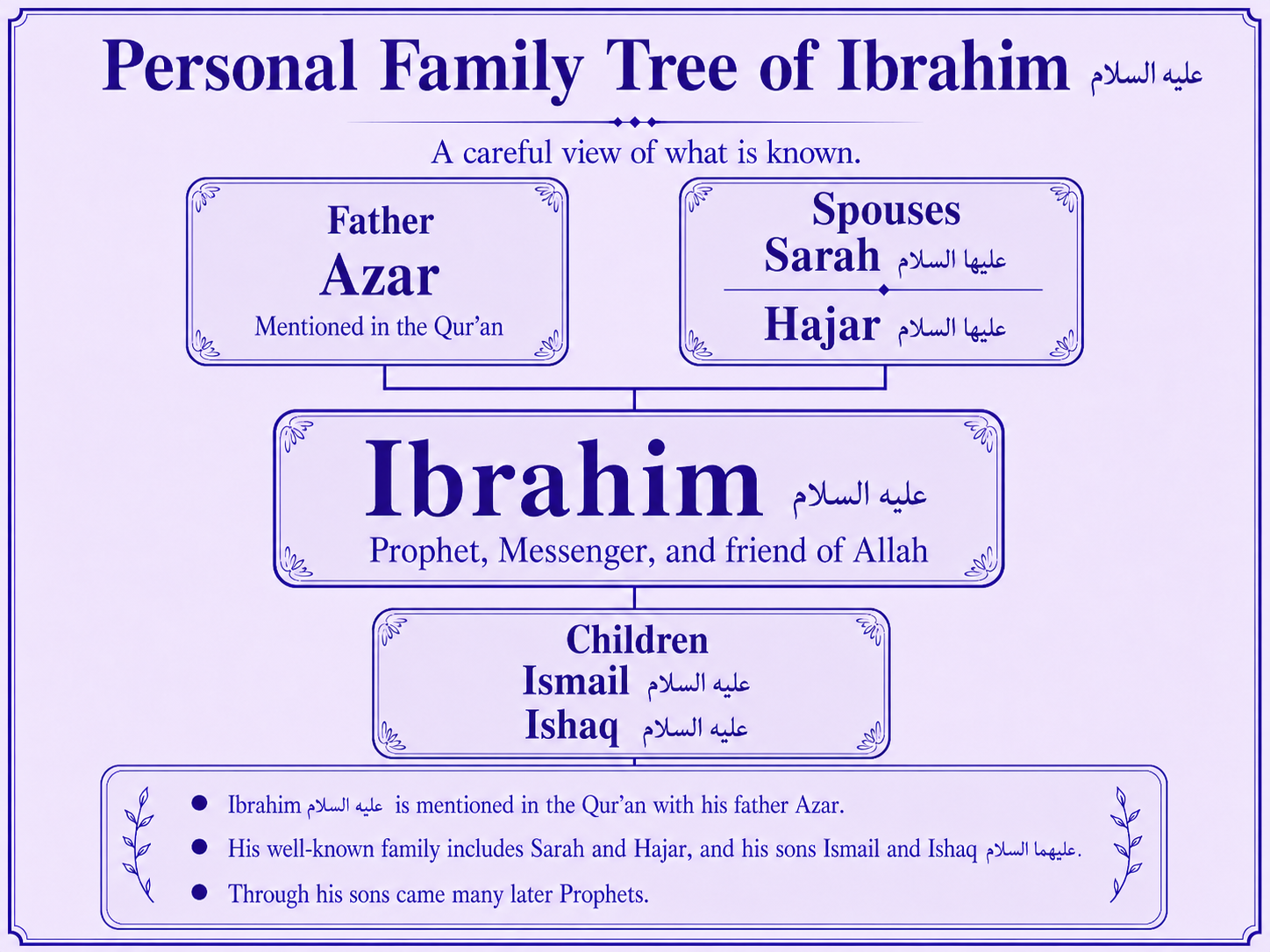
- Use for: Ibrahim عليه السلام, Sarah, Hajar, Isma'il عليه السلام, Ishaq عليه السلام, and Ya'qub عليه السلام.
- Confirmed: Isma'il and Ishaq عليهما السلام were sons of Ibrahim عليه السلام, and Ya'qub عليه السلام came through Ishaq عليه السلام.
- Keep careful: do not add unsupported details about exact ages, graves, or extra family names as Qur’an-confirmed facts.
Prophetic Lineage
This visual should show Ibrahim عليه السلام as a major root of later Prophetic lineages.
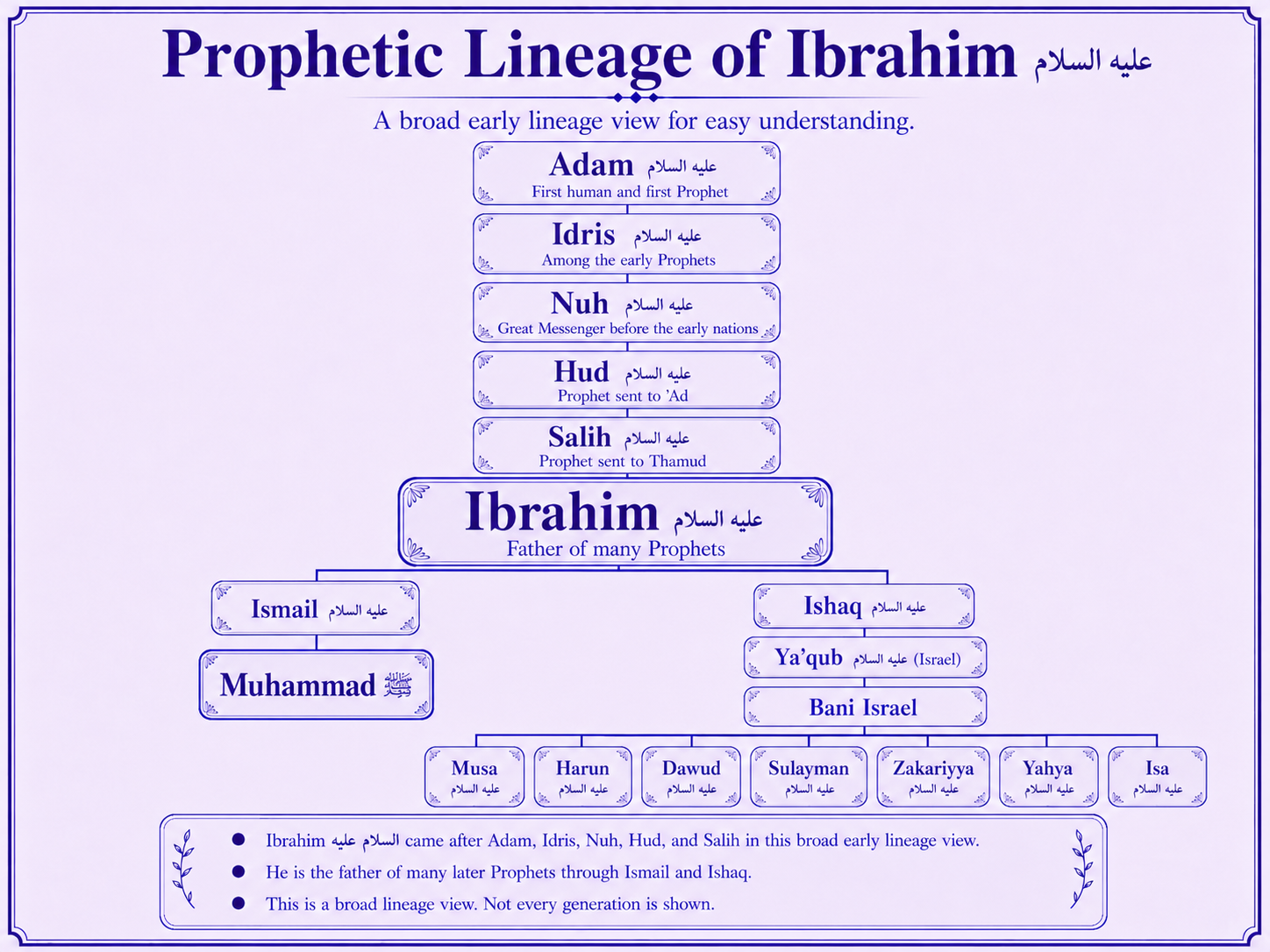
- Use for: Ibrahim عليه السلام → Isma'il عليه السلام → Prophet Muhammad ﷺ, and Ibrahim عليه السلام → Ishaq عليه السلام → Ya'qub عليه السلام → Bani Israel Prophets.
- Purpose: show the two great Prophetic branches from Ibrahim عليه السلام.
- Do not invent: exact intermediate generations where they are not confirmed in the Qur’an or authentic hadith.
A young heart that refused lifeless gods
Ibrahim عليه السلام lived among people who worshipped what their own hands shaped. Idols stood before them, but those idols could not hear, answer, create, guide, eat, speak, protect, or save.
From a young age, Ibrahim عليه السلام saw the emptiness of false worship. He looked at the idols and asked the question that breaks every false religion: how can something helpless be worshipped?
He did not accept faith as an inherited costume. He searched for truth, spoke truth, and stood for truth even when truth placed him against his own people. His story begins with a heart that refused to bow to clay, stone, stars, rulers, family pressure, or fear.
He questioned idol worship
مَا هَٰذِهِ التَّمَاثِيلُ الَّتِي أَنتُمْ لَهَا عَاكِفُونَ
Ma hadhihit-tamathilul-lati antum laha 'akifun?
What are these statues to which you are devoted? Source: Quran 21:52.
True faith is not blind imitation. Ibrahim عليه السلام challenged worship that had no proof.
They followed their fathers without proof
His people answered that they found their fathers worshipping them. Source: Quran 21:53, meaning summarized.
Family tradition is not proof when it opposes revelation. Respect for elders does not mean copying false worship.
Ibrahim عليه السلام calls Azar
One of the most emotional parts of his story is his call to his father, Azar. Ibrahim عليه السلام did not begin with harshness. He said, “O my father,” again and again. The words were soft, but the message was firm.
He asked why his father worshipped what could not hear, see, or benefit him. He told him that knowledge had come to him, and invited him to follow the straight path. He warned him not to worship Shaytan and feared that punishment might touch him.
Azar rejected him and threatened to stone him. Ibrahim عليه السلام did not answer threat with insult. He said peace and promised to seek forgiveness for him. Later, when it became clear that his father was an enemy to Allah, Ibrahim عليه السلام dissociated from him. His mercy did not cancel tawheed.
O my father
يَا أَبَتِ لِمَ تَعْبُدُ مَا لَا يَسْمَعُ وَلَا يُبْصِرُ وَلَا يُغْنِي عَنكَ شَيْئًا
Ya abati lima ta'budu ma la yasma'u wa la yubsiru wa la yughni 'anka shay'a?
O my father, why do you worship that which does not hear, does not see, and cannot benefit you at all? Source: Quran 19:42.
He remained respectful under threat
Azar threatened to stone him and told him to leave. Ibrahim عليه السلام replied with peace and said he would ask forgiveness for him. Source: Quran 19:46-47, meaning summarized.
Kindness to parents is required, but obedience in shirk is not allowed. Ibrahim عليه السلام balanced respect with loyalty to Allah.
Mercy did not cancel tawheed
Ibrahim عليه السلام sought forgiveness for his father because of a promise, but when it became clear that he was an enemy to Allah, Ibrahim separated himself from him. Source: Quran 9:114, meaning summarized.
Azar is mentioned in the Qur’an
The Qur’an mentions Azar in the story of Ibrahim عليه السلام. Some scholars discussed whether Azar was his direct father or another paternal figure, but the page should follow the Qur’anic wording without turning the discussion into confusion for readers.
Azar is mentioned in Quran 6:74.
The star, the moon, and the sun
Ibrahim عليه السلام looked at the sky and used what people admired to show them that created things cannot be the Creator.
He saw a star and said, “This is my lord.” Then it set. He said he did not love those that disappear. He saw the moon, then the sun, and each one also set. The point was not that Ibrahim عليه السلام worshipped them. The point was argument and exposure: anything that rises, sets, changes, disappears, and obeys a system cannot be the Lord of the worlds.
Then Ibrahim عليه السلام turned clearly to the One who created the heavens and the earth. His heart was not attached to the lights in the sky. It was attached to the Maker of the sky.
I turn my face to the Creator
إِنِّي وَجَّهْتُ وَجْهِيَ لِلَّذِي فَطَرَ السَّمَاوَاتِ وَالْأَرْضَ حَنِيفًا
Inni wajjahtu wajhiya lilladhi fataras-samawati wal-arda hanifa.
Indeed, I have turned my face toward the One who created the heavens and the earth, inclining to truth. Source: Quran 6:79, relevant part.
The star, moon, and sun were signs, not gods. The believer admires creation but worships the Creator.
The day the idols broke
Ibrahim عليه السلام made a plan regarding the idols. When his people left, he went to the idols and questioned them. Food was placed before them, but they did not eat. He asked why they did not speak. Then he struck the idols and broke them, leaving the largest one.
When the people returned, they were shocked. They asked who had done this to their gods. Some said they had heard a young man called Ibrahim mention them. They brought him before the people.
Ibrahim عليه السلام told them to ask the largest idol if it could speak. In that moment, the argument pierced them. They knew idols could not speak. But instead of following the truth they had just recognised, they turned back into stubbornness.
He broke the idols
فَجَعَلَهُمْ جُذَاذًا إِلَّا كَبِيرًا لَّهُمْ لَعَلَّهُمْ إِلَيْهِ يَرْجِعُونَ
Faja'alahum judhadhan illa kabiral-lahum la'allahum ilayhi yarji'un.
So he made them into pieces, except a large one among them, so they might return to it. Source: Quran 21:58.
Ask them, if they can speak
Ibrahim عليه السلام told them to ask the idols if they could speak. They knew the idols could not speak, yet they returned to stubbornness. Source: Quran 21:62-65, meaning summarized.
Knowing the truth for a moment is not enough. A person must surrender to it before pride covers it again.
The fire that obeyed Allah
When they could not defeat the truth, they tried to burn the caller.
His people said: burn him and support your gods, if you are going to act. Fire became their argument because their idols had no argument. They gathered against one young Prophet and thought flame would erase tawheed.
But fire is not independent. It burns by Allah’s permission and stops by Allah’s command. Allah said: “O fire, be coolness and safety upon Ibrahim.” The fire that should have destroyed him became a place of protection.
They wanted to harm him, but Allah made them the losers. Ibrahim عليه السلام walked out of a fire that had become a sign for every believer: when Allah protects, the weapon itself can become harmless.
Burn him
They said: Burn him and support your gods, if you are going to act. Source: Quran 21:68, meaning summarized.
When falsehood loses proof, it often reaches for force.
O fire, be cool and safe
يَا نَارُ كُونِي بَرْدًا وَسَلَامًا عَلَىٰ إِبْرَاهِيمَ
Ya naru kuni bardan wa salaman 'ala Ibrahim.
O fire, be coolness and safety upon Ibrahim. Source: Quran 21:69.
The king who argued about life and death
Ibrahim عليه السلام also argued with a king who was deceived by power. Ibrahim said his Lord gives life and causes death. The king claimed that he too gives life and death.
Ibrahim عليه السلام did not stay trapped in the king’s wordplay. He moved to a sign no ruler could fake: Allah brings the sun from the east, so bring it from the west. The arrogant disbeliever was silenced.
Many people call this king Nimrod, but the Qur’an does not name him. The lesson is not the king’s name. The lesson is that political power cannot stand against the Lord of the sun.
Bring the sun from the west
Ibrahim عليه السلام said that Allah brings the sun from the east, so the king should bring it from the west. The disbeliever was stunned. Source: Quran 2:258, meaning summarized.
A ruler may control people, but cannot control the sun. Power becomes foolish when it forgets Allah.
My Lord, show me how You give life to the dead
Ibrahim عليه السلام believed in resurrection, but he wanted the heart to taste a deeper certainty.
He asked Allah to show him how He gives life to the dead. Allah asked, “Have you not believed?” Ibrahim عليه السلام replied that he had believed, but wanted his heart to be reassured.
Allah commanded him to take four birds, train or incline them to himself, place portions of them on mountains, and then call them. They would come to him quickly by Allah’s command. The lesson is clear: resurrection is easy for Allah. The One who gives life the first time can bring it back again.
This story is not doubt against faith. It is faith asking for a stronger witnessing of Allah’s power. Ibrahim عليه السلام already believed. He wanted the calm of certainty to settle even deeper in the heart.
So my heart may be reassured
قَالَ أَوَلَمْ تُؤْمِن ۖ قَالَ بَلَىٰ وَلَٰكِن لِّيَطْمَئِنَّ قَلْبِي
Qala awalam tu'min? Qala bala wa lakil-liyatma'inna qalbi.
He said: Have you not believed? He said: Yes, but so that my heart may be reassured. Source: Quran 2:260, relevant part.
Seeking deeper certainty is not the same as rejecting faith. Ibrahim عليه السلام believed, and Allah increased him in reassurance.
Leaving for Allah
After facing rejection, Ibrahim عليه السلام migrated for Allah. The Qur’an mentions that Allah delivered him and Lut عليه السلام to the land Allah had blessed for the worlds. Migration here was not escape from responsibility. It was obedience when staying among falsehood was no longer the path.
Ibrahim عليه السلام left people, place, comfort, and familiarity. His homeland could not be dearer to him than Allah. This is why his story keeps returning to one theme: when Allah calls, Ibrahim عليه السلام moves.
He would later become a father of Prophets and a guide for nations, but first he had to walk away from idols.
Delivered to the blessed land
Allah delivered Ibrahim and Lut عليهما السلام to the land He blessed for the worlds. Source: Quran 21:71, meaning summarized.
He migrated to his Lord
إِنِّي مُهَاجِرٌ إِلَىٰ رَبِّي
Inni muhajirun ila rabbi.
Indeed, I am migrating to my Lord. Source: Quran 29:26, relevant part.
The honoured guests and the news of Ishaq عليه السلام
One day, noble guests came to Ibrahim عليه السلام. He did not know at first that they were angels.
He quickly brought a roasted calf, showing his generosity. But when he saw that they did not eat, he felt fear. They reassured him and gave good news of a knowledgeable son. Sarah, his wife, was amazed because both she and Ibrahim عليه السلام were old. The angels said the command of Allah was not strange.
Those same angels were also sent toward the people of Lut عليه السلام. In this scene, mercy and punishment stand close together: glad tidings for the house of Ibrahim عليه السلام, and warning for a corrupt nation.
He honoured his guests
Ibrahim عليه السلام brought a roasted calf to his guests. Source: Quran 11:69 and Quran 51:24-27, meaning summarized.
Generosity was part of his character. His worship did not make him cold with people.
Glad tidings of Ishaq عليه السلام
The angels gave glad tidings of Ishaq, and after Ishaq, Ya'qub. Source: Quran 11:71, meaning summarized.
Allah can send joy when people think the age of hope has passed.
Sarah عليها السلام, the tyrant, and Hajar عليها السلام
Authentic hadith mention an important event involving Ibrahim عليه السلام, Sarah عليها السلام, a tyrant ruler, and Hajar عليها السلام.
Ibrahim عليه السلام travelled with Sarah عليها السلام. They entered the land of a tyrant. Ibrahim عليه السلام described Sarah as his sister, meaning his sister in faith, to protect her from the tyrant’s evil. The tyrant tried to approach Sarah, but Allah protected her.
Sarah عليها السلام made dua, and the tyrant was seized. This happened more than once. When he realised she was protected, he released her and gave Hajar عليها السلام. Later, Hajar became the mother of Isma'il عليه السلام, and through Isma'il came the line of Prophet Muhammad ﷺ.
This story should be told with honour for Sarah and Hajar عليهما السلام. Sarah was protected by Allah, and Hajar was not a side note. Allah made her part of the story of Zamzam, Makkah, Hajj, and the final Prophet ﷺ.
The story of Ibrahim عليه السلام, Sarah عليها السلام, the tyrant, and Hajar عليها السلام is reported in Sahih al-Bukhari and Sahih Muslim, meaning summarized.
Hajar and Isma'il عليهما السلام in the valley
Ibrahim عليه السلام brought Hajar and their baby Isma'il عليه السلام to the barren valley of Makkah. There were no crops, no crowd, and no visible comfort. Hajar asked if Allah had commanded this. When she understood it was by Allah’s command, her words became a mountain of trust: Allah would not abandon them.
Ibrahim عليه السلام walked away with a heart tied to Allah and made dua for his family near the Sacred House. Hajar searched between Safa and Marwah, looking for help for her child. Then Allah brought Zamzam, and the empty valley began to breathe with mercy.
This was not abandonment. It was the planting of a future: Zamzam, Makkah, the Ka'bah, Hajj, and the line of Prophet Muhammad ﷺ.
The story of Ibrahim عليه السلام leaving Hajar and Isma'il in Makkah, Hajar running between Safa and Marwah, and Zamzam is reported in Sahih al-Bukhari, meaning summarized.
A valley without crops
رَبَّنَا إِنِّي أَسْكَنتُ مِن ذُرِّيَّتِي بِوَادٍ غَيْرِ ذِي زَرْعٍ
Rabbana inni askantu min dhurriyyati biwadin ghayri dhi zar'in.
Our Lord, I have settled some of my descendants in a valley without cultivation. Source: Quran 14:37, relevant part.
Make hearts incline toward them
فَاجْعَلْ أَفْئِدَةً مِّنَ النَّاسِ تَهْوِي إِلَيْهِمْ
Faj'al af'idatam-minan-nasi tahwi ilayhim.
So make hearts among the people incline toward them. Source: Quran 14:37, relevant part.
The crowds that love Makkah today are connected to a dua made in an empty valley.
The dream and the son who surrendered
When his son became old enough to walk with him, Ibrahim عليه السلام saw in a dream that he was sacrificing him.
For Prophets, dreams can be revelation. Ibrahim عليه السلام did not hide the command from his son. He said, “O my son, I see in a dream that I am sacrificing you, so see what you think.” The son answered with surrender: “O my father, do as you are commanded. You will find me, if Allah wills, among the patient.”
When they both submitted and Ibrahim عليه السلام laid him down, Allah called him. The test had been fulfilled. Allah ransomed the son with a great sacrifice and left honour for Ibrahim عليه السلام among later generations.
The Qur’an does not name the son in the sacrifice passage. Many Muslim scholars identify him as Isma'il عليه السلام, especially because the glad tidings of Ishaq عليه السلام are mentioned after the sacrifice passage. This page follows that well-known Muslim understanding while noting that the passage itself does not name him.
O my son, I see in a dream
يَا بُنَيَّ إِنِّي أَرَىٰ فِي الْمَنَامِ أَنِّي أَذْبَحُكَ
Ya bunayya inni ara fil-manami anni adhbahuk.
O my son, indeed I see in a dream that I am sacrificing you. Source: Quran 37:102, relevant part.
You will find me patient
يَا أَبَتِ افْعَلْ مَا تُؤْمَرُ ۖ سَتَجِدُنِي إِن شَاءَ اللَّهُ مِنَ الصَّابِرِينَ
Ya abatif'al ma tu'mar. Satajiduni in sha Allahu minas-sabirin.
O my father, do as you are commanded. You will find me, if Allah wills, among the patient. Source: Quran 37:102, relevant part.
Allah ransomed him
وَفَدَيْنَاهُ بِذِبْحٍ عَظِيمٍ
Wa fadaynahu bidhibhin 'azim.
And We ransomed him with a great sacrifice. Source: Quran 37:107.
Why this story lives in our worship
The sacrifice story is remembered in the worship of Eid al-Adha and Qurbani. The point is not meat alone. It is surrender, obedience, sincerity, and love of Allah above every attachment.
Father and son raise the House
Ibrahim عليه السلام and Isma'il عليه السلام raised the foundations of the Ka'bah. This was not a monument to their names. It was the House of Allah, built for tawheed, prayer, purification, and pilgrimage.
As they built, they made a dua every worker for Allah should remember: “Our Lord, accept from us.” They were Prophets doing one of the greatest acts in history, yet their hearts were not proud. They were asking for acceptance.
Then Ibrahim عليه السلام was commanded to proclaim the pilgrimage. People would come from distant paths, and the call would travel through centuries until hearts still turn to the House today.
Our Lord, accept from us
رَبَّنَا تَقَبَّلْ مِنَّا ۖ إِنَّكَ أَنتَ السَّمِيعُ الْعَلِيمُ
Rabbana taqabbal minna innaka antas-sami'ul-'alim.
Our Lord, accept from us. Indeed, You are the Hearing, the Knowing. Source: Quran 2:127.
Call people to Hajj
Allah commanded Ibrahim عليه السلام to proclaim Hajj to the people, and they would come from distant paths. Source: Quran 22:27, meaning summarized.
A command obeyed in a desert can echo across the world when Allah gives it life.
Duas of Ibrahim عليه السلام
رَبِّ اجْعَلْنِي مُقِيمَ الصَّلَاةِ وَمِن ذُرِّيَّتِي
Rabbij'alni muqimas-salati wa min dhurriyyati.
My Lord, make me an establisher of prayer, and also from my descendants. Source: Quran 14:40, relevant part.
رَبَّنَا اغْفِرْ لِي وَلِوَالِدَيَّ وَلِلْمُؤْمِنِينَ يَوْمَ يَقُومُ الْحِسَابُ
Rabbana-ghfir li wa liwalidayya wa lil-mu'minina yawma yaqumul-hisab.
Our Lord, forgive me, my parents, and the believers on the Day the account is established. Source: Quran 14:41.
رَبِّ هَبْ لِي حُكْمًا وَأَلْحِقْنِي بِالصَّالِحِينَ
Rabbi hab li hukman wa alhiqni bis-salihin.
My Lord, grant me wisdom and join me with the righteous. Source: Quran 26:83.
Common questions about Ibrahim عليه السلام
Popular details should be kept in their proper place so the page stays accurate.
Was the king called Nimrod?
Many historical and tafsir discussions call him Nimrod, but the Qur’an does not name him. The page should say “the king who argued with Ibrahim عليه السلام,” not present the name as Qur’anic fact.
Was the son Isma'il عليه السلام?
The Qur’an does not name the son in the sacrifice passage. Many Muslim scholars identify him as Isma'il عليه السلام, and this is the well-known Muslim understanding. The wording should still note that the passage itself does not name him.
Do we know his exact birthplace?
Historical books mention places connected to Ibrahim عليه السلام, but the Qur’an does not give a confirmed birthplace, birth year, or full childhood biography. The lesson is his tawheed, not a tourist map.
Do we know his grave?
There is a famous historical connection between Ibrahim عليه السلام and al-Khalil/Hebron, but exact grave claims should not be treated like Qur’an. The page can mention such claims only as historical tradition, not as required belief.
Circumcision of Ibrahim عليه السلام
Authentic hadith mention that Ibrahim عليه السلام circumcised himself at an old age. This shows his obedience to Allah even when the command was difficult. It is a prophetic detail, not the main storyline, so it is mentioned briefly.
Reported in Sahih al-Bukhari and Sahih Muslim, meaning summarized.
The three statements mentioned in hadith
There is an authentic hadith mentioning three statements of Ibrahim عليه السلام, including “I am sick,” “the big one did it,” and his statement about Sarah being his sister. Scholars explain these within their contexts and objectives, not as ordinary lying for worldly gain. This topic should be presented briefly and respectfully so readers do not misunderstand the honour of a Prophet.
The report is found in Sahih al-Bukhari and Sahih Muslim, meaning summarized.
Tawheed is worth standing alone for
Ibrahim عليه السلام stood against idols, people, family pressure, and kings for the sake of Allah.
Respect does not mean obeying shirk
He spoke gently to his father, but he did not follow him into false worship.
Allah controls the fire
What people use to destroy can become harmless when Allah commands it to be safe.
Dua can plant a future
A dua made in an empty valley became Makkah, Zamzam, Hajj, and hearts turning toward the House.
Surrender is the soul of sacrifice
The sacrifice test was not about blood alone. It was about love of Allah above every attachment.
Acceptance matters more than action size
Even while raising the Ka'bah, Ibrahim and Isma'il عليهما السلام asked Allah to accept from them.
Common mistakes about this story
- Thinking he worshipped the star, moon, or sun: he used them to expose false worship, not to worship them.
- Calling the king Nimrod as Qur’an fact: the Qur’an does not name the king.
- Turning birthplace and grave claims into belief: exact locations are not the heart of the story.
- Making the sacrifice debate harsh: the Qur’an does not name the son in that passage, though many Muslim scholars identify him as Isma'il عليه السلام.
- Forgetting Hajar: her trust in Allah is a major part of the Makkah story and should not be erased.
The whole story in six lines
- Ibrahim عليه السلام rejected idols and called his father and people to Allah.
- He broke the idols and was thrown into fire, but Allah made it cool and safe.
- He silenced the arrogant king and asked Allah to show him how He gives life to the dead.
- Allah protected Sarah عليها السلام and later blessed the family through Hajar عليها السلام and Isma'il عليه السلام.
- Hajar and Isma'il were placed in Makkah, and Zamzam opened by Allah’s mercy.
- The sacrifice test came, then Ibrahim and Isma'il عليهما السلام raised the Ka'bah and made dua for acceptance.
Main references used
- Qur’an: Ibrahim عليه السلام and his father/people: Quran 6:74-83, 19:41-50, 21:51-73, 26:69-89, 29:16-27, 37:83-113.
- Qur’an: Debate with the king: Quran 2:258.
- Qur’an: Ibrahim asking to see how Allah gives life to the dead: Quran 2:260.
- Qur’an: Ibrahim as Khalil, hanif, and an ummah: Quran 4:125, 16:120.
- Qur’an: Makkah dua and family in the valley: Quran 14:35-41.
- Qur’an: Building the Ka'bah with Isma'il عليه السلام: Quran 2:125-129, 22:26-27.
- Qur’an: Sacrifice test: Quran 37:102-107.
- Hadith: Sarah عليها السلام, the tyrant, and Hajar عليها السلام are reported in Sahih al-Bukhari and Sahih Muslim, meaning summarized.
- Hadith: Hajar, Isma'il, Safa and Marwah, and Zamzam are reported in Sahih al-Bukhari, meaning summarized.
- Hadith: Circumcision of Ibrahim عليه السلام and the three statements report are found in Sahih al-Bukhari and Sahih Muslim, meaning summarized.
- Extra details: Exact birth date, death date, childhood details, king’s name, and exact grave location are not established as clear Qur’an or authentic hadith facts.
Ibrahim عليه السلام teaches the religion of surrender
He stood before idols, fire, kings, distance, family tests, an empty valley, and the command of sacrifice. Every time, his answer was surrender to Allah. That is why his story does not feel like one story, but a whole road. Whoever walks it learns that tawheed is not a slogan. It is the heart choosing Allah again and again, until even fire, desert, and sacrifice become doors to mercy.