

Story of Idris عليه السلام
Idris عليه السلام is mentioned only briefly in the Qur’an, yet those few words shine with truthfulness, prophethood, patience, righteousness, mercy, and a high station. His story teaches that a person does not need a long public biography to be honoured by Allah.
Family Tree / Lineage
Personal Family Tree
This visual should show only the reliable close family details connected to Idris عليه السلام.
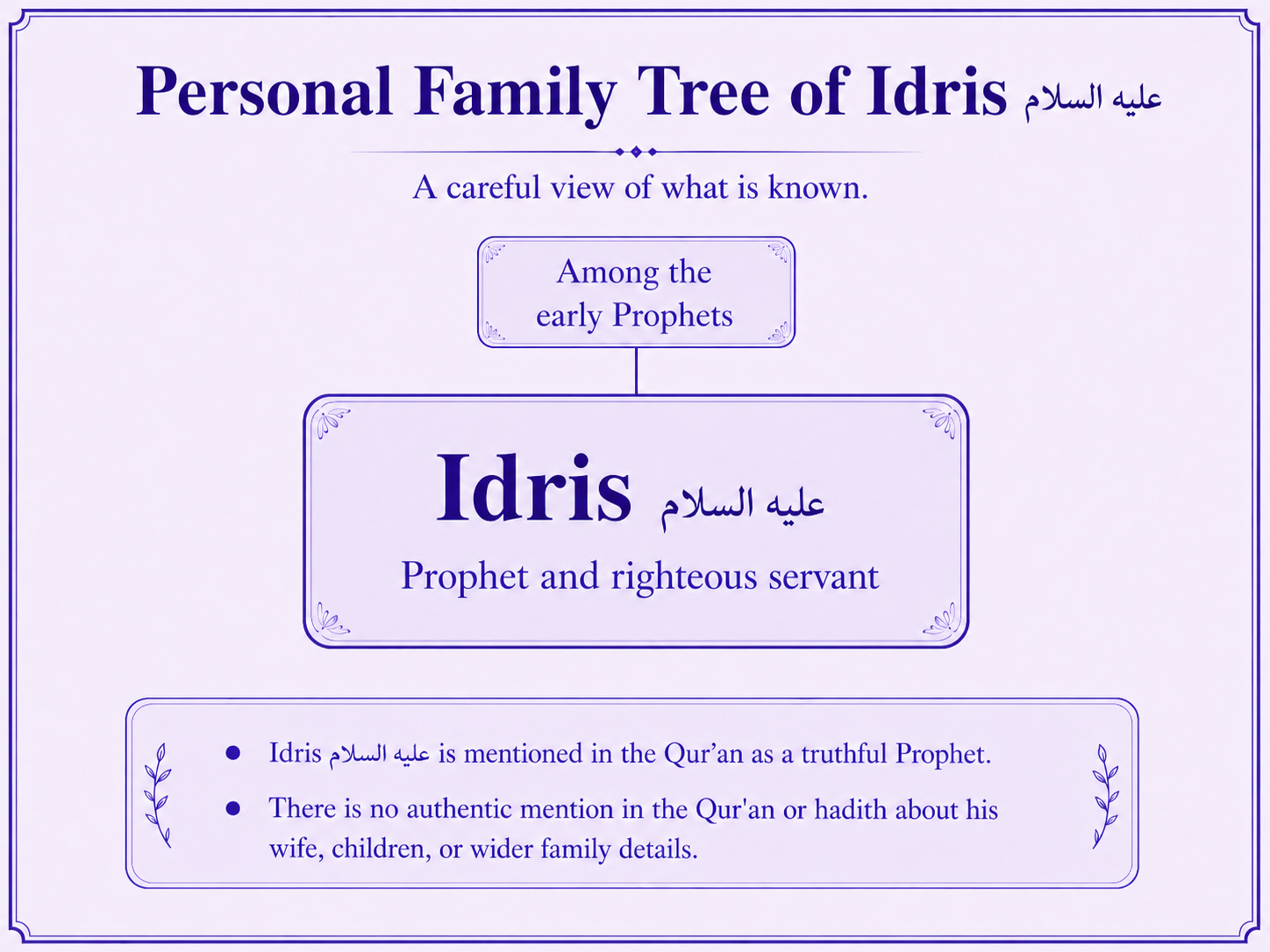
- Use for: Idris عليه السلام only, unless reliable close family details are added later.
- Not confirmed: parents, mother’s name, spouse, children, exact tribe, and grave location are not named in the Qur’an.
- Keep simple: the image can clearly state that personal family details are not confirmed.
Prophetic Lineage
This visual should show broad Prophetic context without claiming every missing generation is known.
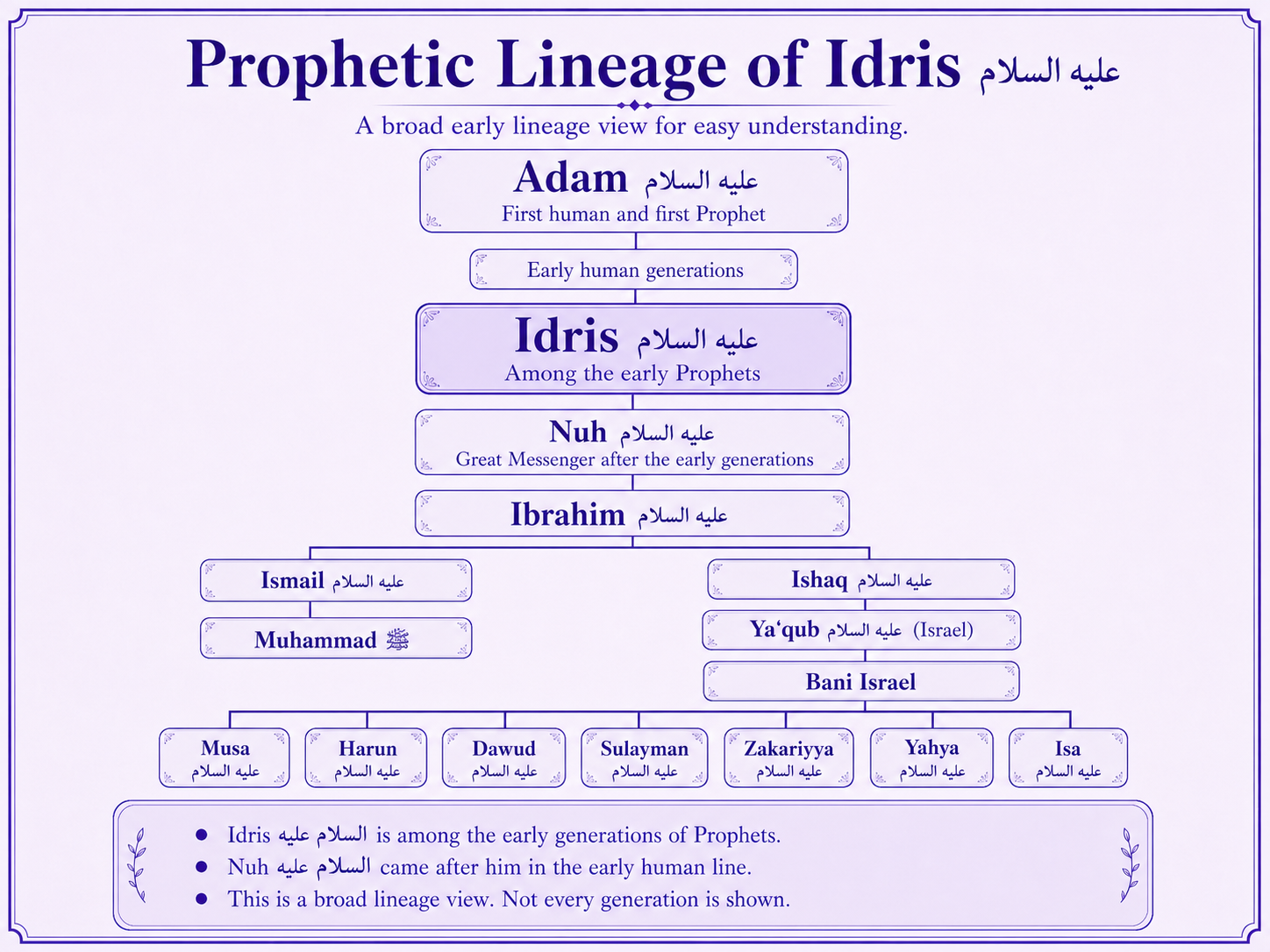
- Use for: Adam عليه السلام → early generations → Idris عليه السلام → Nuh عليه السلام later in the Prophets journey.
- Purpose: show Idris عليه السلام among the earliest Prophets before Nuh عليه السلام in the section order.
- Do not invent: exact intermediate generations, dates, or detailed ancestry not confirmed in the Qur’an or authentic hadith.
What this story is based on
The Qur’an mentions Idris عليه السلام by name and describes him as truthful, a Prophet, patient, righteous, and raised to a high station. Authentic hadith mention that Prophet Muhammad ﷺ met Idris عليه السلام during the Night Journey. Many extra stories about Idris عليه السلام are found in tafsir and history books, but they are not all established with the same strength, so they must be worded carefully.
Do we know the exact dates of Idris عليه السلام?
The Qur’an and authentic hadith do not give the birth year, death year, exact age, city, or full worldly timeline of Idris عليه السلام. He is commonly placed among the early Prophets, before Nuh عليه السلام, in many Prophet lists and historical discussions, but exact dates should not be presented as confirmed Islamic history.
What is safely covered on this page
This page covers everything clearly established about Idris عليه السلام from Qur’an and authentic hadith: his prophethood, truthfulness, patience, righteousness, mercy from Allah, high station, and the meeting during Mi'raj. Popular extra details are included only as cautious notes, not as confirmed facts.
The story in one clear path
A clear journey through his confirmed life qualities and the reports that need careful wording.
Idris عليه السلام is named in the Qur’an
Allah tells the Prophet ﷺ to mention Idris عليه السلام in the Book.
He was truthful and a Prophet
The Qur’an calls him siddeeq and nabiyy, a man of truth and a Prophet.
Allah raised him to a high station
The Qur’an gives him a special honour without giving every detail of how and when.
He was among the patient and righteous
Allah mentions him with Isma'il and Dhu al-Kifl عليهم السلام as people of patience and righteousness.
The Prophet ﷺ met him during Mi'raj
Authentic hadith mention Idris عليه السلام during the Night Journey and Ascension.
Extra stories need caution
Claims about him being first to write, first to sew, his exact era, death, or being alive must not be taught as certain unless proven.
The life of Idris عليه السلام
After Adam عليه السلام, generations spread on earth. Families grew, people worked, worshipped, learned, forgot, remembered, and faced the same test every generation faces: will the heart remain truthful with Allah?
Among the early Prophets, Allah chose Idris عليه السلام. The Qur’an does not give us his city, family details, childhood, marriage, children, or the exact people he was sent to. But it gives something more important than those details: Allah Himself describes the quality of his life.
Allah calls him siddeeq, a person of deep truthfulness, and nabiyy, a Prophet. This means his life was not built on empty words. He lived with truth in belief, truth in speech, truth in worship, truth in calling people to Allah, and truth in private moments no one else could see.
Every Prophet called to the same foundation: worship Allah alone and avoid false worship. So the life of Idris عليه السلام should be understood as a life of da'wah, patience, righteousness, and calling people back to Allah. But the exact conversations, names of his people, and details of their response are not given in authentic texts.
Then Allah gives Idris عليه السلام a special honour: “We raised him to a high station.” The Qur’an leaves the detail noble and brief. Authentic hadith later show that Prophet Muhammad ﷺ met Idris عليه السلام during the Mi'raj, in the heavens, where Idris عليه السلام welcomed him as a righteous brother and Prophet.
So his life story is not a noisy story. It is a story of a truthful servant, an early Prophet, a patient worshipper, a righteous caller, and a man whom Allah raised. The world may not know every chapter of his life, but Allah recorded enough for believers to remember the kind of person he was.
What his life teaches through the few confirmed details
For Idris عليه السلام, the Qur’an gives qualities more than scenes. Those qualities are the story.
He lived as a truthful man
Allah did not introduce Idris عليه السلام by wealth, tribe, city, or public power. Allah introduced him through truthfulness. That means his heart and tongue were aligned. He did not use religion as a mask. He did not call to Allah while living a double life.
This is why his story should not be treated as “only two verses.” Those two verses show the backbone of a Prophet’s life: truthfulness before Allah.
He called to the message of all Prophets
The Qur’an teaches that every Messenger was sent with the call to worship Allah and avoid false worship. So Idris عليه السلام was not merely a historical personality. He was a Prophet who carried the message of tawheed.
Allah says that He sent messengers before Prophet Muhammad ﷺ with the message: there is no deity worthy of worship except Allah, so worship Him. Source: Quran 21:25, meaning summarized.
He was patient, even though the details are hidden
Allah includes Idris عليه السلام among the patient. This tells us he had tests, but Allah did not describe every wound. Sometimes the Qur’an teaches us that a person’s hidden patience is known to Allah even when people do not know the full story.
Allah raised him
The high station of Idris عليه السلام is confirmed. The exact details are not fully opened to us. The believer stops where revelation stops and takes the lesson: Allah raises whom He wills through truth, patience, prophethood, and righteousness.
Idris عليه السلام was truthful and a Prophet
وَاذْكُرْ فِي الْكِتَابِ إِدْرِيسَ ۚ إِنَّهُ كَانَ صِدِّيقًا نَّبِيًّا
Wadhkur fil-kitabi Idris. Innahu kana siddeeqan nabiyya.
And mention in the Book Idris. Indeed, he was a man of truth and a Prophet. Source: Quran 19:56.
The first description Allah gives here is truthfulness. Before fame, miracles, or long history, truthfulness stands as a mark of honour.
Allah raised him to a high station
وَرَفَعْنَاهُ مَكَانًا عَلِيًّا
Wa rafa'nahu makanan 'aliyya.
And We raised him to a high station. Source: Quran 19:57.
The high station is confirmed by the Qur’an. Details about exactly how this raising happened should not be invented beyond reliable evidence.
He was among the patient
وَإِسْمَاعِيلَ وَإِدْرِيسَ وَذَا الْكِفْلِ ۖ كُلٌّ مِّنَ الصَّابِرِينَ
Wa Isma'ila wa Idrisa wa Dhal-Kifl. Kullum-minas-sabirin.
And Isma'il, Idris, and Dhu al-Kifl; all were among the patient. Source: Quran 21:85.
Allah praises patience even when the full story of the trial is not mentioned. The reward of patience is not lost just because people do not know the whole pain.
Allah admitted him into mercy
وَأَدْخَلْنَاهُمْ فِي رَحْمَتِنَا ۖ إِنَّهُم مِّنَ الصَّالِحِينَ
Wa adkhalnahum fi rahmatina, innahum minas-salihin.
And We admitted them into Our mercy. Indeed, they were among the righteous. Source: Quran 21:86.
The honour of Idris عليه السلام is connected to patience, mercy, and righteousness. The goal is not only knowledge about him, but becoming closer to the qualities Allah praised.
The Prophet ﷺ met Idris عليه السلام during the Night Journey
Authentic hadith tell us that during the Night Journey and Ascension, Prophet Muhammad ﷺ met several Prophets in the heavens. Among them was Idris عليه السلام. In well-known authentic reports, Idris عليه السلام is mentioned in the fourth heaven. The Prophet ﷺ greeted him, and Idris عليه السلام welcomed him as a righteous brother and Prophet.
This moment is beautiful because the Qur’an says Allah raised Idris عليه السلام to a high station, and the Mi'raj reports show him honoured in the heavens. We do not need to add dramatic scenes beyond the authentic narration. The honour itself is enough.
Meeting Idris عليه السلام during the Night Journey is reported in Sahih al-Bukhari 3887 and Sahih Muslim 164a, meaning summarized.
What people commonly say about Idris عليه السلام
These details are popular, but a public teaching page should separate what is proven from what is only reported.
Was Idris عليه السلام the first to write with the pen?
Some tafsir and history reports mention that Idris عليه السلام was the first to write with the pen. This is commonly narrated in books of history, but it is not established clearly from the Qur’an or an authentic hadith that can be taught as certain. It may be mentioned as a reported historical statement, not as confirmed belief.
Was he the first to sew clothes or study stars?
Some popular stories say Idris عليه السلام was the first to sew, wear stitched clothes, study astronomy, or teach certain crafts. These details are not proven from the Qur’an or sahih hadith. They should not be presented as definite Islamic history.
Is Idris عليه السلام the same as Enoch?
Many Muslim historians and scholars identified Idris عليه السلام with Enoch from earlier scriptures, but the Qur’an does not state this directly. A Muslim can mention that this identification exists in history and tafsir discussions, but should not build religious certainty on it.
Was he before Nuh عليه السلام?
Idris عليه السلام is commonly placed among the early Prophets before Nuh عليه السلام in many lists. However, the Qur’an does not give a full dated timeline for him. So we can place him in the early Prophetic period, while avoiding exact dates as confirmed facts.
Did he die or is he alive in heaven?
The Qur’an says Allah raised Idris عليه السلام to a high station. Some reports and interpretations discuss whether this means a raised rank, a raised place, or a special heavenly honour. The Qur’an does not give a complete death scene. We affirm what Allah said and avoid claiming exact details that are not proven.
Do we know his grave?
No confirmed grave location of Idris عليه السلام is established from the Qur’an or authentic hadith. Claims about exact burial places should not be taught as Islamic fact.
The quiet power of a truthful life
Idris عليه السلام is not remembered in the Qur’an through a long battle scene or a large public argument with his people. He is remembered through qualities: truthfulness, prophethood, patience, righteousness, mercy, and high rank.
That is a lesson for every believer. Some people spend their lives trying to be seen. Idris عليه السلام teaches us to worry about being true. Truth in belief. Truth in speech. Truth in worship. Truth in promises. Truth when alone. Truth when no one is clapping.
Allah can raise a person without the world knowing their full story. The unseen record is not missing even one sincere deed.
Truthfulness is a rank
Allah praised Idris عليه السلام as siddeeq. Truthfulness is not only not lying. It is living with a heart that does not play games with Allah.
Patience may be hidden
The Qur’an praises his patience without describing every trial. Your private patience is not invisible to Allah.
High station comes from Allah
Real elevation is not followers, titles, money, or fame. Real elevation is when Allah raises a servant.
Do not fill silence with fiction
When Allah leaves details hidden, we should not decorate the story with weak or invented claims.
A short mention can carry deep meaning
Two Qur’anic passages teach enough to change a heart: be truthful, be patient, be righteous, and hope for Allah’s mercy.
Being known to Allah is enough
A believer does not need the whole world to know their story. The One who matters knows every hidden deed.
Common mistakes about this story
- Turning weak reports into certainty: popular details about writing, sewing, stars, and crafts should be worded carefully.
- Claiming exact dates: the Qur’an does not give his birth year, death year, or full timeline.
- Claiming a confirmed grave: no grave location is proven from Qur’an or authentic hadith.
- Arguing beyond the evidence: the high station is confirmed; the exact unseen details should not be forced.
- Missing the main lesson: the point is not curiosity, but truthfulness, patience, righteousness, and mercy.
The whole story in six lines
- Idris عليه السلام is mentioned by name in the Qur’an.
- Allah called him truthful and a Prophet.
- Allah raised him to a high station.
- Allah counted him among the patient and righteous.
- The Prophet ﷺ met him during the Night Journey.
- Extra historical stories should be treated with caution unless proven.
Main authentic references used
- Qur’an: Idris عليه السلام as truthful and a Prophet: Quran 19:56.
- Qur’an: Allah raised him to a high station: Quran 19:57.
- Qur’an: Idris عليه السلام among the patient: Quran 21:85.
- Qur’an: Allah admitted them into His mercy and described them as righteous: Quran 21:86.
- Qur’an: The shared message of all Prophets was worshipping Allah alone: Quran 21:25, meaning summarized.
- Hadith: Meeting Idris عليه السلام during Mi'raj: Sahih al-Bukhari 3887; Sahih Muslim 164a, meaning summarized.
- Dates: No exact birth year, death year, age, city, or grave location of Idris عليه السلام is established from the Qur’an or authentic hadith.
- Tafsir and history caution: Reports about writing, sewing, exact timeline, death, or grave location are not established as clear Qur’an or sahih hadith facts.
Idris عليه السلام teaches quiet greatness
His story is short, but it does not feel empty. It feels like a sealed letter from the unseen: be truthful, be patient, be righteous, and let Allah raise you. The world may not know every chapter of your life, but Allah knows every sincere line.