

Story of Adam عليه السلام
The first human being, the first father of mankind, and the first story that teaches us honour, knowledge, temptation, sin, repentance, and hope. Adam عليه السلام did not leave us a story of perfection. He left us a story of returning to Allah.
Family Tree / Lineage
Personal Family Tree
This visual should show the first human family in a simple, respectful, text-only layout.
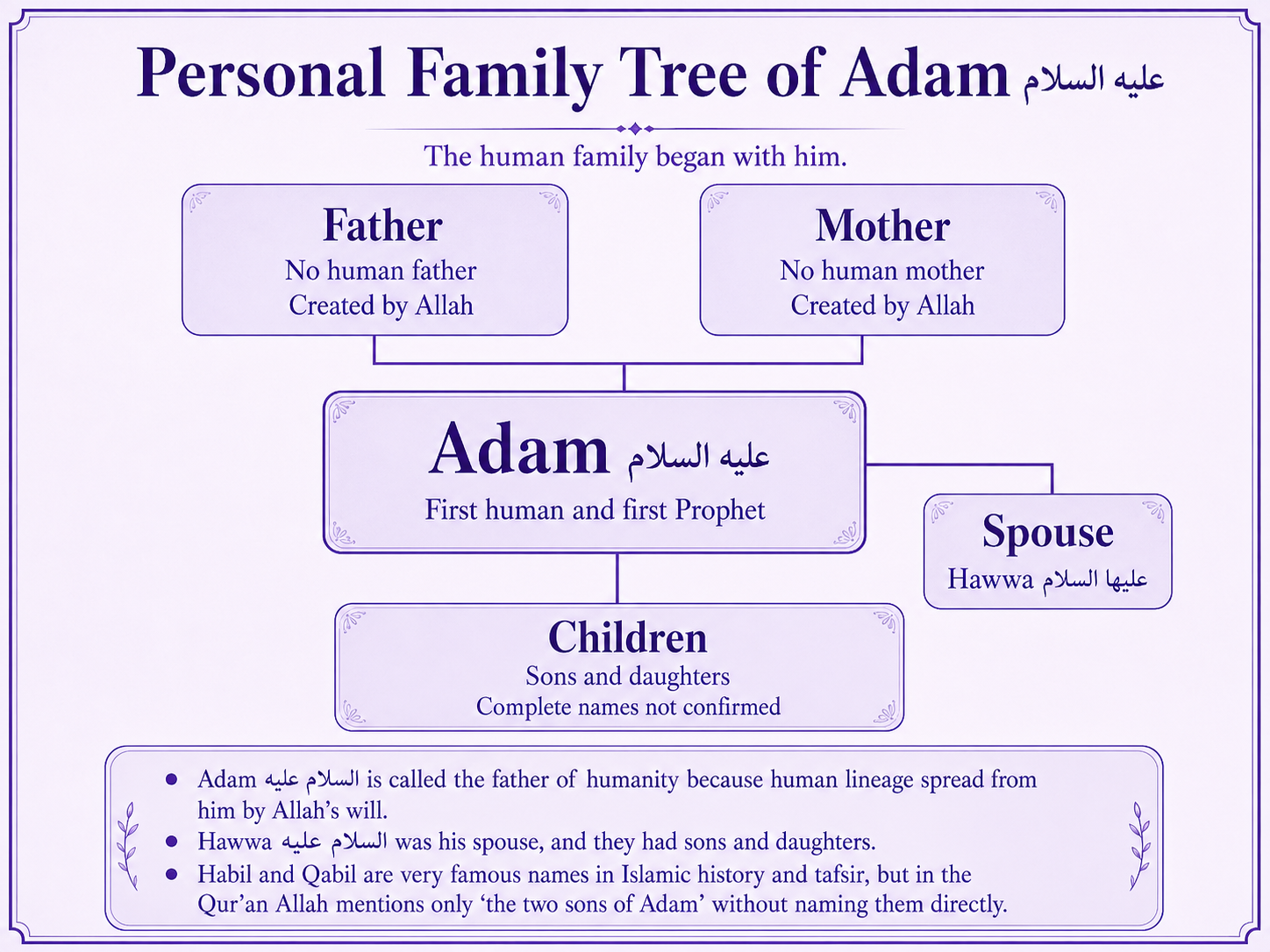
- Use for: Adam عليه السلام, Hawwa, and the children of Adam and Hawwa.
- Confirmed: Adam عليه السلام and his wife are mentioned in the Qur’an, and the two sons of Adam are mentioned in Quran 5:27-31.
- Keep clear: Habil and Qabil are known from tafsir and reports, but their names are not mentioned in the Qur’an.
Prophetic Lineage
This visual should show Adam عليه السلام as the first father of mankind and the beginning of the Prophetic family journey.
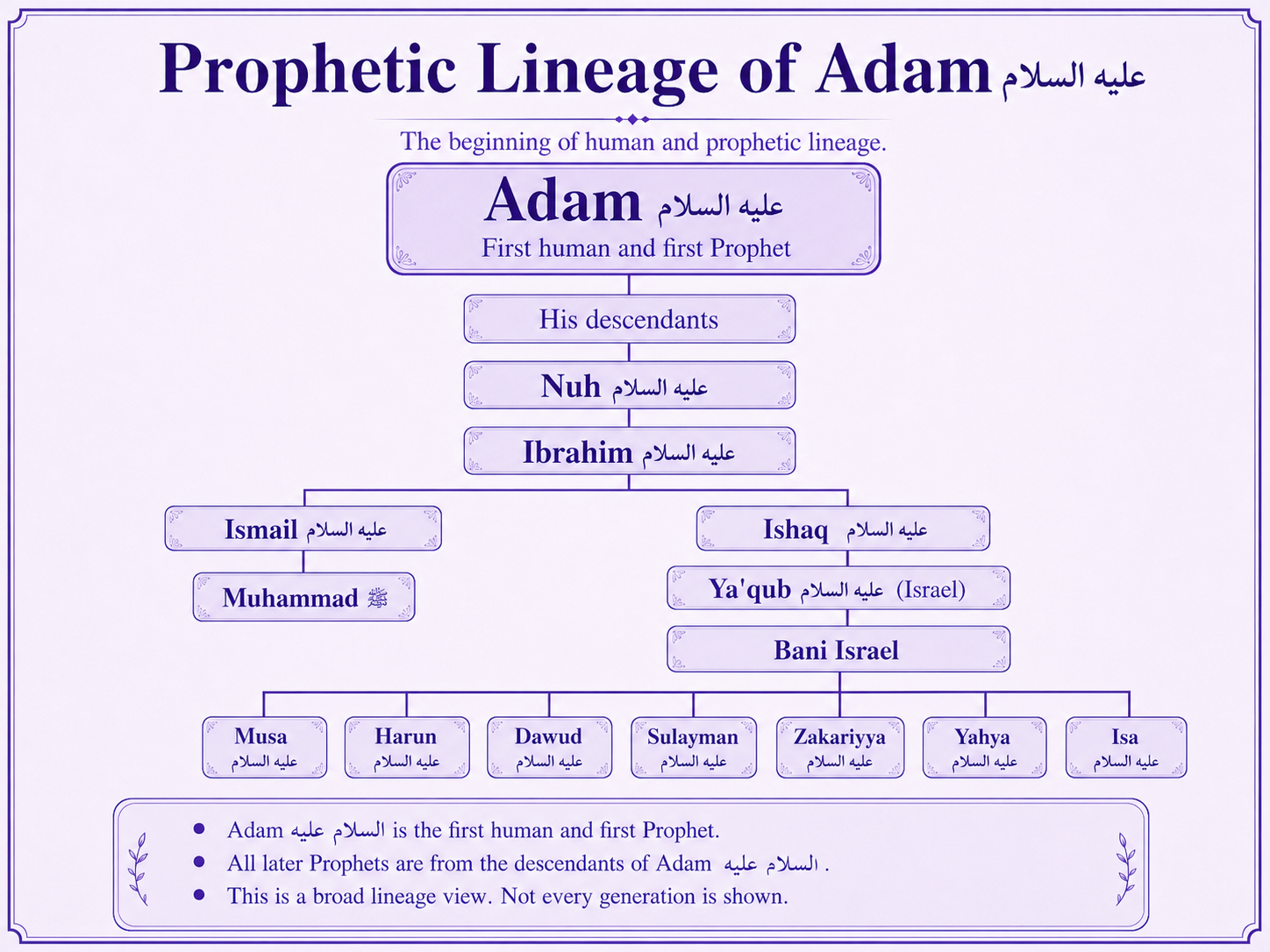
- Use for: Adam عليه السلام humanity later Prophets from his descendants Nuh عليه السلام and the Prophetic lines after him.
- Purpose: show that all later Prophets and all people descend from Adam عليه السلام.
- Do not invent: exact early-generation chains that are not confirmed in the Qur’an or authentic hadith.
Qur’an and authentic reports
The story of Adam عليه السلام is mainly found in the Qur’an. Authentic hadith add some details, such as the creation of Adam عليه السلام and the debate between Adam and Musa عليهما السلام. Details that are not proven, such as exact dates, exact places on earth where Adam and Hawwa came down, and dramatic stories involving a snake or peacock, are not treated as facts.
Important details to understand correctly
Some parts of the story are clearly proven, while other details are mentioned in tafsir or history books but are not established as certain facts.
Allah taught Adam عليه السلام the names
The Qur’an says Allah taught Adam عليه السلام the names, all of them. This shows that Adam عليه السلام was not created empty of understanding. Allah honoured him with knowledge, language, recognition, and the ability to learn by Allah’s permission.
Allah says: “And He taught Adam the names, all of them.” Source: Quran 2:31, relevant part.
Adam عليه السلام had his wife with him in Jannah
The Qur’an clearly mentions that Adam عليه السلام and his wife were told to dwell in Jannah. This confirms that Hawwa was his wife in Jannah. However, details of a marriage ceremony, wording, witnesses, or how the marriage took place are not mentioned in the Qur’an or authentic hadith, so they should not be invented.
Allah says: “O Adam, dwell, you and your wife, in Paradise.” Source: Quran 2:35 and Quran 7:19, meaning summarized.
Adam and Hawwa were sent down to earth
After the slip and repentance, Adam and Hawwa were sent down to earth. The Qur’an teaches the important part: life on earth would be a test, guidance would come from Allah, and whoever follows Allah’s guidance will be safe.
Descent to earth and promise of guidance: Quran 2:36-38, Quran 7:24-25, Quran 20:123.
Their exact place of descent and reunion is not proven
Some popular stories say Adam and Hawwa were separated on earth and later met at a specific place. These details are not established from the Qur’an or authentic hadith. They may be found in some historical or tafsir reports, but they should not be taught as certain Islamic fact.
The Qur’an mentions the two sons of Adam عليه السلام
The Qur’an tells us about two sons of Adam عليه السلام, their offerings, jealousy, murder, regret, and the lesson that Allah accepts from people of taqwa. The Qur’an does not name them, though they are commonly known in historical reports as Habil and Qabil.
The story of the two sons of Adam عليه السلام is in Quran 5:27-31.
Twin births and marriage details are not certain
Some tafsir and history reports mention that Hawwa gave birth to twins and that marriage rules were different at the beginning of humanity. These details are not stated clearly in the Qur’an or authentic hadith, so they should only be mentioned with caution, not as a confirmed fact.
Jibril عليه السلام and earth-life details
Some narrations mention angels or Jibril عليه السلام in details connected to Adam’s life on earth, farming, burial, or teaching practical matters. Unless a report is authentic, such details should not be presented as certain. What is enough for belief is what Allah and His Messenger ﷺ have authentically taught.
Death details of Adam and Hawwa عليهما السلام
Adam عليه السلام and Hawwa died, like all human beings. But exact details of their death, burial place, and the death of Hawwa are not established in the Qur’an or authentic hadith. It is better to avoid presenting those details as fact.
Hawwa, the first family, and the beginning of human life
The Qur’an gives the foundation clearly, while some extra details are mentioned in tafsir and history reports and should be read with care.
Allah created Adam’s wife from him
يَا أَيُّهَا النَّاسُ اتَّقُوا رَبَّكُمُ الَّذِي خَلَقَكُم مِّن نَّفْسٍ وَاحِدَةٍ وَخَلَقَ مِنْهَا زَوْجَهَا
Ya ayyuhan-nasu ittaqu rabbakumul-ladhi khalaqakum min nafsin wahidah, wa khalaqa minha zawjaha.
O mankind, fear your Lord, who created you from one soul and created from it its mate. Source: Quran 4:1, relevant part.
Humanity begins from one father and one mother. No race, tribe, colour, or nation has a reason to feel superior over another.
The rib is mentioned in authentic hadith
The Prophet ﷺ taught kindness toward women and mentioned that woman was created from a rib. Scholars connect this with the creation of Hawwa from Adam عليه السلام. The hadith is not a permission to insult women. It is a reminder to deal with women with wisdom, gentleness, and care.
Woman being created from a rib is reported in Sahih al-Bukhari 3331 and Sahih Muslim 1468, meaning summarized.
Hawwa was Adam’s wife in Jannah
The Qur’an clearly says that Adam عليه السلام and his wife were told to dwell in Jannah. This proves they were husband and wife before they came to earth. However, the Qur’an and authentic hadith do not give us a detailed marriage ceremony, wording, witness list, or exact scene.
“O Adam, dwell, you and your wife, in Paradise.” Source: Quran 2:35 and Quran 7:19, meaning summarized.
Loneliness, parda, and marriage details
Some storytellers mention that Adam عليه السلام felt lonely, that Hawwa was created while he slept, that she was covered, and that Allah joined them as husband and wife in Jannah. The meaning that Hawwa became his wife is proven by the Qur’an, but the detailed scenes of loneliness, sleep, parda, and a ceremony are not established clearly from the Qur’an or authentic hadith. So they should not be taught as certain facts.
From Adam and Hawwa came many men and women
وَبَثَّ مِنْهُمَا رِجَالًا كَثِيرًا وَنِسَاءً
Wa baththa minhuma rijalan kathiran wa nisa'a.
And from them both He spread many men and women. Source: Quran 4:1, relevant part.
The first family became the beginning of human society. Every family after that carries the trust of faith, mercy, marriage, children, rights, and responsibility before Allah.
Twin births and early marriage rules
Many tafsir and history books mention that Hawwa gave birth to twins and that, in the earliest generation, Allah allowed marriage between children from different births because humanity had to begin from one family. This is mentioned by scholars as an explanation of early human family life, but the exact details are not stated clearly in the Qur’an or authentic hadith, so we mention it with caution.
The story in one clear path
A simple journey through the main moments in the story of Adam عليه السلام.
Allah announces the creation of a khalifah on earth
The story begins before Adam عليه السلام lives on earth, when Allah tells the angels that He will place a successor on earth.
Adam عليه السلام is created and honoured
Allah creates Adam عليه السلام from clay, breathes into him the created soul, teaches him the names, and honours him above many creations.
The angels obey, Iblis refuses
The angels prostrate by Allah’s command, but Iblis refuses out of pride and becomes an enemy to Adam and his children.
Adam and Hawwa live in Jannah
They are allowed to enjoy Jannah, but are warned not to approach one tree.
Shaytan whispers and they slip
Iblis deceives them. They eat from the tree. Their shame becomes visible, and they realise their mistake.
They repent instead of arguing
Adam and Hawwa do not blame Allah, fate, or each other. They confess: Our Lord, we have wronged ourselves.
Life on earth begins
Allah sends them to earth with guidance. Whoever follows Allah’s guidance will not be lost, and whoever turns away will carry loss.
Before the first footprint on earth
The story of Adam عليه السلام does not begin with a child, a family, a city, or a nation. It begins in the unseen, when Allah tells the angels that He will place a khalifah on earth. The angels ask a question, not to object to Allah, but to understand the wisdom. They say that humans may spread corruption and shed blood, while they glorify and praise Allah.
Allah answers with words that should humble every human being: He knows what the angels do not know. Human beings would be weak, but they would also carry knowledge, worship, repentance, patience, sacrifice, and love for Allah. From Adam عليه السلام would come Prophets, truthful believers, martyrs, scholars, righteous parents, patient servants, and people who fall into sin then return with tears.
From the first moment, the human story is not a story of blind power. It is a story of responsibility. We are not on earth by accident. We are here for worship, test, guidance, repentance, and return.
Allah announces Adam’s creation
وَإِذْ قَالَ رَبُّكَ لِلْمَلَائِكَةِ إِنِّي جَاعِلٌ فِي الْأَرْضِ خَلِيفَةً
Wa idh qala rabbuka lil-mala'ikati inni ja'ilun fil-ardi khalifah.
And when your Lord said to the angels: Indeed, I will place upon the earth a successor. Source: Quran 2:30, relevant part.
Human life is not random. We were created with responsibility, and earth is a place of test, worship, and return to Allah.
Allah knows what we do not know
قَالَ إِنِّي أَعْلَمُ مَا لَا تَعْلَمُونَ
Qala inni a'lamu ma la ta'lamun.
He said: Indeed, I know that which you do not know. Source: Quran 2:30, relevant part.
Allah’s wisdom is greater than what creation can see. A believer trusts Allah even when the full picture is hidden.
Created from clay, honoured by Allah
Allah created Adam عليه السلام from clay. The Qur’an mentions Adam’s creation in different expressions: dust, clay, sounding clay, and altered black mud. These are not contradictions. They describe stages or aspects of the material from which Adam عليه السلام was created.
Then Allah honoured Adam عليه السلام. Allah taught him the names, gave him knowledge, and commanded the angels to prostrate to him. This prostration was not worship of Adam. Worship belongs only to Allah. It was a prostration of honour and obedience to Allah’s command.
This is where the difference between Adam and Iblis becomes clear. Adam عليه السلام was made from clay, but Allah raised him through knowledge and obedience. Iblis was from the jinn, but he fell because of pride.
Adam عليه السلام was created from clay
وَلَقَدْ خَلَقْنَا الْإِنسَانَ مِن صَلْصَالٍ مِّنْ حَمَإٍ مَّسْنُونٍ
Wa laqad khalaqnal-insana min salsalim-min hama'im-masnun.
And We certainly created man from sounding clay, from altered black mud. Source: Quran 15:26.
The origin of the body is humble. No human being has a reason to be arrogant about race, wealth, beauty, tribe, or status.
Allah taught Adam عليه السلام
وَعَلَّمَ آدَمَ الْأَسْمَاءَ كُلَّهَا
Wa 'allama Adama al-asma'a kullaha.
And He taught Adam the names, all of them. Source: Quran 2:31, relevant part.
Knowledge is an honour from Allah. The first human story includes learning, naming, understanding, and being taught by Allah.
Adam عليه السلام was created with honour
The Prophet ﷺ mentioned that Allah created Adam عليه السلام and that Adam was sixty cubits tall. Source: Sahih al-Bukhari 3326; Sahih Muslim 2841, meaning summarized.
We believe authentic hadith, but we do not add fantasy details around them. The purpose is not curiosity alone. The purpose is to recognise Allah’s power and Adam’s honoured beginning.
The prostration was not worship of Adam
When Allah commanded the angels to prostrate, they obeyed Allah. This does not mean anyone may worship humans, Prophets, saints, graves, angels, or jinn. Worship belongs only to Allah. The honour of Adam عليه السلام came through Allah’s command, not through Adam being divine.
The first fall was pride
The angels obeyed. Iblis refused. His problem was not lack of information. His problem was arrogance.
Allah asked Iblis why he did not prostrate when commanded. Iblis answered with the logic of pride: he believed he was better because he was created from fire while Adam عليه السلام was created from clay. In one sentence, Iblis revealed a disease that still destroys people: looking down on someone because of origin, appearance, tribe, wealth, colour, position, or background.
Iblis did not say, “I made a mistake, forgive me.” He argued. He compared. He blamed. He insisted. That is why the story of Adam عليه السلام is also the story of two responses to sin: Adam عليه السلام repented, while Iblis became arrogant.
Iblis refused out of pride
قَالَ مَا مَنَعَكَ أَلَّا تَسْجُدَ إِذْ أَمَرْتُكَ ۖ قَالَ أَنَا خَيْرٌ مِّنْهُ
Qala ma mana'aka alla tasjuda idh amartuk. Qala ana khayrum-minh.
Allah said: What prevented you from prostrating when I commanded you? He said: I am better than him. Source: Quran 7:12, relevant part.
The first open rebellion came from arrogance. A person can know a command and still be destroyed if pride rules the heart.
Iblis used origin to feel superior
خَلَقْتَنِي مِن نَّارٍ وَخَلَقْتَهُ مِن طِينٍ
Khalaqtani min narin wa khalaqtahu min tin.
You created me from fire and created him from clay. Source: Quran 7:12, relevant part.
Do not measure people by material, family, language, race, country, job, money, or looks. With Allah, honour is through taqwa.
Adam and Hawwa in Jannah
Allah allowed Adam عليه السلام and his wife Hawwa to live in Jannah and enjoy its blessings. They were given freedom and one clear boundary: do not approach a particular tree. The test was not because Allah needed to know what they would do. Allah already knows everything. The test was to teach human beings the reality of command, temptation, choice, consequence, repentance, and guidance.
Iblis did not come to them openly saying, “I am your enemy and I want to ruin you.” Shaytan rarely comes dressed as an enemy. He came with whispers, false advice, and beautified promises. He suggested that the tree would give them lasting life or a kingdom that would not decay.
The mistake happened. Their covering became visible. Their hearts felt the weight of disobedience. They began covering themselves with leaves from Jannah. This scene is deeply human: when innocence is wounded, the heart knows shame before it knows excuses.
One clear boundary
وَلَا تَقْرَبَا هَٰذِهِ الشَّجَرَةَ فَتَكُونَا مِنَ الظَّالِمِينَ
Wa la taqraba hadhihish-shajarata fatakuna minaz-zalimin.
Do not approach this tree, lest you both become among the wrongdoers. Source: Quran 2:35, relevant part.
Allah did not only say “do not eat.” He said “do not approach.” Many sins become easier when a person keeps walking closer to the doorway.
Shaytan promised what he could not give
Shaytan whispered to Adam and said that the tree would lead to eternity and a kingdom that would not decay. Source: Quran 20:120, meaning summarized.
Shaytan sells sin with future promises: freedom, status, pleasure, power, attention, or comfort. But after sin, he leaves the person with shame and regret.
When a sin looks beautiful, ask: what will this look like after I do it, in my grave, and on the Day of Judgment?
Do not blame Hawwa
The Qur’an does not teach that women are the root of human sin. It speaks about both Adam and Hawwa. Both slipped, and both turned back to Allah. A Muslim should not use this story to insult women, blame wives, or spread ideas that the Qur’an did not teach.
Do not invent the type of tree
The Qur’an does not name the tree. So we do not need to say it was wheat, grapes, figs, or anything else as fact. The lesson is not the fruit. The lesson is obedience, temptation, repentance, and guidance.
The most unforgettable moment: they repented
The greatness of Adam عليه السلام is not that he never slipped. The greatness is that when he slipped, he returned.
Adam and Hawwa did not say, “Shaytan forced us.” They did not say, “We were created this way.” They did not say, “It is not our fault.” They did not blame each other. They looked at themselves with honesty and said the words every sinner needs.
Our Lord, we have wronged ourselves. If You do not forgive us and have mercy on us, we will surely be among the losers.
This dua is one of the most powerful lessons in the Qur’an. It teaches that real repentance begins with admitting the wrong. Not performing for people. Not arguing. Not hiding under excuses. Just a servant standing before Allah with a broken but truthful heart.
The dua of Adam and Hawwa عليهما السلام
رَبَّنَا ظَلَمْنَا أَنفُسَنَا وَإِن لَّمْ تَغْفِرْ لَنَا وَتَرْحَمْنَا لَنَكُونَنَّ مِنَ الْخَاسِرِينَ
Rabbana zalamna anfusana wa in lam taghfir lana wa tarhamna lanakunanna minal-khasirin.
Our Lord, we have wronged ourselves, and if You do not forgive us and have mercy on us, we will surely be among the losers. Source: Quran 7:23.
Say this dua after sins, after moments of regret, before sleep, during sujood, and whenever the heart wants to return to Allah.
Allah accepted Adam’s repentance
فَتَلَقَّىٰ آدَمُ مِن رَّبِّهِ كَلِمَاتٍ فَتَابَ عَلَيْهِ
Fatalaqqa Adamu mir-rabbihi kalimatin fataba 'alayh.
Then Adam received words from his Lord, and He accepted his repentance. Source: Quran 2:37, relevant part.
Allah did not leave Adam عليه السلام lost. Allah taught him how to return. Tawbah itself is a mercy from Allah.
Allah chose Adam عليه السلام
ثُمَّ اجْتَبَاهُ رَبُّهُ فَتَابَ عَلَيْهِ وَهَدَىٰ
Thummajtabahu rabbuhu fataba 'alayhi wa hada.
Then his Lord chose him, accepted his repentance, and guided him. Source: Quran 20:122.
A forgiven servant should not remain trapped in shame. Adam عليه السلام was chosen, forgiven, and guided after repentance.
Coming down to earth with guidance
Adam and Hawwa were sent down to earth. But Allah did not send humanity into darkness without a lamp. Allah promised guidance. Whoever follows Allah’s guidance will have no fear about what is ahead and no grief about what was left behind.
This is the beginning of life as we know it: families, work, hunger, worship, struggle, children, temptation, death, and return to Allah. Earth is not Jannah. Earth is a test. But it is also the place where repentance can raise a servant, where patience can become light, and where obedience can lead back to Jannah.
Guidance would come
فَإِمَّا يَأْتِيَنَّكُم مِّنِّي هُدًى فَمَن تَبِعَ هُدَايَ فَلَا خَوْفٌ عَلَيْهِمْ وَلَا هُمْ يَحْزَنُونَ
Fa imma ya'tiyannakum minni hudan faman tabi'a hudaya fala khawfun 'alayhim wa la hum yahzanun.
When guidance comes to you from Me, whoever follows My guidance will have no fear upon them, nor will they grieve. Source: Quran 2:38, meaning.
Earth is not home, it is the road
The story begins in Jannah and the believer hopes it ends in Jannah by Allah’s mercy. The dunya is the road between the two. The wise person does not decorate the road so much that they forget the destination.
Habil, Qabil, jealousy, and the first murder
The Qur’an tells us the story of two sons of Adam عليه السلام. The Qur’an does not name them, though they are commonly known in tafsir and history reports as Habil and Qabil. Each offered a sacrifice. Allah accepted from one and did not accept from the other.
This should have been a moment of self-correction. The brother whose offering was not accepted could have asked, “What is missing in my taqwa?” But jealousy turned his eyes away from his own heart and toward his brother. He threatened to kill him.
The righteous brother did not answer evil with evil. He reminded him that Allah accepts only from people of taqwa. But jealousy, when fed, becomes a fire inside the chest. Qabil killed Habil, and the first murder in human history came from envy, anger, and refusal to accept Allah’s decision.
After the killing, Allah sent a crow scratching the ground to show him how to cover the body of his brother. The killer then felt regret, but regret after committing oppression does not erase the need for repentance and accountability.
The story of the two sons of Adam عليه السلام is in Quran 5:27-31. The crow showing burial is mentioned in Quran 5:31.
The Prophet ﷺ said that no soul is killed unjustly except that the first son of Adam has a share of its burden, because he was the first to begin killing. Source: Sahih al-Bukhari 3335; Sahih Muslim 1677, meaning summarized.
Allah accepts from people of taqwa
إِنَّمَا يَتَقَبَّلُ اللَّهُ مِنَ الْمُتَّقِينَ
Innama yataqabbalullahu minal-muttaqin.
Allah only accepts from the people of taqwa. Source: Quran 5:27, relevant part.
Acceptance is not about showing off. It is about sincerity, obedience, and taqwa.
Jealousy can turn worship into anger
One brother could have asked, “How can I improve?” Instead he asked, “Why was he accepted?” This is how jealousy damages the heart. It makes another person’s blessing feel like your insult.
The crow showed how to bury
فَبَعَثَ اللَّهُ غُرَابًا يَبْحَثُ فِي الْأَرْضِ لِيُرِيَهُ كَيْفَ يُوَارِي سَوْءَةَ أَخِيهِ
Faba'athallahu ghuraban yabhathu fil-ardi liyuriyahu kayfa yuwari saw'ata akhih.
Then Allah sent a crow scratching in the ground to show him how to hide the body of his brother. Source: Quran 5:31, meaning.
A human being who refuses guidance can become so lost that Allah teaches him through a bird. Pride lowers a person, while obedience raises them.
Adam and Musa عليهما السلام
The Prophet ﷺ told us that Adam and Musa عليهما السلام had a debate. Musa عليه السلام mentioned the event because of which Adam’s descendants came out from Jannah to earth. Adam عليه السلام replied that this matter had already been decreed by Allah before his creation.
This hadith must be understood carefully. It does not mean a person may commit sins and say, “Allah decreed it, so I am not responsible.” Adam عليه السلام had already repented, and Allah had accepted his repentance. The debate was about the hardship that followed, not about using qadar as an excuse to continue sin.
The debate of Adam and Musa عليهما السلام is reported in Sahih al-Bukhari 3409 and Sahih Muslim 2652, meaning summarized.
Honour is from Allah, not material
Adam عليه السلام was created from clay, yet Allah honoured him. Iblis was proud of fire and fell. Your value is not your material, it is your obedience to Allah.
Knowledge is a trust
Allah taught Adam عليه السلام. Knowledge should make a person humble and grateful, not arrogant and harsh.
Pride is older than many sins
Iblis refused because he felt superior. When the heart says “I am better,” danger has already entered.
Do not approach the doorway of sin
Allah said not to approach the tree. Many sins happen because a person walks step by step toward what they were told to avoid.
Repentance is stronger than excuses
Adam and Hawwa confessed their wrong. The believer should learn to return quickly instead of building a palace of excuses.
Jealousy can destroy families
The story of Adam’s sons shows that jealousy, if not controlled, can turn a brother into an enemy.
Common mistakes about this story
- Blaming Hawwa: the Qur’an does not make women the root of human sin.
- Naming the tree as fact: the Qur’an does not name the tree.
- Inventing exact locations: where Adam and Hawwa descended or met again on earth is not proven from Qur’an or authentic hadith.
- Claiming a detailed marriage ceremony: the Qur’an confirms Hawwa was Adam’s wife in Jannah, but ceremony details are not established.
- Teaching twin-birth marriage reports as certainty: these are mentioned in some tafsir or history reports, not as clear Qur’an or sahih hadith facts.
- Using qadar to justify sin: Allah’s decree is not an excuse to disobey knowingly.
- Adding dramatic stories: details about a snake, peacock, exact worldly dates, or exact death and burial places should not be taught as established facts.
The whole story in six lines
- Allah created Adam عليه السلام and honoured him.
- Allah taught him knowledge.
- The angels obeyed, and Iblis refused out of pride.
- Adam and Hawwa slipped after Shaytan’s whisper.
- They repented with humility, and Allah accepted their repentance.
- Human life on earth began with guidance, test, repentance, and hope.
End of Adam’s life and grave claims
These details are often asked about, so they should be answered clearly without turning unproven stories into public facts.
How long did Adam عليه السلام live?
There is a reported narration that Adam عليه السلام had a lifespan of one thousand years, and that he gave forty years to Dawud عليه السلام, so Adam lived nine hundred and sixty years. This is not mentioned as a Qur’an verse, so it should be worded as a reported narration, not as a detail from the Qur’an.
The lifespan report is narrated in Jami at-Tirmidhi and other hadith collections, with discussion among scholars about its chains and wording. It should be presented carefully as a reported narration.
Death details of Adam عليه السلام
Adam عليه السلام died, as Allah decreed death for human beings. Some reports mention details about angels washing, shrouding, and burying him, but these details are not as strong as Qur’an and sahih hadith reports. So they should not be made the centre of the story.
Death details of Hawwa
Hawwa also died, but the exact details of her death, age, and burial place are not established clearly from the Qur’an or authentic hadith. A public Islamic page should avoid presenting such details as confirmed history.
Is Adam’s grave in Sri Lanka?
There are local traditions that connect Adam عليه السلام with Sri Lanka, including claims about Adam’s Peak or his grave. These claims are not proven from the Qur’an or authentic hadith. A Muslim does not need to believe that Adam’s grave is in Sri Lanka, and it should not be taught as an Islamic fact.
Main authentic references used
- Qur’an: 2:30-39, 3:33, 4:1, 5:27-31, 7:11-27, 15:26-44, 17:61, 18:50, 20:115-123, 38:71-85.
- Hadith: Creation and height of Adam عليه السلام: Sahih al-Bukhari 3326; Sahih Muslim 2841.
- Hadith: Woman created from a rib: Sahih al-Bukhari 3331; Sahih Muslim 1468.
- Hadith: Debate of Adam and Musa عليهما السلام: Sahih al-Bukhari 3409; Sahih Muslim 2652.
- Hadith: First son of Adam carrying a share of unjust killings: Sahih al-Bukhari 3335; Sahih Muslim 1677.
- Reported narration: Lifespan of Adam عليه السلام and the years given to Dawud عليه السلام is reported in Jami at-Tirmidhi and other collections, with scholarly discussion on the chain and wording.
Adam عليه السلام teaches us how to come back
The first human story is not written to make us feel hopeless about sin. It teaches us that the door of return is real. Iblis sinned and became proud. Adam عليه السلام slipped and became humble. That is the road: not never falling, but never making a home inside the fall. Return, confess, seek forgiveness, follow guidance, and keep walking back to Allah.